
A China sourcing agent for electronics has to do three things a general merchandise agent does not: read a bill of materials, check that a test report covers your exact model number, and get a battery-powered shipment onto an aircraft legally. Those three capabilities separate the 15 agents compared here.
Electronics is where sourcing goes wrong quietly. A substituted capacitor, a firmware version that was never frozen, or an FCC test report covering a different antenna layout all pass a standard visual inspection and still stop your launch.
A third-party pre-shipment inspection starts at $419 per man-day, a lithium battery shipped on its own cannot legally fly above 30 percent state of charge, and an FCC grantee code costs $35. Those numbers change which agent makes sense for your order.
In this article from HiSourcing, we compared and selected 15 best sourcing agents for electronics in China, to help you find the one that suits your business and current situation most.
Quick Comparison: 15 China Sourcing Agents for Electronics
Start with the Electronics depth column. It rates whether an agent can verify a BOM, read a test report, and run a functional test, not whether it can ship a container of gadgets.
| Agent | Best for | Electronics depth | Base | Pricing model | Custom electronics? |
|---|---|---|---|---|---|
| HiSourcing | Consumer electronics and accessories, certification and battery shipping | High | Yiwu | Commission, factory price disclosed | OEM and private label |
| China Sourcing Agents | Custom PCBA, IoT devices | High | Shenzhen | Commission or per-service | Yes |
| China Supply Chain Link | OEM and ODM electronics | High | Shenzhen | Quoted per project | Yes |
| China 2 West | Manufacturing management, not agency work | Medium-high | Zhuhai | Retainer or project | Yes, as manufacturer |
| Leeline Sourcing | Amazon FBA sellers, accessories | Medium | Multiple offices | Commission plus service fees | Limited |
| Maple Sourcing | Consumer electronics at catalog complexity | Medium | Shenzhen | Commission | Some |
| JingSourcing | Mixed catalogs with simple electronics | Medium | Yiwu | Commission | Limited |
| Sourcify | US-contract production | Medium | United States | Project-based | Some |
| Dragon Sourcing | Enterprise procurement | Medium | Global offices | Consulting engagement | Some |
| Imex Sourcing Services | Data-driven SME sourcing | Medium | Guangzhou | Service fees | Some |
| Owl Sourcing | US-hours ecommerce support | Medium-low | US plus China ops | Commission plus fees | Limited |
| Supplyia | Budget orders, standard products | Medium-low | Yiwu | Low commission | No |
| iHomechinabuy | First-time importers, mixed goods | Medium-low | Ningbo | Commission | Limited |
| CherylSourcing | Consumer goods with ODM support | Low | Shenzhen | Quoted per project | Unclear |
| Techkin USA | Precision metal parts with electronic assemblies | Low for electronics | United States | Quoted per project | Metal parts focus |
Not sure which row you belong in? Tell us the product, the quantity, and the market you are shipping to, and we will point you to the right kind of agent even if it is not us. Talk to a sourcing specialist.
Why Electronics Sourcing Is Different From General Sourcing?
Electronics fails in ways a visual inspection cannot see. That single fact drives every other difference in how you pick and manage an agent.
Four failure modes account for most of the damage, and none of them show up when an inspector opens a carton and counts units.
- Component substitution. A factory swaps a capacitor, a MOSFET, or a connector for a cheaper equivalent. The unit powers on and ships. Field failures start at month four.
- Firmware drift. The version on the production line is not the version you approved. Nothing on the outside of the product indicates which build is inside.
- Certification mismatch. The test report is genuine but covers a different model number, a different antenna, or a different power supply than the unit in the carton.
- Transport documentation gaps. A battery-powered shipment arrives at the freight forwarder without a UN 38.3 test summary or a safety data sheet, and the airline refuses the whole consignment.
The first three are caught by someone reading documents and testing function. The fourth is caught before the goods leave the factory, or not at all. An agent who only counts cartons and checks cosmetics will miss all four.
What Services Do Electronics Sourcing Agents in China Provide?
Thirteen services define the category. General China sourcing agents deliver the first eight; the last five are what separates an agent who can handle a powered, certified product from one who cannot.
| Service | What it should include | Red flag in the answer |
|---|---|---|
| Factory verification | Business license, scope of operations, production equipment, comparable order volumes | Sends photos instead of documents |
| BOM review | Line-by-line check of parts, tolerances, and lifecycle status; flags obsolete components | Quotes from listing photos alone |
| PCB and PCBA supplier management | Separate board house and assembly house control, stencil and panelization sign-off | Treats the assembler as the only supplier |
| Quality inspection | Incoming material check, during-production check, pre-shipment inspection | Only offers final visual sampling |
| Certification checks | Model number, product scope, and issuing lab matched against the certificate | Accepts a PDF without matching the model |
| Prototype and sample management | Sealed golden sample retained by both sides, dated and photographed | No retained reference sample |
| Price negotiation | Target costing against a BOM, not a percentage off the first quote | Negotiates only on the finished unit price |
| Shipping and logistics | Routing that accounts for battery classification and packing instruction | Quotes air freight without asking about batteries |
| Identifying the real manufacturer | Confirms you are quoted by the factory that builds the product, not a trading company reselling it | Cannot say who owns the production line |
| Functional testing | Power-on, RF performance, firmware version, and burn-in on a defined sample size | Refers only to AQL visual sampling |
| Firmware version control | Written record of the approved build and a change-notification rule | Has no process for it |
| Design and IP protection | NDA covering drawings, Gerber files, and firmware; tooling ownership stated in writing | Shares your files to collect quotes |
| References in your category | Two contactable buyers importing a comparable powered product | Offers testimonials but no reachable buyer |
Functional Testing vs AQL Visual Inspection
AQL sampling checks appearance, count, packaging, and labeling against an accept-reject table. It does not power the product on.
Functional testing on electronics means a defined protocol: power-on and current draw, RF output and channel behavior on wireless products, firmware version read back from the device, charge and discharge cycles on anything with a battery, and a burn-in period on a stated sample size. On assembled boards, workmanship is judged against IPC-A-610 acceptability standards rather than a general visual check.
The practical difference is cost and time. A functional protocol adds inspector hours because each unit takes minutes rather than seconds, so expect a functional inspection to run longer than a visual one on the same order size. For anything with a radio, a rechargeable battery, or a firmware image, that added cost is small next to the cost of a recalled production run.
The 15 Best China Sourcing Agents for Electronics
1. HiSourcing
HiSourcing is a Yiwu-based sourcing agency specializing in consumer electronics and electronic accessories, with the commercial side of the job handled openly: you see the factory’s price and our commission as two separate numbers.
- Category focus: chargers, cables, power banks, Bluetooth audio, LED lighting, and small powered appliances, including OEM and private-label versions
- Compliance scope: coordinates FCC, CE, RoHS, and UN 38.3 testing through third-party labs, and matches the resulting certificate against the exact model number going into production
- Battery logistics: routes shipments by packing instruction and watt-hour rating, and assembles the UN 38.3 test summary and safety data sheet before the goods reach the forwarder
- Company: founded 2017, 1,200+ clients across 50+ countries, 6,000 square metre warehouse for consolidation and inspection
Best if: you are importing consumer electronics or accessories, need certification and battery paperwork handled as part of the job rather than as an afterthought, and want the factory price visible.
Watch: we are not the right choice for ground-up hardware development. If you need schematic design, firmware engineering, or new product introduction management, entries 2 through 4 are built for that and we are not. We also decline replica and counterfeit-branded electronics without exception. Scope is on our product sourcing service page.
2. China Sourcing Agents
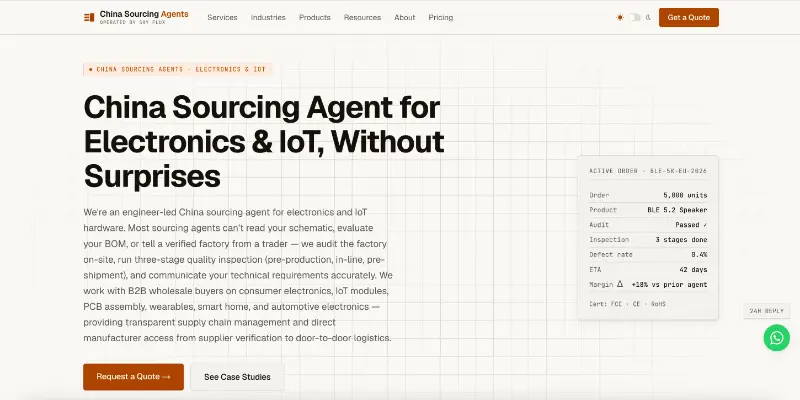
An engineer-led sourcing company in Shenzhen working exclusively on electronics and IoT hardware, with no general merchandise in scope.
- Specialises in PCBA, modules, and finished connected devices
- Based in Shenzhen, with the Dongguan and Huizhou clusters inside day-trip range
- Publishes its commission rate openly alongside standalone per-service pricing
Best if: your product has a custom PCB in it and ships into a certified market.
Watch: mixed-category orders that include textiles or homeware sit outside their scope.
3. China Supply Chain Link
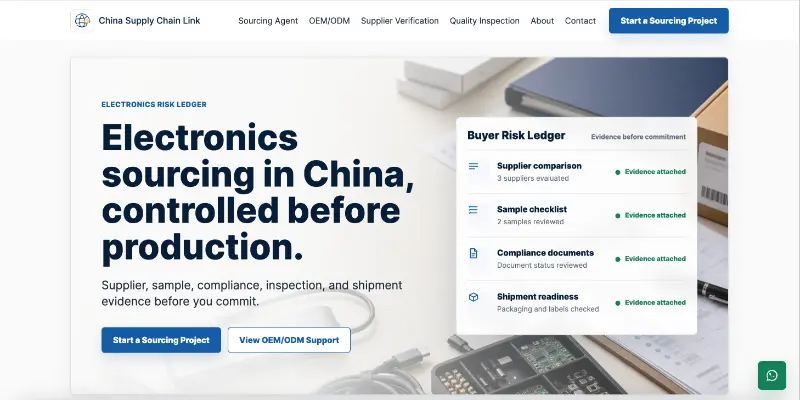
A Shenzhen agency whose published service pages are almost entirely electronics: OEM and ODM programmes, electronics quality inspection, and prototype sampling.
- Service scope is built around supplier verification, factory audits, and shipment coordination for powered products
- Small published site, with more than half of its pages dedicated to electronics services rather than blog content
- Quotes per project rather than on a published commission rate
Best if: you want an OEM or ODM partner managed end to end.
Watch: pricing is not published, so budget the quotation stage into your timeline.
4. China 2 West
China 2 West describes itself as a contract manufacturer rather than a sourcing agent, and that distinction matters when you compare quotes. It operates its own precision manufacturing and assembly facility in Zhuhai alongside supply chain services.
- Runs new product introduction, design-for-manufacturing review, tooling management, and production oversight
- British-managed with Western project managers on the ground since 2005
- Prices as service contracts and retainers, not as a percentage commission
Best if: your problem is managing your product’s manufacture rather than finding a supplier.
Watch: a retainer structure rarely pays for itself on a single purchase order.
5. Leeline Sourcing
A full-service agent covering sourcing, inspection, FBA prep, and freight under one roof, aimed at Amazon sellers.
- Electronics content on their site concentrates on accessories and consumer categories rather than custom development
- Combines sourcing commission with per-service fees for inspection and logistics
- Multiple China offices, with FBA inbound handled as part of the same engagement
Best if: you want sourcing and Amazon prep from one vendor.
Watch: specify functional testing in writing, since AQL sampling is the default inspection mode across most FBA-focused agents.
6. Maple Sourcing
A Shenzhen-based generalist with a published consumer electronics category page, which puts the factories inside same-day reach.
- Operating since 2012, covering consumer products with electronics as a named category
- Shenzhen base gives direct access to the Pearl River Delta supplier pool
- Commission-based pricing
Best if: your products are electronic but not engineering-intensive, and you want a Shenzhen address without specialist pricing.
Watch: depth is general-agency grade rather than engineering grade.
7. JingSourcing
One of the best-known general merchandise agents in China, with a dedicated electronics sourcing service page alongside its main consumer goods business.
- Yiwu-based, with a wide supplier network and consolidation built in
- Publishes electronics content covering PCB factories and market guides
- Commission-based with free quotation up front
Best if: you are buying mixed catalogues where electronics accessories are one line among several.
Watch: certified or custom electronics sit at the edge of the published scope.
8. Sourcify
A US-based sourcing platform that matches brands with vetted factories and manages production through software, with a US contracting entity.
- Multi-category platform with consumer electronics included
- Factory network across China and Southeast Asia
- Project-based engagements quoted per scope
Best if: you want a US contract and US legal recourse on a stable, repeating product.
Watch: platform standardisation suits products that fit the template better than iterative hardware.
9. Dragon Sourcing
An enterprise procurement services firm with offices across Asia, Europe, and the Americas, running structured RFQ processes for corporate buyers.
- Formal supplier evaluation matrices and audit-grade documentation
- Multi-country benchmarking, comparing China against Vietnam and India
- Consulting and project engagements rather than commission
Best if: your company has a procurement policy document and needs category sourcing outsourced.
Watch: the engagement model is sized for procurement projects, not single purchase orders.
10. Imex Sourcing Services
A Guangzhou-based agency that wraps its sourcing process in its own software for supplier data, inspection reporting, and landed-cost visibility.
- Operating since 2011 from Guangzhou, inside Pearl River Delta working range
- Broad category coverage with structured, comparable quotation and QC data
- Transparent service fees quoted per engagement
Best if: you want every quotation and inspection report in a comparable format for landed-cost modelling.
Watch: process tooling is the strength here rather than staff-level electrical engineering.
11. Owl Sourcing
A US-headquartered agency with a China operations team, oriented toward Amazon sellers and ecommerce importers.
- US front end for time-zone-aligned communication, execution handled by the China team
- Combines sourcing with freight and prep services
- Commission plus per-service fees
Best if: you want a domestic point of contact during US business hours.
Watch: published electronics content is market-guide material rather than certified-device service scope.
12. Supplyia
A Yiwu-based sourcing company serving small importers with low-commission sourcing, inspection, and consolidation.
- Budget-tier positioning, stated openly
- Covers supplier finding, basic inspection, and shipment consolidation
- Low commission relative to the rest of the market
Best if: your first order is small, in standard categories, and your specification is precise.
Watch: test-report verification and functional testing are not part of a budget commission.
13. iHomechinabuy
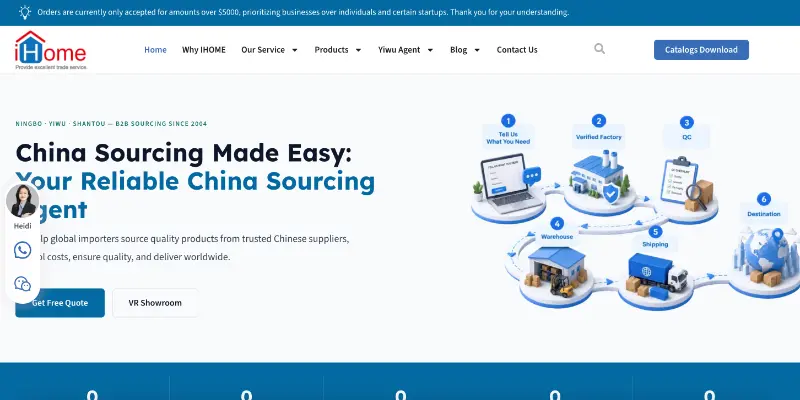
A Ningbo-based agency operating since 2004, positioned around a large verified supplier pool and hand-holding for first-time importers.
- Long operating history, with sourcing agency work as the core service
- Ningbo base puts the Cixi small-appliance cluster inside easy reach
- Commission-based
Best if: you are importing for the first time and want a lot of guidance, particularly on small powered appliances.
Watch: electronics is one category among many rather than a specialisation.
14. CherylSourcing
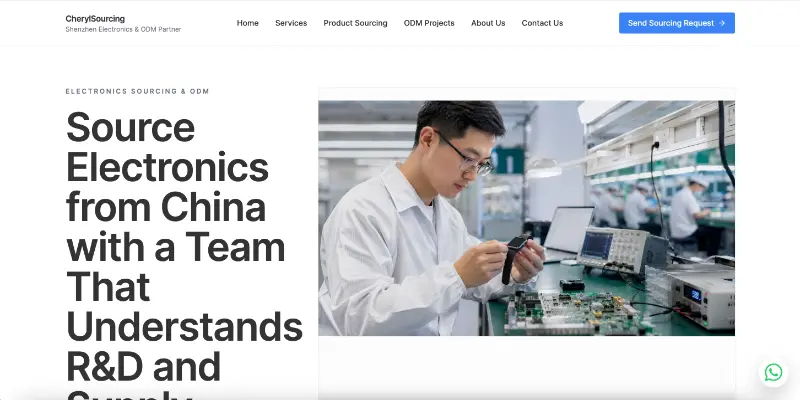
A Shenzhen-based agency presented around technical project management and ODM support for consumer goods.
- Shenzhen location, inside the main electronics manufacturing region
- Published site is product-catalogue led rather than service-scope led
- Quotes per project
Best if: you have a specific consumer product in mind and want ODM support on it.
Watch: the electronics capability described in third-party listings is not documented on the company’s own site, so ask for project references in your category before committing.
15. Techkin USA
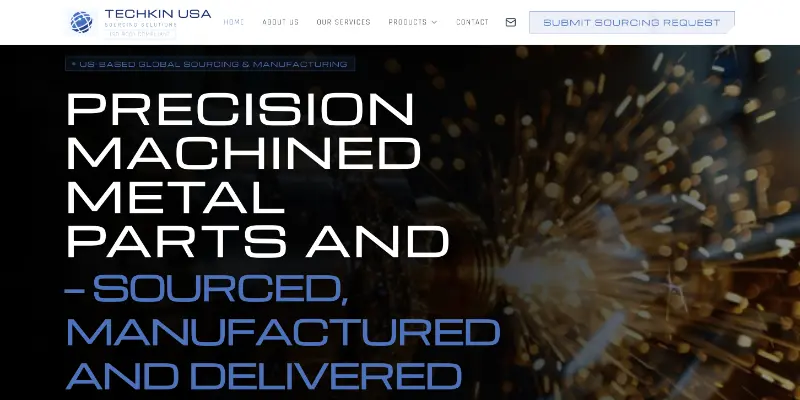
A US-based sourcing company whose published capability list is precision metal fabrication: sheet metal, CNC machining, forging, casting, and data centre enclosures. Electronics appears as one of the industries served rather than as a manufacturing capability.
- US entity with China operations, US-based account managers, and Nevada warehousing
- Core processes are laser cutting, press brake forming, multi-axis milling, and casting
- DDP delivery available on quoted projects
Best if: your product is a metal enclosure or structural assembly that also contains electronic components. That combination is genuinely hard to source from a pure electronics agent.
Watch: for a board-level or firmware-driven product, this is the wrong end of the capability range.
Which One Is Best for Your Situation?
Three inputs decide this, and you can answer all three before you contact anyone:
- What type of electronics are you buying?
- How much are you ordering?
- Is the product already existing, or are you designing it?
| Your situation | What the job actually requires | Where to look |
|---|---|---|
| Off-the-shelf accessories, under $10,000 | Supplier finding, basic inspection, consolidation | Supplyia, iHomechinabuy, JingSourcing |
| Consumer electronics with certification and battery exposure | Certificate-to-model matching, functional testing, UN 38.3 documentation | HiSourcing, China Supply Chain Link |
| Amazon private label, existing certified product | Sourcing plus FBA prep and freight in one engagement | Leeline Sourcing, Owl Sourcing |
| New custom device with a PCB you are designing | BOM review, DFM feedback, firmware control, NPI management | China Sourcing Agents, China 2 West |
| Corporate procurement, multi-country benchmarking | Formal RFQ process and audit-grade documentation | Dragon Sourcing, Imex Sourcing Services |
| You need a US contracting entity | US legal recourse and domestic-hours contact | Sourcify, Techkin USA, Owl Sourcing |
The order-size input matters more than most buyers expect. A specialist commission on a $6,000 order earns the agent a few hundred dollars, which does not fund a factory audit and a functional inspection. Below roughly $10,000, a budget generalist with a precise specification usually beats a specialist working under its own minimum.
How to Find a Reliable Sourcing Agent for Electronics in China
Work in this order: match the agent to your product category first, then to the manufacturing region, then test their technical competence with a small paid engagement before you commit to a commission agreement.
Category comes first because it determines everything downstream. An agent whose daily work is lighting and small appliances has different factory relationships from one whose daily work is connected devices, and neither can fake the other’s supplier list.
Region follows from category rather than from an agent’s address. Technical competence is the part most buyers skip, and it costs nothing to test: send a real test report from any previous supplier and ask the agent to walk you through what it covers. Someone who works on certified electronics will check the issuing lab’s accreditation, the model numbers in scope, and the standards tested against. Someone who does not will describe the logo.
When you do make contact, send enough for a real quote rather than a placeholder. Five things get you a usable answer on the first exchange.
- The product, as a link to a comparable item or a specification sheet, whichever you have
- Target quantity for the first order and your expected annual volume, since those two numbers drive different answers
- Whether it exists already or you are designing it, which decides whether you need a sourcing agent or a manufacturing partner
- Destination market, because it sets the certification path before anything else is priced
- Whether it contains a battery, and its watt-hour rating if you know it
An agent who quotes a unit price without asking about the last two has not priced your actual order.
How to Verify the Credibility of a Sourcing Agent
Three checks before you sign, all of which you can complete in a day.
First, ask for the Chinese business license and confirm the 18-digit unified social credit code, then check that the registered company name matches the bank account you are asked to pay. A payment routed to a personal account or a third-country account is where most losses begin. Second, send the agent a real test report from any previous supplier and ask them to walk you through what it covers. Third, buy one standalone service, usually a factory audit, before agreeing to any ongoing commission.
Score an agent against the table below. Anything under five points out of seven is a risky choice for a powered product.
| Criterion | Why it decides the outcome | Good answer | Bad answer |
|---|---|---|---|
| BOM literacy | Electronics failures start with the wrong part | Asks about alternates, tolerances, and lifecycle status | Quotes from listing photos |
| Certificate matching | A genuine certificate can still cover a different model | Checks model scope, issuing lab, and standards | Confirms only that a PDF exists |
| Functional test protocol | Visual sampling misses firmware, RF, and power faults | Defines power-on, RF, and firmware checks in writing | Offers AQL visual inspection only |
| Category-matched factory access | Supplier relationships do not transfer across categories | Names comparable products they have run | Describes a general supplier database |
| Price transparency | A bundled price hides where your money goes | Shows factory quote and fee separately | Refuses to split the number |
| Battery and dangerous goods handling | Documentation gaps stop shipments after production | Asks watt-hour rating before quoting freight | Treats batteries as ordinary cargo |
| Legal identity | The company you pay must be the company you contracted | License name matches the bank account | Pushes a personal account |
Cost Structure for a China-Based Electronics Sourcing Agent
Look at the pricing model before the rate. A 5 percent commission with the factory price hidden can cost more than an 8 percent commission with it disclosed, because the hidden version lets the quoted factory price absorb whatever margin the agent wants.
| Cost item | Typical range | Who charges it | What changes the number |
|---|---|---|---|
| Sourcing commission | Commonly 5 to 8 percent of order value | Agent | Order size, category complexity, repeat business |
| Flat project fee | Quoted per scope, common on one-off RFQs | Agent | Number of suppliers shortlisted, engineering iterations |
| Monthly retainer | Used for ongoing manufacturing management | Manufacturing services firm | Headcount assigned, whether tooling is in scope |
| Pre-shipment inspection | From $419 per man-day at a major third-party firm; local Chinese inspection houses quote below that | Inspection body | Sample size, functional versus visual protocol |
| Supplier audit | From $669 per man-day at a major third-party firm | Audit body | Audit type, factory location |
| Certification testing | Roughly $3,000 to $5,000 for typical FCC testing; more for multi-radio devices | Test laboratory | Number of radios, applicable rule parts |
| Samples and tooling | Charged per iteration; tooling is a separate capital item | Factory | Whether a new mould or only firmware changes |
| MOQ | Set by the component with the longest lead time, not by the assembler | Factory | Custom PCB, custom moulding, or catalogue parts |
The inspection and audit figures come from QIMA’s published pricing for Zone A, which includes China and covers inspector travel, meals, and accommodation. Local Chinese inspection houses quote below those figures, and the gap is usually accreditation and reporting depth rather than inspector hours.
Scale changes which structure wins. On a $30,000 order, a 6 percent commission is $1,800 and buys you an agent who will chase the factory daily. On a $300,000 order, that same rate is $18,000, and at that point a flat fee plus separately purchased audits and inspections often costs less while giving you more control over what gets checked. What the extra money buys at either level is attention and documentation, not a lower factory price. Our breakdown of China sourcing agent fees works through the arithmetic on both structures.
Want a specific number for your product instead of a range? Send us the product link or spec, your target quantity, and the market you are shipping to. Get a landed-cost estimate.
What FCC, CE, RoHS, and UL Cost and How Long They Take
Certification splits into two paths with roughly an order of magnitude between them, and which path applies is decided by your product, not by your budget.
| Mark | Market | Self-declared or third-party | Typical timeline | Where the cost sits |
|---|---|---|---|---|
| FCC SDoC | United States | Self-declared | 3 to 4 weeks | Lab testing only, no government approval step |
| FCC Certification | United States, anything with a radio | Third-party, via a Telecommunication Certification Body | 8 to 12 weeks single-band; 6 to 9 months for cellular | Lab testing plus TCB review |
| CE | European Union | Self-assessed for most consumer electronics | 2 to 4 weeks; 6 to 8 weeks for complex devices | Testing plus compiling the technical file |
| RoHS | EU, and mirrored elsewhere | Self-declared on lab analysis | Runs in parallel with other testing | Scales with number of distinct materials |
| UL | North America, voluntary in most cases | Third-party | Continues after the grant through factory follow-up visits | Testing plus ongoing factory follow-up |
The gap between the two paths is the part worth planning around. A self-declared product can be tested and documented in about three to four weeks, while a single-band radio device typically takes eight to twelve weeks and a cellular product runs six to nine months, according to published FCC timeline breakdowns. Lab booking alone can sit six to eight weeks out in peak season. What the extra weeks buy is a defensible grant on file, not a better product.
Two scheduling rules follow from all of this.
- Book certification against your production schedule, not after it. A failed test means a hardware change and a full retest, and that sequence does not fit into the gap before your ship date.
- Freeze the bill of materials before testing starts. A component substitution after the test invalidates the report you paid for, which is the same failure mode as buying a certificate that covers a different model.
In the United States, the FCC runs both procedures under 47 CFR Part 2, Subpart J. Certification, required for anything with a deliberate radio, needs a grant from a Telecommunication Certification Body. The FCC’s own charge is small: the fee schedule at 47 CFR 1.1103 sets a grantee code at $35 as a one-time charge. The money goes to the lab and the TCB, where typical FCC testing runs $3,000 to $5,000 and climbs with each additional radio.
In the European Union the split works the same way, but the trigger is written into each piece of product legislation. The EU’s own guidance directs you to check the conformity assessment procedure in the specific law covering your product, then to the NANDO database if a notified body turns out to be required. For UL, the question is whether your retailer or insurer demands it, since it is voluntary in most consumer categories rather than a legal condition of entry.
Shipping Electronics With Batteries: UN 38.3, MSDS, and Air Freight Limits
A lithium battery shipment can be stopped after the goods are made, boxed, and paid for, and nothing the factory did caused it. The block happens at the freight forwarder or the airline, over paperwork and packing rules that had to be satisfied before production finished.
Every lithium cell and battery moving by air has to have passed the tests in subsection 38.3 of the UN Manual of Tests and Criteria. The test is done once per battery design by the cell manufacturer, and what you need in hand is the test summary document. Your supplier either has it or does not; it is not something a forwarder can produce for you later.
How the battery travels with your product decides which rules apply, and the three cases are treated very differently.
| How the battery ships | UN number | Packing instruction | Passenger aircraft | What it means for you |
|---|---|---|---|---|
| Batteries on their own | UN 3480 | PI 965 | Forbidden as cargo | Cargo Aircraft Only label required; charge limited to 30% of rated capacity |
| Batteries packed alongside the device | UN 3481 | PI 966 | Permitted within package limits | Middle option; still needs full documentation |
| Batteries installed inside the device | UN 3481 | PI 967 | Permitted within package limits | Easiest of the three to move by air |
Two numbers set the thresholds. A cell above 20 watt-hours, or a battery above 100 watt-hours, moves into the more restrictive sections with lower package weight limits. Watt-hours are rated capacity in ampere-hours multiplied by nominal voltage, so you can place your own product before asking anyone.
The rule that surprises importers most is the charge limit. Under IATA’s lithium battery guidance, lithium-ion batteries shipped by themselves must travel at a state of charge not exceeding 30 percent of rated capacity, and anything above that needs approval from both the state of origin and the state of the operator. Factories that ship power banks fully charged for retail presentation get consignments rejected on exactly this point.
Packaging rules also moved. Since January 2025, non-UN-specification packaging under the packed-with and contained-in-equipment instructions has had to meet a 3 metre stack test on top of the existing 1.2 metre drop test. Cartons that passed in 2024 do not automatically pass now.
Two documents travel with the goods, and both come from the supplier rather than the forwarder.
- The UN 38.3 test summary for the specific cell in your product. The most common cause of a delayed electronics shipment we see is a supplier who can build the product but cannot produce this document.
- A safety data sheet for the cell. Forwarders ask for both together, so request both at the quotation stage rather than when the goods are ready.
Pre-production prototypes are the one narrow exception. Batteries that have not been through UN 38.3 testing may move when they are prototypes in transport for testing, or part of low-production runs of no more than 100 cells or batteries a year. Outside that allowance, untested batteries do not fly. Routing and dangerous goods documentation are part of our shipping service.
Where Chinese Electronics Actually Get Made
Match the cluster to your product category, not to the city with the biggest electronics reputation. Every category below has a different centre of gravity, and an agent embedded in the wrong one is working through the same intermediaries you could find yourself.
| Product category | Main cluster | What sits there |
|---|---|---|
| PCBA, connected devices, wireless products | Shenzhen, Dongguan, Huizhou | Board houses, assembly, module suppliers, component markets |
| LED and decorative lighting | Guzhen, Zhongshan | Lamp assembly, drivers, fixtures, and the component supply around them |
| Small powered appliances | Cixi, Ningbo | Irons, heaters, kitchen and personal-care appliances |
| Accessories, cables, low-value consumer electronics | Yiwu and surrounding Zhejiang | High-mix, lower-MOQ production and consolidation |
| Components and short-run prototyping | Huaqiangbei, Shenzhen | Component trading, small-batch buying, rework services |
The concentration is real and it is measurable. Guzhen in Zhongshan accounts for roughly 70 percent of China’s domestic lighting market and around half of global lighting output, according to Guangdong provincial reporting. Cixi in Ningbo has more than 2,000 household appliance manufacturers and nearly 10,000 supporting enterprises, and its annual output of electric irons alone exceeds 60 million units, which China Daily reports as over 60 percent of national export volume.
We have seen buyers spend months with an agent who was three provinces from their actual factory, which is why the question “should my agent be in Shenzhen?” has no single answer. If you are building a wireless device, yes. If you are buying LED downlights or countertop appliances, an agent whose daily route is Shenzhen board houses is not closer to your factory than one based in Zhejiang. Ask an agent which cluster your specific product comes from. Getting that answer wrong is a faster disqualifier than any credential.
Recommended Platforms to Connect With Chinese Suppliers
Online platforms and physical markets solve different problems, and for electronics the split is unusually clean.
Alibaba and Global Sources are where you find export-ready suppliers who already handle documentation and international shipping, which matters more for electronics than for most categories because of the certification and battery paperwork. 1688 lists domestic Chinese suppliers at closer to factory-gate pricing, but in Chinese, without export support, and our comparison of 1688 vs Alibaba covers when that trade-off pays.
For components, short runs, and physical inspection before you commit, the markets are still faster than any platform. Huaqiangbei in Shenzhen is the component and small-batch centre, and the Guangzhou electronics markets serve consumer devices and accessories. Both are places to verify a part exists and works before ordering thousands of them.
Frequently Asked Questions
Where to find reviews for electronics sourcing agents based in China?
Reviews for this industry are thin, and the ones that exist are hard to verify. More useful sources are direct references, LinkedIn profiles of the staff you will actually work with, and the company’s Chinese business license, which shows registration date and scope. Ask for two references importing a product in your category, then ask those buyers what went wrong on the last order and how it was handled.
Who is the best China sourcing agent for small electronics orders?
For orders under about $10,000, a generalist agent usually beats a specialist. An engineering-led agent’s commission on a small order does not cover the audit and inspection work that makes them worth hiring, so you pay specialist rates for generalist service. Keep the product simple, catalogue accessories rather than custom devices, and put your functional test requirements in writing regardless of who you use.
Do I need a sourcing agent for electronics, or can I use Alibaba directly?
Frequently you do not need one. If the product is off-the-shelf, the order is under a few thousand dollars, and the supplier is one you have bought from before, Alibaba direct with Trade Assurance is adequate and an agent adds cost without adding much. The case for an agent gets strong when three things stack: a new supplier, a product needing certification or carrying a battery, and an order value where a failed run hurts.
Should I use a Shenzhen-based sourcing agent for electronics?
Only if your product is made there. Shenzhen, Dongguan, and Huizhou are the right base for boards, wireless devices, and components. Lighting concentrates in Zhongshan and small appliances in Ningbo, and an agent sitting in Shenzhen has no proximity advantage in either. Ask which cluster your category comes from, then ask how often the agent physically visits factories in that cluster.
Final Thoughts
Hope this comparison helps you shortlist the right agent for your product. If you have questions about a specific category or certification path, feel free to reach out.
We are HiSourcing, a China sourcing company based in Yiwu, founded in 2017 and serving 1,200+ clients from 50+ countries, helping importers source, customise, inspect, and ship products from China.
If you want a straight answer on whether your electronics product is worth sourcing from China, send us the specification, your target quantity, and the market you are selling into, and we will come back with supplier fit, the certification path, and a landed-cost estimate. Get a sourcing assessment.


