
For international buyers, small business owners, and anyone who wants to source products from China, Alibaba and 1688 are two platforms that can’t be avoided. Which one is the best fit? How does everything differ between them?
In this guide from HiSourcing, we break down everything you need to know about 1688 vs Alibaba, including pricing, MOQ, payment safety, logistics, and more, to help you make a decision and choose the option that best fits your business type. Let’s get started.
1688 vs Alibaba at a Glance: Full Comparison Table
The table below covers the 9 dimensions that actually matter when comparing 1688 vs Alibaba.
| Dimension | 1688.com | Alibaba.com |
|---|---|---|
| Target buyer | Chinese domestic resellers and wholesalers | International B2B importers |
| Primary language | Mandarin only, no official English interface | English plus 15 other major languages |
| Typical listing price | 15 to 30 percent lower for similar items | Export-ready pricing, higher per unit |
| MOQ flexibility | Often very low, sometimes 1 to 10 units | Frequently 100 to 1,000 units per SKU |
| Payment | Alipay, WeChat, local bank transfer in RMB | Wire, credit card, Trade Assurance escrow, PayPal on some listings |
| Shipping | Domestic within mainland China only | International shipping supported by most suppliers |
| Buyer protection | Platform rules written for domestic disputes | Trade Assurance escrow with refund support |
| Dominant supplier type | Factories and domestic wholesalers, with some trading layers | Mix of trading companies, factories, and export agents |
| Best fit for | Buyers with China-side logistics already in place | Buyers who need an export-ready workflow out of the box |
Are 1688 and Alibaba the Same Company?
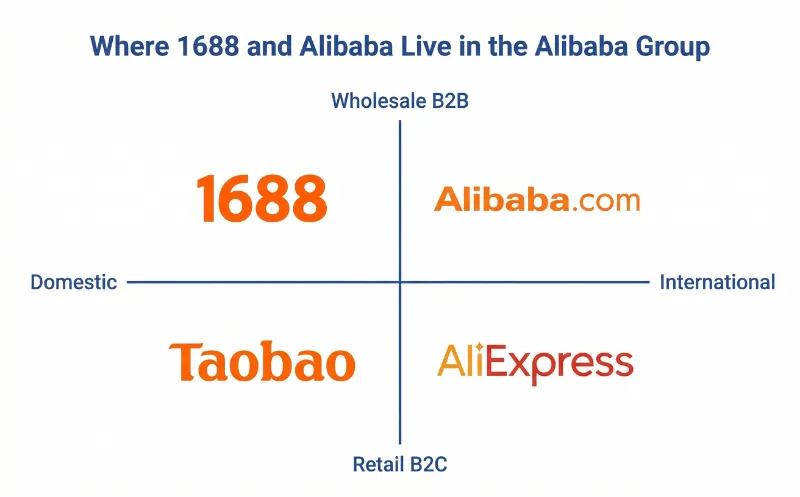
Yes. Both 1688.com and Alibaba.com belong to Alibaba Group, the same parent that owns Taobao, Tmall, AliExpress, and Alipay. They share the same infrastructure and often the same suppliers.
They were built for different audiences. Alibaba.com launched in 1999 for buyers outside China importing from Chinese suppliers. 1688.com came later as the domestic wholesale counterpart, built in Mandarin for Chinese resellers and factory procurement departments.
That single design choice, domestic versus international, is the source of almost every real difference between the two platforms. It drives the language gap, the payment rails, the shipping support, and the supplier vetting system.
Is 1688 Cheaper Than Alibaba?
At the listing price, yes. Across most categories, 1688 lists 15 to 30 percent below Alibaba, and for commodity goods like phone cases, pet accessories, and basic home items, the gap can reach 40 percent.
But listing price is not the number that matters. Landed cost is.
The Hidden Cost Chain Behind Every 1688 Order
Every 1688 order that leaves China runs through a cost chain that an Alibaba order usually bundles into a single number. Here is what happens between the listing and your warehouse.
- Listing price in RMB
- Domestic freight from supplier to consolidator
- Sourcing agent service fee or markup (if have)
- FX conversion loss
- Consolidation and repacking at a China warehouse
- International freight to your country
- Import duty and taxes
- Last-mile delivery to your door
On Alibaba, most suppliers will quote you a number that already bundles export packaging, domestic pickup, and international freight on DDP terms. In 1688, you stitch that chain together yourself, or you can find and pay a 1688 sourcing agent to do it for you.
Both paths end at the same warehouse. The difference is where each line in the chain gets paid.
Real Example: Import 500 Pet Bowls From 1688 vs Alibaba
Here is a representative example. The numbers are estimates based on real quotes commonly seen in Yiwu for mid-quality collapsible silicone pet travel bowls, a typical Amazon FBA item.
Actual figures will shift with product weight, packaging, currency, and freight forwarder. Treat this as a reasonable window, not a fixed quote.
Order: 500 collapsible silicone pet travel bowls, mid-grade, delivered duty paid to a US FBA warehouse near Los Angeles.
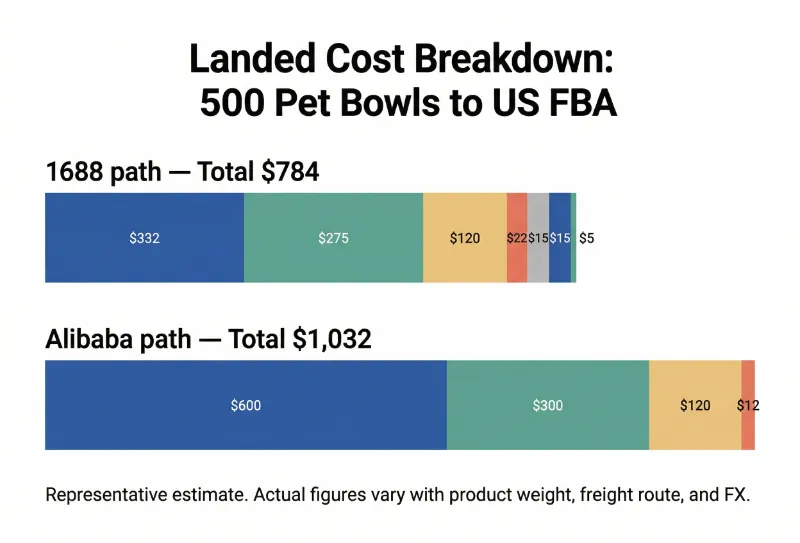
| Cost line | 1688 path | Alibaba path |
|---|---|---|
| Product unit price | ~$0.55 × 500 = $275 | ~$1.20 × 500 = $600 |
| China domestic freight to Yiwu consolidator | ~$15 | Included by supplier |
| Sourcing agent fee or handling | ~$22 (around 8 percent of product value) | Not applicable |
| Payment and FX conversion loss | ~$5 | ~$12 (wire or card fee) |
| Pre-shipment quality inspection, one man-day | ~$120 | ~$120 |
| Consolidation and export packing | ~$15 | Included |
| International freight, air express, ~47 kg | ~$332 | ~$300 |
| Import duty | Bundled under DDP | Bundled under DDP |
| Total landed cost | ~$784 | ~$1,032 |
| Landed cost per unit | ~$1.57 | ~$2.06 |
| 1688 saving vs Alibaba | — | About 24 percent |
The pattern in this table is the one that shows up almost every week in Yiwu for this size of order. At mid volume for a lightweight, cert-free item, 1688 lands roughly 20 to 30 percent cheaper than Alibaba once all costs are counted.
The raw listing-price gap is larger, but agent fees and international freight take a real bite out of it.
Notice also that skipping the quality inspection saves $120 on either path and changes nothing about the gap. Skipping inspection on the cheaper platform means saving the wrong $120.
When 1688 Is Not Cheaper Than Alibaba?
The 1688 advantage is not universal. Here are the five situations where the math flips or collapses entirely:
- Very small orders under roughly 200 to 300 units. A flat minimum handling fee from your agent can erase the per-unit savings.
- Heavy or bulky products where international freight already dominates the landed cost. Saving 20 percent of a 30 percent cost line is not material.
- Products that require CE, UL, FCC, CPSIA, or CPSC certification for your destination market. Most 1688 listings are written for the domestic Chinese market, and the compliance redo usually costs more than the listing-price saving.
- Products with lithium batteries, aerosols, flammable liquids, or restricted-ingredient cosmetics. Special logistics and compliance paperwork collapse the 1688 advantage entirely.
- Complex private-label packaging, where the 1688 factory has no export experience. You pay in time and rework rather than dollars.
Listing price lies. Landed cost tells the truth. Once you can see the full chain, you can decide.
1688 vs Alibaba, Which is Better?
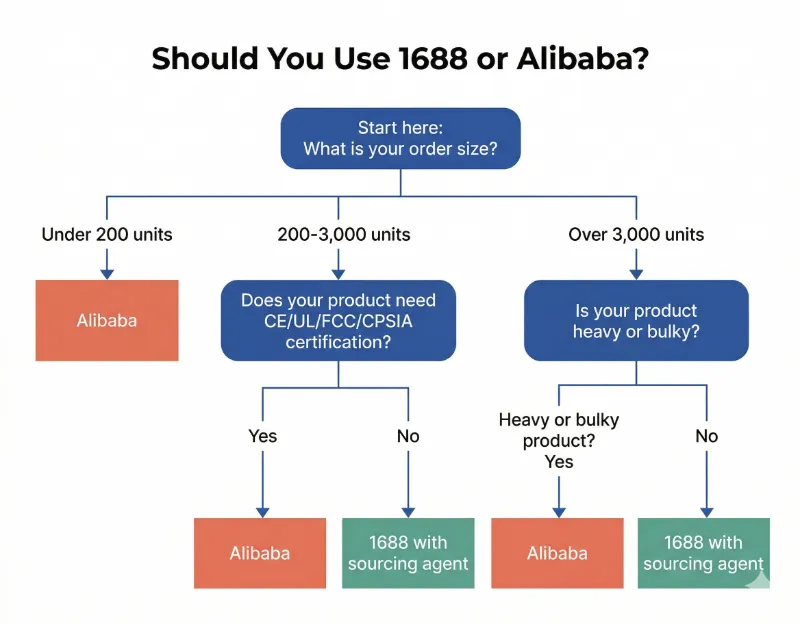
Instead of a generic pros and cons list, here is a decision matrix based on the three variables that actually move the answer: order volume, product category risk, and export readiness.
| Your situation | Best platform | Why |
|---|---|---|
| Under 200 units, low-risk commodity | Alibaba | Agent floor fees erase the 1688 saving at this scale |
| 300 to 3,000 units, cert-free commodity | 1688 with a sourcing agent | The 20 to 30 percent landed cost saving is real and reliable here |
| Any volume, product requires CE, UL, FCC, or CPSIA | Alibaba | Export suppliers already carry the compliance paperwork |
| Custom private label, complex packaging, first production run | Alibaba with an Alibaba sourcing agent first, then 1688 once the product is stable | Alibaba suppliers handle export packaging natively |
| Heavy or bulky product, freight dominates cost | Alibaba | Saving 20 percent of a 40 percent cost line is marginal |
| You already have a trusted China-side agent and need the lowest possible unit cost | 1688 | This is the scenario 1688 was designed for |
For the products we see most often in Yiwu, the sweet spot for 1688 is 500 to 3,000 units of an item that needs no mandatory certification. Think profitable product categories like collapsible silicone goods, kitchen accessories, pet items, and general home organisation. Outside that window, the math gets noisy, and the answer is usually Alibaba.
Not sure which path fits your product? Send us the SKU, and we will run a real two-platform landed cost comparison against our current supplier network, with no obligation.
Who Actually Sells on 1688 and Alibaba?
Neither platform is pure. The ratio is different, and the vetting is different, but anyone who tells you 1688 is all factories, and Alibaba is all middlemen is simplifying a story with real consequences for your margins.
Is 1688 All Factories and Alibaba All Trading Companies
No. On Alibaba, the supplier pool skews toward trading companies, export brokers, and factories with English-speaking sales teams. A significant portion of listings, often cited in the industry as around half or more, come from trading layers rather than source factories.
On 1688, the pool skews toward factories and domestic wholesalers because the platform was built for local procurement. But trading layers still exist, especially in electronics, apparel, and branded accessories where resellers are common.
In our experience walking Yiwu workshops, the same factory often sells on both platforms at the same time. It is normal to visit a workshop in the morning, see their 1688 listing on one monitor, and find the same item at a higher price on their Alibaba storefront on the next.
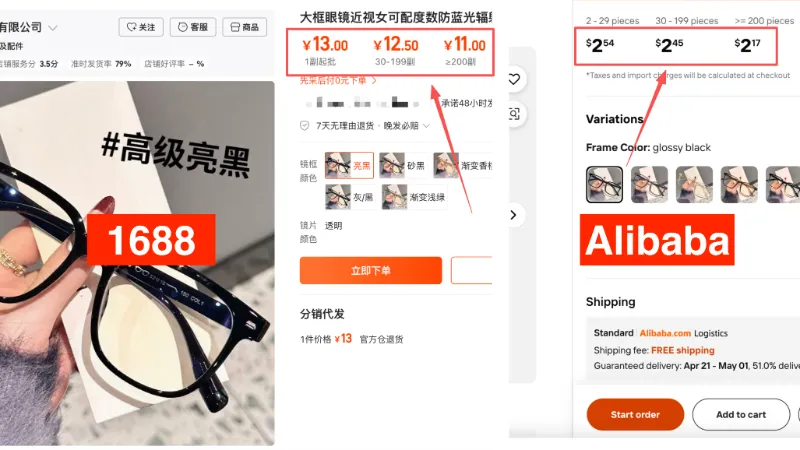
The higher Alibaba price is not dishonest. It covers export documentation, multilingual sales, better packaging, and the time cost of answering English inquiries.
The real question is not which platform hides the factory. It is whether your specific listing is coming from a factory, a trading company, or a wholesaler. That question has to be answered listing by listing, not platform by platform.
What 1688 Verified Supplier Badges Actually Mean
1688 uses several badges that look like vetting signals and mean different things.
Chengxintong (诚信通) is the basic paid membership. Suppliers pay an annual fee, commonly around 6,888 RMB, for a verified business-license check and display privileges.
It confirms a registered business exists at the given address. It does not confirm the business is a factory, that the factory has ever produced your specific product, or that it passes any quality audit.
Powerful Merchant (实力商家) is a platform ranking based on transaction history, response rate, dispute rate, and operating metrics. It tells you the store has real traffic. It says nothing about the underlying factory.
Delivery Guarantee (严选商家 or 深度验商) requires suppliers to place a security deposit with the platform, often around 3,000 RMB, which the platform can withhold against a legitimate complaint. It is a small insurance layer. It is not a factory audit.
None of these replaces a third-party factory audit. For orders large enough to matter, none should be your only vetting step.
What Alibaba Verified Supplier and Gold Supplier Mean
Gold Supplier is a paid premium membership with platform privileges and basic business verification. But Alibaba withdrew and canceled this verification several years ago.
Verified Supplier is stronger. A third-party inspection agency has confirmed the supplier’s basic production capability, which means an inspector physically visited the claimed address.
It is closer to a real signal, though still not a guarantee that any specific production run will pass quality.
The strongest Alibaba protection is Trade Assurance, which is not a supplier badge at all. It is an escrow-style payment and refund mechanism. It holds your payment until the order ships on time and meets the pre-agreed specification.
You can read the rules on the official Alibaba Trade Assurance page. Our breakdown of is Alibaba safe to buy from covers the cases where Trade Assurance does not cover you.
Final Thoughts
1688 and Alibaba are not rivals. They are two entry points into the same Chinese supply chain, designed for two different kinds of buyers. There’s no need to choose one over another.
If you are comparing 1688 vs Alibaba for an upcoming order, HiSourcing can help. We are a Yiwu-based sourcing company handling product sourcing, quality control, and shipping solutions on a no-service-fee basis. Click here to Contact Us and get a transparent two-platform landed cost comparison designed only for you.
Recommended Reading:
Alibaba vs 1688 FAQs
Is 1688 owned by Alibaba?
Yes. 1688.com is part of Alibaba Group, the same parent company that owns Alibaba.com, Taobao, Tmall, AliExpress, and Alipay. 1688 was positioned as the domestic Chinese counterpart to the international-facing Alibaba.com.
Can I buy from 1688 outside of China?
Technically yes, but in practice almost no international buyer does it directly. The website is in Mandarin, payment requires Alipay or a Chinese bank account, and suppliers only ship within mainland China. Most overseas buyers work through a Chinese sourcing agent who places the order, consolidates the goods, and handles international shipping.
Is 1688 legit?
The platform itself is legitimate and operated by Alibaba Group. Individual suppliers on the platform vary in quality, just like on Alibaba. Verify any supplier against gsxt.gov.cn before sending money, regardless of the badges displayed on their 1688 storefront.
Does 1688 ship to the USA?
1688 does not offer native international shipping to the United States. Goods from 1688 suppliers are delivered to a Chinese address, usually a sourcing agent’s warehouse, and then forwarded internationally by a freight forwarder. There is no single-step 1688-to-USA workflow.
Can I pay on 1688 with PayPal?
Not directly. 1688 is built around Alipay, WeChat Pay, and local Chinese bank transfers. A handful of suppliers will accept PayPal for overseas buyers on negotiated terms, but it is not the norm. The standard international workflow is to pay your sourcing agent in USD or EUR via wire, PayPal, or Wise, and let the agent settle with the 1688 supplier in RMB.
Why does the same product look cheaper on 1688 than on Alibaba?
Because the 1688 listing price is the domestic Chinese wholesale price, quoted in RMB for local buyers who handle their own logistics. The Alibaba price bundles export documentation, multilingual sales support, international shipping readiness, and buyer protection through Trade Assurance. The gap is real at the listing level but shrinks once you add domestic freight, agent fees, and international shipping to the 1688 path.
Is it worth using 1688 for small orders?
Usually not. Below roughly 200 to 300 units, the flat minimum fees a sourcing agent charges, combined with small-shipment freight minimums, erase the per-unit price advantage of 1688. For small test orders, Alibaba with Trade Assurance is often cheaper and always simpler.


