
A quality control checklist is the difference between catching a defect at the factory and discovering it in your customer’s hands. One costs you a conversation with the supplier. The other costs you a refund, a one-star review, and a repeat customer who never comes back.
Without a written checklist, your factory decides what “good quality” means. Their definition rarely matches yours. A QC checklist spells out exactly what your inspector should check: packaging, appearance, dimensions, function, labeling, and defect tolerances. It turns a subjective judgment call into an objective pass-or-fail test.
This guide shows you the 5 sections every quality control checklist must have, explains AQL in plain English, includes a real product example, and gives you a free downloadable template you can customize for your own products.
At HiSourcing, our in-house QC team inspects shipments in our own Yiwu warehouse every day before they leave for overseas buyers. The checklist framework in this article is the same one we use internally.
What Is a Quality Control Checklist?
A quality control checklist (also called a QC checklist or inspection criteria sheet) is a written document that defines your product requirements, packaging standards, labeling specifications, on-site tests, and defect tolerances. It tells your factory and your inspector exactly what to produce and exactly what to check.
Think of it as a contract for quality. Without it, your inspector checks against generic industry standards. With it, they check against your standards.
A QC checklist is not the same as a spec sheet. Your spec sheet tells the factory how to make the product. Your QC checklist tells the inspector how to verify it. They share information but serve different audiences.
QC Checklist vs. Quality Assurance (QA)
QC is reactive: you inspect the finished product to find defects.
QA is proactive: you build processes to prevent defects from happening in the first place.
Your QC checklist is a QC tool. But the act of creating it and sharing it with the factory before production starts is a QA action. It prevents problems that would otherwise only surface during final inspection.
Who Creates the QC Checklist, You or the Factory?

You. Always. The factory will happily produce without one. But then they set the quality standard, and “good enough” in a Chinese factory often means “won’t cause a return” rather than “will delight a customer.”
Your QC company or sourcing agent can help you build the checklist, but the requirements must come from you. You know your market, your customer expectations, and your tolerance for imperfection.
We have seen importers send a one-line email to their factory: “Make sure quality is good.” That is not a checklist. That is a gamble. The factory will interpret “good” in its own favor every single time.
The 5 Sections Every QC Checklist Must Have
This is the structure your checklist should follow. Whether you are importing ceramic mugs, LED lights, backpacks, or other products, the five sections remain the same, only the specific criteria change.
Section 1: Packaging and Labeling
What to specify:
- Shipper carton material (single-wall or double-wall corrugated)
- Carton dimensions
- Inner packaging (polybag, foam insert, dividers, tissue wrap)
- Carton markings and shipping marks
- Barcode placement
- Product labels (UPC, country of origin like Made in PRC label, care labels)
What your inspector checks:
- Carton drop test results
- Label accuracy (does UPC match your listing?)
- Correct shipping marks per your spec
- Barcode scannability
- Country of origin label present and correct
Many importers specify the product in detail but forget packaging entirely.
Result: beautiful products arrive in crushed cartons because the factory used single-wall corrugated instead of double-wall. For fragile items like ceramics or glassware, packaging is half the battle.
Section 2: Product Appearance and Dimensions
What to specify:
- Acceptable color range (Pantone reference or golden sample)
- Surface finish (matte, glossy, brushed)
- Dimensional tolerances (±2mm on length, ±1mm on diameter)
- Weight tolerance (±5%)
What your inspector checks:
- Visual inspection under standard lighting (D65 light box if color-critical)
- Caliper and ruler measurements on random samples
- Weight spot-check with digital scale
Provide your inspector with a golden sample, a physical reference unit that represents the exact quality level you accept. Photos alone are not enough. Colors on screens vary. A golden sample in the inspector’s hand removes ambiguity.
Section 3: Functionality and Performance
What to specify:
All functional requirements. Zipper opens and closes smoothly. Lid seals without leaking. Electronics power on and perform their stated function. Button clicks are responsive.
What your inspector checks:
On-site functional tests on a random sample:
- For electronics: power-on test, button test, charge test
- For garments: seam strength pull test
- For kitchenware: water-fill leak test
- For bags: zipper cycle test (open/close 50 times)
Every functional claim you make on your product listing should have a corresponding test on your QC checklist. If you say “leak-proof,” your inspector should fill it with water and flip it upside down.
Section 4: Compliance and Safety
What to specify:
Required certifications for your target market. For example:
- US: CPSIA for children’s products, FCC for electronics, FDA for food contact, California Prop 65.
- EU: CE marking, REACH.
List the specific test reports you require.
What your inspector checks:
- Test report matches the current production batch (not a report from a previous order)
- Warning labels are present and correctly worded
- Materials match the certified formula
A test report from 2024 for a different production batch does not certify your 2026 order. Always confirm the test report covers the actual materials and batch you are shipping. Factories sometimes show old reports for products they no longer manufacture to the same spec.
Section 5: Defect Classification and AQL
Not all defects are equal. A scratch on the bottom of a mug is not the same as a crack in the handle.
This section of your checklist classifies every potential defect as Critical, Major, or Minor, and sets the AQL (Acceptable Quality Limit) tolerance for each category. Full AQL explanation follows in the next section.
| Section | What to Specify | What Inspector Checks | Common Mistake |
|---|---|---|---|
| Packaging | Carton type, inner packaging, labels, shipping marks | Drop test, barcode scan, label accuracy | Forgetting packaging specs entirely |
| Appearance | Color (Pantone), finish, dimensions, weight | Visual + caliper measurements on sample | No golden sample provided |
| Function | Every functional claim on your listing | On-site tests (leak, power, zipper cycle) | Skipping functional tests to save time |
| Compliance | Certifications, test reports, warning labels | Report matches current batch, labels correct | Accepting old test reports |
| Defects | Critical/Major/Minor classification + AQL | Random sample per AQL, classify each defect | No written defect tolerance |
AQL Explained: How to Set Your Defect Tolerance
AQL stands for Acceptable Quality Limit. It is the maximum percentage of defective units you will accept in a production batch before rejecting the entire shipment.
AQL is not a guarantee that zero defects exist. It is a statistical sampling method. You inspect a random sample from the batch, and if defects in that sample exceed your AQL threshold, you reject the batch.
AQL is defined in ISO 2859-1: 2026 and is the universal standard used by third-party inspection companies worldwide.
Critical vs. Major vs. Minor Defects
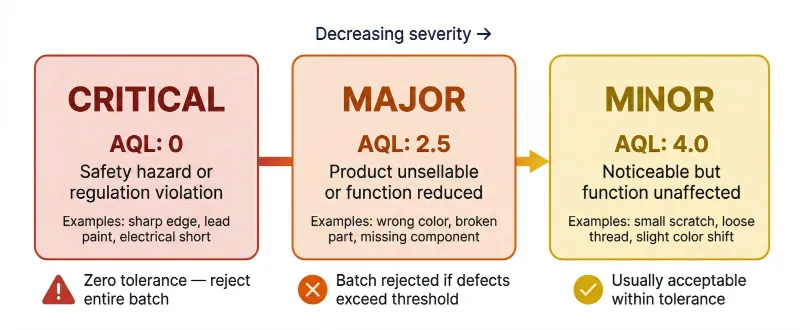
| Defect Level | Typical AQL | Definition | Examples |
|---|---|---|---|
| Critical | 0 (zero tolerance) | Poses a safety risk or violates a regulation. Entire batch rejected if ANY critical defect is found. | Sharp edge on children’s toy, lead in paint, electrical short circuit, mold on food-contact item |
| Major | 2.5 | Makes the product unsellable or significantly reduces its function. The buyer would likely return it. | Wrong color, broken handle, product does not turn on, missing component, print significantly off-center |
| Minor | 4.0 | Noticeable but does not affect function or saleability. The buyer would probably keep it. | Small scratch on the bottom surface, loose thread (trimmable), slight color variation within Pantone tolerance |
Which AQL Level Should You Use?
Your AQL should match the quality expectations of your market and product type.
| Product Type | Critical | Major | Minor |
|---|---|---|---|
| Premium / luxury brand | 0 | 1.0 | 2.5 |
| Standard consumer product (most common) | 0 | 2.5 | 4.0 |
| Promotional / low-cost giveaway | 0 | 4.0 | 6.5 |
If you are new to AQL, start with the industry standard: 0 / 2.5 / 4.0. Tighten later based on your actual return data. For Amazon FBA sellers, we sometimes recommend tightening Major to 1.5 because Amazon’s return rate threshold is very unforgiving. A few defective units can damage your listing’s ranking.
AQL Sample Size: How Many Units to Inspect?
You do not inspect every unit. AQL uses statistical sampling based on your total batch size (lot size). The table below is a simplified version of the ISO 2859-1 sampling plan:
| Lot Size (total units) | Sample Size | Notes |
|---|---|---|
| 2 – 8 | Inspect all | Too small to sample |
| 9 – 150 | 20 units | |
| 151 – 500 | 50 units | |
| 501 – 1,200 | 80 units | Most common for China imports |
| 1,201 – 3,200 | 125 units | |
| 3,201 – 10,000 | 200 units | |
| 10,001 – 35,000 | 315 units |
A third-party inspector typically completes a pre-shipment inspection of 80–200 units in a single man-day.
Typical cost: $200 to $350 per man-day, depending on the inspection company and location.
Not sure which AQL level to use for your product? Our QC team can recommend the right defect tolerances based on your product type and target market. Click here to contact us.
How to Use Your QC Checklist (Step by Step)
Step 1: Build It from Your Spec Sheet
Your spec sheet defines the product. Your QC checklist translates those specs into checkable, measurable criteria.
If your spec sheet says “ceramic body, food-grade glaze,” your QC checklist says “Verify FDA food-contact test report for current batch. Visual check: glaze covers all food-contact surfaces with no bare spots. Scratch test: glaze should not flake when scratched with fingernail.”
Every line on your spec sheet should have a corresponding checkpoint on your QC checklist. If it’s important enough to specify, it’s important enough to verify.
Step 2: Share It with the Factory BEFORE Production
Send the checklist with your purchase order. Do not wait until the goods are finished to reveal your standards.
This is QA, not just QC. The factory reviews your defect classification, AQL levels, and specific tolerances before they start production. This alone prevents a significant percentage of quality issues because the factory adjusts its process to match your documented expectations.
Step 3: Send It to Your Inspector
Whether you use a third-party QC company like SGS, Intertek, or QIMA, or your sourcing agent’s internal QC team, the inspector needs your checklist before they arrive at the factory.
Without it, they inspect against generic standards. With it, they inspect against your standards. The difference is enormous.
Step 4: Review the Inspection Report
The inspector returns a report with pass or fail on each checklist item, photos of defects found, and AQL results for the sample.
If the batch fails, you have three options: reject and demand rework at the factory’s expense, negotiate a price discount for the defective portion, or cancel the order (depending on your contract terms and payment structure).
Never ship a failed batch hoping your customers won’t notice. They will. And the returns, bad reviews, and listing damage will cost far more than the rework.
Step 5: Update the Checklist After Every Order
After every inspection, update your checklist. Add any new defect types you discovered. Remove checks that pass consistently (to save inspection time). Tighten tolerances on items that caused customer complaints.
Your QC checklist is a living document. It gets better with every order.
Real Example: QC Checklist for Custom Ceramic Coffee Mugs
Here is what a completed checklist looks like for a real product.
Product: 3,000 custom printed ceramic coffee mugs (11oz, white body, full-color logo wrap).
Factory: ceramics manufacturer in Dehua, Fujian.
Buyer: e-commerce brand selling on Amazon US.
| Section | Checkpoint | Pass/Fail Criteria |
|---|---|---|
| Packaging | Individual white box per mug with foam insert top and bottom | Box undamaged, foam fully covers rim and base |
| Shipper carton: double-wall, 12 mugs per carton, cardboard dividers | No loose mugs, dividers between every unit | |
| UPC barcode on individual box, shipping marks on carton | Barcode scannable, marks match buyer’s spec | |
| Appearance | White body color: no yellowing, no gray spots | Compare against golden sample under D65 light |
| Logo print: centered, full color, no smearing or fading | Print position within ±2mm of approved artwork file | |
| Dimensions: height 95mm ±2mm, rim diameter 80mm ±1mm | Caliper measurement on 10% of sample | |
| Weight: 340g ±15g per mug | Digital scale spot-check on 20 units | |
| Function | Microwave safe: no metallic elements in glaze or print | Confirm material test report states microwave safe |
| Dishwasher safe: print does not fade after 50 wash cycles | Verify test report or rub test with damp cloth (30 rubs) | |
| Handle strength: no cracking under 2kg vertical load | Hang 2kg weight from handle for 30 seconds on 5 units | |
| Compliance | FDA food contact test report (21 CFR 177/175) | Report dated within 12 months, matches current glaze batch |
| California Prop 65: lead and cadmium below threshold | Lab report shows lead <0.1ppm, cadmium <0.1ppm | |
| “Made in China” label on mug bottom | Permanently printed or fired into glaze, not a sticker | |
| Defects | Critical (AQL 0): crack in body or handle, sharp edge on rim | Reject entire batch if ANY critical defect found |
| Major (AQL 2.5): chipped rim, logo misalignment >2mm, visible glaze bubble >2mm | Count against AQL Major threshold | |
| Minor (AQL 4.0): small glaze pinhole <1mm on outer surface, minor color variation | Count against AQL Minor threshold |
AQL for this order:
- Lot size 3,000 → sample 125 units
- Critical AQL 0 (zero tolerance)
- Major AQL 2.5 (accept ≤7 major defects in 125 units)
- Minor AQL 4.0 (accept ≤10 minor defects in 125 units)
We sourced a similar order for a client last year. The first inspection failed — 14 major defects in 125 units (mostly chipped rims and off-center prints). The factory reworked the batch, and the second inspection passed with 3 major defects.
Without the checklist and AQL standard, the client would have received 3,000 mugs with a roughly 11% defect rate. With it, they received a batch under 2.5%.
Download Our Free Quality Control Checklist Template
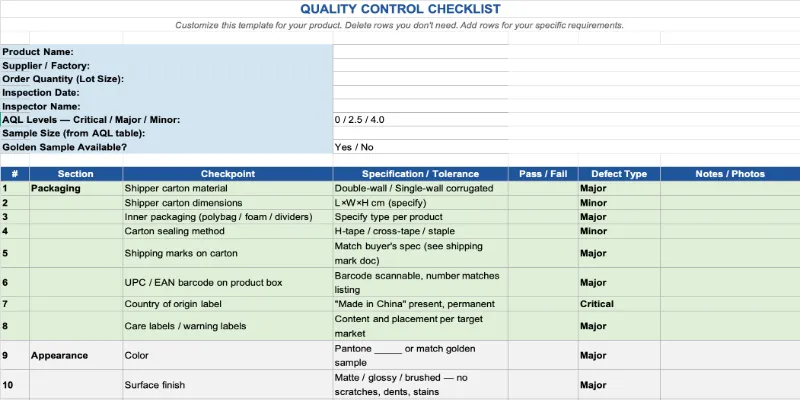
This is the same checklist framework our team uses for every shipment from Yiwu. It is free, editable, and ready to customize for your own products.
The template includes four sheets:
Sheet 1 – QC Checklist: five pre-built sections (Packaging, Appearance, Function, Compliance, Defects) with editable rows. Add your own checkpoints, delete the ones that do not apply.
Sheet 2 – AQL Reference Table: sample sizes for lot sizes from 2 to 35,000. Look up your batch size and instantly know how many units to inspect.
Sheet 3 – Defect Classification Guide: Critical, Major, and Minor definitions with examples across common product categories (electronics, textiles, ceramics, plastics).
Sheet 4 – Instructions: how to fill out and customize the checklist for your specific product.
Click here and download the free Quality Control Checklist Template
Final Words
A quality control checklist does not guarantee perfect products. But it guarantees that everyone, you, your factory, and your inspector, is working from the same definition of “acceptable.” That alone eliminates most quality disputes before they happen.
If you would rather not manage QC yourself, HiSourcing’s inspection team in Yiwu can handle it for you. With the Quality Control service we provide, we inspect every shipment using the same checklist framework described in this guide, at no service fee. Feel free to contact us.
Frequently Asked Questions
How do you inspect products from China?
Request a pre-shipment inspection (PSI) when production is 100% complete and at least 80% of units are packed. Send your QC checklist to a third-party inspector or your sourcing agent’s QC team. The inspector visits the factory, pulls a random sample based on AQL, checks every item on your checklist, and sends you a pass-or-fail report with photos.
Do I need a third-party inspector?
If you are not physically in China, yes. Relying on the factory to inspect its own products is like asking a student to grade their own exam. A third-party inspector (like your sourcing agent’s QC team) provides an unbiased report. Typical cost: $200 to $350 per man-day.
What is the most common QC problem when importing from China?
Miscommunication. The buyer assumes the factory understands what ‘good quality’ means. The factory assumes the buyer will accept minor cosmetic issues. A written QC checklist with specific defect classifications eliminates this gap entirely.
Can I use the same checklist for every order?
Use the same template structure, but update the specifics for each product and order. Dimensions, colors, certifications, and defect types change between products. Your checklist should reflect each product’s unique requirements.
When should I inspect, during production or after?
Both, if possible. A during-production inspection (DUPRO) at 20–60% completion catches problems early when they are still cheap to fix. A pre-shipment inspection (PSI) at 100% completion is the final gate. For first orders with a new factory, do both. For repeat orders with trusted factories, PSI alone is usually sufficient.
What happens if my shipment fails the QC inspection?
Three options: reject the batch and demand rework at the factory’s expense, negotiate a price discount for the defective portion, or cancel the order, depending on your contract terms. Never ship a failed batch hoping your customers won’t notice — the returns and negative reviews will cost far more than the rework.


