
A spec sheet is the most important document in your China product sourcing process. Get it right, and your factory delivers exactly what you expect. Get it wrong, and you are looking at months of rework, wasted money, and a product that does not match your vision.
Yet most first-time importers skip this step entirely. They send a supplier a few product photos on WhatsApp, WeChat, type “good quality, 20000 pieces,” and hope for the best. That is not sourcing. That is gambling.
In this guide, you will learn exactly what a spec sheet is, what to include in your product spec sheet section by section, and how to write one that factories actually follow. You will also get real spec sheet examples from four product categories and a free downloadable spec sheet template.
Download Free Spec Sheet Template

What Is a Spec Sheet?
A spec sheet is a document that tells your manufacturer exactly what to build, what materials to use, and what standards the finished product must meet. It covers materials, dimensions, colors, packaging, compliance, and quality acceptance criteria, all in one place.
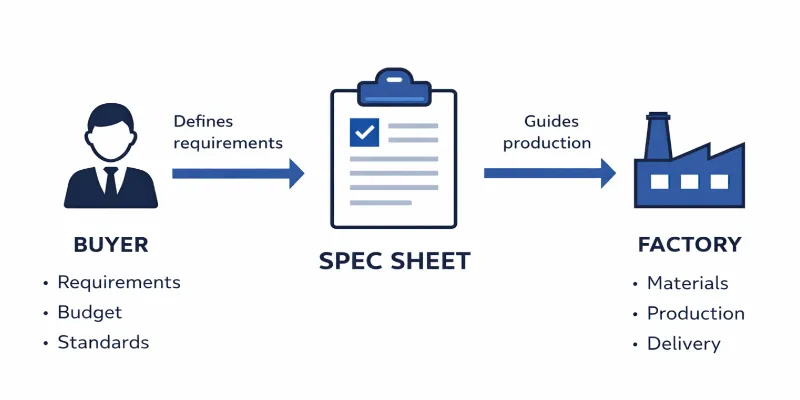
Think of it as the single source of truth between you and your factory. If something is on the spec sheet and the factory deviates from it, you have grounds for a refund or replacement. If something is not on the spec sheet, the factory gets to decide. And they will always choose the cheapest option.
You may also hear this document called a “product specification sheet” or simply “product spec sheet.” They all mean the same thing.
Key takeaway: A spec sheet defines what you WANT produced. A datasheet describes a product that already EXISTS. Importers create spec sheets; manufacturers create datasheets.
Spec Sheet vs. Technical Drawing vs. Tech Pack
Importers frequently confuse these three documents. Here is how they compare:
| Spec Sheet | Technical Drawing | Tech Pack | |
|---|---|---|---|
| Purpose | Overall product requirements for manufacturing | Precise dimensions, geometry, and engineering tolerances | Apparel construction and grading details |
| Used for | All product categories | Engineering and molded parts | Garments and textiles only |
| Includes | Materials, colors, packaging, QC, compliance | CAD files, tolerances, angles | Fabric, stitching, size grading, wash care |
| Created by | Importer/buyer | Engineer or industrial designer | Fashion designer or merchandiser |
| Format | Excel, Word, or PDF | CAD (DWG, STEP, IGES) | Illustrator + Excel |
Bottom line:
If you are sourcing products from China, you need a spec sheet.
If your product involves custom molds, add a technical drawing.
If you are sourcing apparel, you need a tech pack.
Why Every Importer Needs a Spec Sheet
Three reasons. Each one is tied to real money lost when importers skip this step.
Reason 1: You get accurate quotes
Without a spec sheet, suppliers quote based on assumptions and inflate prices. Those assumptions always favor the cheapest materials. Always. Basically, you’re buying a cheap product at a premium price.
Here is a real example. A client ordered stainless steel water bottles and simply wrote “stainless steel” on the inquiry. The factory quoted based on 201-grade steel — cheaper, less corrosion-resistant. The client expected 304-grade. The entire first order failed compliance testing. Cost to rework and re-ship over $12,000.
One line on a spec sheet — “Material: SUS304 stainless steel” — would have prevented the entire situation.
Reason 2: You prevent production errors
The spec sheet is what the production floor follows. Without it, instructions pass through your sales contact, to the production manager, to the line supervisor, to the workers. Details get lost at every handoff.
Reason 3: You enable quality inspection
When a QC inspector visits the factory, they inspect against the quality control checklist, and the list should be created based on your spec sheet. No spec sheet means no objective pass/fail criteria. Your inspector literally cannot do their job.
What to Include in a Product Spec Sheet
This is the most important section of this guide. Every element below should appear on your spec sheet. If you skip a section, you are giving the factory permission to make that decision for you.
Product Name, SKU, and Revision Number
Start with the basics:
- Product name
- Your internal SKU
- A revision number
The revision number is the detail most importers forget. And it is the one that causes the most painful disputes.
Every time you update the spec sheet, even a minor color change, increment the revision: Rev 1, Rev 2, Rev 3. When you place a production order, reference the specific revision on the PO.
Real case: A client changed their packaging from poly bag to rigid box, emailed the updated spec sheet, but did not mark a new revision. The factory still had Rev 1 on file. 3,000 units shipped in poly bags. The dispute lasted weeks because neither side could prove which version was current.
Materials and Components
This is where most spec sheets fail. Vague descriptions like “good quality plastic” or “premium leather” mean nothing on a factory floor. At most times, vague words like good quality and premium are regarded as Ordinary in the eyes of suppliers.
You need to specify the exact material type, grade, and performance requirements. Here is what that looks like for common materials:
| Material | ❌ Wrong (Vague) | ✅ Right (Specific) |
|---|---|---|
| Plastic | “Good quality plastic” | ABS plastic, virgin material, UL94-V0 flame retardant, matte finish |
| Metal | “Stainless steel” | SUS304 stainless steel, brushed finish, 0.8mm wall thickness |
| Fabric | “Cotton, good quality” | 100% combed cotton, 350 GSM, French terry weave |
| Leather | “Premium leather” | PU leather, 1.2mm thickness, matte finish, REACH compliant |
If your product has multiple components, list every single one separately. A kitchen utensil might have a silicone head, a stainless steel shaft, and a PP handle. Each needs its own spec line.
Why do factories default to cheap materials? It is not deception. They are trying to hit a price point. If you say, “I want good quality for $2 per unit,” every material choice will be driven by that $2 target. Your spec sheet is the guardrail.
Dimensions, Weight, and Tolerances
Every critical dimension needs a tolerance. A tolerance defines the acceptable range of variation.
For example, “Height: 250mm ± 2mm” means anything between 248mm and 252mm is acceptable.
No tolerance on your spec sheet? The factory decides what is acceptable. And their definition of “close enough” is probably much looser than yours.
Include both product dimensions and packaging dimensions. If you sell on Amazon, packaging dimensions directly affect your FBA fees. An extra centimeter in any direction can push you into a larger size tier.
Weight should include both the net weight (product only) and the gross weight (product plus packaging). Your freight forwarder needs gross weight and carton dimensions to calculate shipping costs.
Colors and Surface Finish
Never describe colors with words. “Sky blue” means something different to every factory in China.
Use Pantone Matching System (PMS) codes for consumer products. Use RAL codes for industrial products. These are universal standards any factory can match.
One detail most importers miss: Pantone colors look different on coated vs. uncoated surfaces. PMS 2935 C (coated) and PMS 2935 U (uncoated) are technically the same blue, but they look noticeably different in person. Specify which one you want.
For surface finish, be equally specific: matte, glossy, brushed, satin, powder-coated, anodized. If your product has different finishes on different surfaces, specify each one separately.
Logo, Branding, and Artwork
Provide artwork in vector format (AI or EPS). If unavailable, use PNG or PDF at minimum 300 DPI.
Specify three things: the exact position (measured in millimeters from reference edges), the size, and the printing method.
Common printing methods include screen printing, pad printing, heat transfer, embossing, debossing, laser engraving, and UV printing. Each produces a different look at a different cost. If you do not specify, the factory picks the cheapest one.
Packaging Requirements
Packaging is a product in its own right. It deserves its own section on the spec sheet with the same level of detail as the product itself.
Your spec sheet should define:
| Packaging Layer | What to Specify |
|---|---|
| Inner packaging | Type (poly bag, blister, rigid box, foam insert), material, printed elements (color box, hang tag, instruction card) |
| Outer packaging | Carton material (single/double wall), dimensions, quantity per carton, max carton weight, and arrangement inside |
| Labeling | UPC/EAN barcode, FNSKU label (if Amazon FBA), country of origin labels (like Made in PRC), shipping marks |
For Amazon FBA sellers: Your factory can produce a perfect product, but if the packaging does not comply with FBA standards, Amazon will reject the entire shipment at their receiving dock. Specify FBA requirements on the spec sheet.
Compliance and Certifications
Compliance is the importer’s responsibility, not the factory’s. If your product gets held at customs, that is on you.
Here are the most common requirements by market:
| Market | Common Requirements |
|---|---|
| United States | CPSC, CPSIA (consumer products), ASTM F963 (toys), FDA (food-contact), FCC (electronics), California Prop 65 |
| European Union | CE marking, REACH (chemicals), RoHS (electronics), EN71 (toys) |
| Both markets | ISO 9001 (factory certification – supplier’s responsibility), third-party testing (SGS, Bureau Veritas, Intertek) |
List every applicable standard on your spec sheet. Require the supplier to provide test reports from accredited labs before shipment.
Quality Acceptance Criteria
Without this section, your quality inspector has no objective basis for passing or rejecting the goods.
The standard framework is AQL (Acceptable Quality Level) sampling. It classifies defects into three levels:
| Defect Level | Definition | AQL Level | Product-Specific Examples |
|---|---|---|---|
| Critical | Safety risk or regulatory violation | 0% acceptable | Crack that could cause injury; lead content above legal limit |
| Major | Functional failure or visible flaw that would cause a return | AQL 2.5 | Button does not work; color mismatch visible at arm’s length; dent > 3mm |
| Minor | Small cosmetic flaw most customers would not notice | AQL 4.0 | Slight color variation within Pantone tolerance; scratch < 1mm |
The more specific your defect definitions, the easier it is for an inspector to make consistent pass/fail decisions.
Spec Sheet Examples by Product Category
Most guides online show one generic example. That is not useful.
Below are four category-specific breakdowns showing what each type of spec sheet should cover. These are the categories we handle most frequently at HiSourcing.
Garment and Apparel Spec Sheet Example

A garment spec sheet, often called a tech pack, is the most detailed type. It should include:
- Fabric composition and weight (e.g., 350 GSM 100% cotton French terry).
- A complete size grading chart with measurements in centimeters for each size.
- Stitching details: stitches per inch, seam type, thread color by Pantone.
- Wash care label content and placement.
- Hang tag design.
- Poly bag packaging with suffocation warning if required.
The most critical detail: the size chart. Chinese domestic sizing runs significantly smaller than US or European sizing. If you do not provide a grading chart, the factory produces to Chinese sizing by default.
We have seen clients receive entire orders where a US “Small” fit like a Chinese “Large.” Every single time, the cause was a missing size chart on the spec sheet. If you’re not sure how to make the Asia size to US size conversion, you can kindly check this guide.
Consumer Electronics Spec Sheet Example
Electronics spec sheets go beyond physical dimensions. They should include:
- PCB specifications and component list.
- Battery capacity (mAh) and type.
- Charging interface (USB-C, Micro-USB).
- Wireless protocols (Bluetooth version, Wi-Fi standard).
- Operating temperature range.
- IP rating if waterproofing is required.
- All certifications: FCC, CE, UL, RoHS.
For electronics, always attach a technical drawing or schematic as a separate file alongside the main spec sheet.
Promotional Products Spec Sheet Example
Branded pens, tote bags, drinkware, and keychains are among the top categories importers buy from Yiwu Market.
A promo spec sheet should include:
- Base product description and material
- Imprint area in millimeters
- Imprint method (screen print, laser, UV)
- Pantone colors for the imprint
- Packaging type
- Carton quantities.
One detail unique to promo orders: always specify logo position relative to a fixed point. “Center logo: 15mm from bottom edge” works. “Put the logo on the front” does not.
Food Contact and Kitchen Products Spec Sheet Example
For anything that touches food, like cutting boards, utensils, bottles, and containers, compliance is non-negotiable.
Your spec sheet must include:
- Food-grade material certification (FDA 21 CFR in the US, EU 1935/2004 in Europe)
- BPA-free and phthalate-free declarations
- Dishwasher safety testing
- California Prop 65 screening if selling in the US
A missing food-contact certification can get your entire shipment detained at customs. Always require third-party lab reports before shipment.
Free Spec Sheet Template
We created a spec sheet template that covers every section in this guide. It is an Excel spreadsheet with pre-built sections for product info, materials, dimensions, colors, branding, packaging, compliance, and QC criteria.
Each section includes example entries so you can see exactly how to fill it out.
Download Free Spec Sheet Template

How to use it:
Fill in every field that applies. If a field does not apply, mark it “N/A” rather than leaving it blank. This tells your supplier you intentionally skipped it, not that you forgot.
When finished, export as a PDF before sending to the factory. This prevents accidental edits and keeps formatting consistent.
Not sure if your spec sheet covers everything? You can contact us and send it. We review spec sheets for free as part of our sourcing consultation.
How to Write a Spec Sheet in 5 Steps
Starting from scratch? Follow this process. Each step builds on the previous one.
Step 1: Research Your Product Category
Before you write anything, study similar products on Amazon, Alibaba, and competitor websites. Order samples from 2-3 suppliers if needed.
Read customer reviews, especially the negative ones. They tell you exactly what can go wrong with this type of product.
Watch manufacturing process videos on YouTube. Understanding how your product is made helps you write specifications that a factory can actually follow.
Step 2: List Every Material and Component
Break your product into individual parts. For each part: material, grade, performance requirements.
Example for a reusable water bottle:
- Body (SUS304 stainless steel, 0.6mm wall)
- Lid (PP plastic, food-grade, BPA-free)
- Seal ring (food-grade silicone, FDA compliant)
- Coating (powder coat, Pantone 7462 C)
Step 3: Define Dimensions with Tolerances
Measure the product, inner packaging, and outer carton. Use millimeters.
Add ± tolerance to every critical dimension. Standard for consumer products: ± 1–2mm. Tighter tolerances increase cost.
Include net weight and gross weight. Your freight forwarder needs both.
Step 4: Specify Colors, Artwork, and Branding
Pantone codes for colors. Vector files for artwork. A placement diagram showing logo position in millimeters from reference edges. The printing method you want.
No Pantone code? No vector file? You are leaving the most visible part of your product up to the factory’s interpretation.
Step 5: Add Compliance and Testing Requirements
Research regulations for your target market before you write the spec sheet. Not after.
For the US, start with the CPSC website. For the EU, check the European Commission’s product safety pages. If unsure, consult a testing company (SGS, Intertek, Bureau Veritas) or ask a China sourcing agent.
6 Spec Sheet Mistakes That Cost Importers Money
Every mistake below comes from real cases we have seen. Each one costs the importer real money.
1. Using Vague Language Like Good Quality
“Good quality” is not a specification. Neither is “premium feel” nor “high-end look.”
If you cannot measure it or test it, it does not belong on a spec sheet without a concrete definition attached.
Replace this: “Good quality plastic.”
With this: “ABS plastic, virgin material, UL94-V0 flame retardant, matte finish.”
2. Missing Tolerance Levels
Your spec sheet says “Height: 250mm” without a tolerance. The factory delivers units from 245mm to 258mm. They argue all are “approximately 250mm.”
You have no documentation to dispute this. Because you never defined what was acceptable.
3. No Revision Control
You change the material from PU leather to genuine leather. You email the updated spec sheet. Three months later, goods arrive in PU leather.
Without a revision number on the PO, you cannot prove you ever changed the spec. Always mark revisions. Always reference the revision on the purchase order.
4. Sending Photos Instead of Specifications
A photo shows what a product looks like. It does not show what it is made of, how thick the walls are, what color code to match, or how to package it.
Photos supplement a spec sheet. They do not replace it.
5. Forgetting Packaging Specifications
The product is perfect. Packaging does not fit FBA requirements. Barcode is in the wrong format. Poly bags are missing suffocation warnings. The master carton weighs 28kg when Amazon’s limit is 22.5kg.
Result: entire shipment rejected at the receiving dock.
6. Ignoring Market Compliance
An importer sources children’s toys without specifying ASTM F963. The toys arrive at US customs. CPSC flags the shipment. The container is held.
Testing fees, re-testing, storage costs: more than the value of the goods.
Research compliance before you write the spec sheet. Not after the container is on the water.
Frequently Asked Questions
What is the difference between spec sheet and datasheet?
A spec sheet defines what you want produced. A datasheet describes a product that already exists. Importers create spec sheets before production. Manufacturers create datasheets for existing products.
What format should I use for my spec sheet?
Create in Excel or Word. Send to suppliers as PDF. PDF prevents accidental modifications and keeps formatting consistent. Include your company name in the header and page numbers on every page.
How detailed should a spec sheet be?
As detailed as possible. Write your spec sheet as if the reader has never seen your product and has no idea what you want. If a detail is important enough to notice when the product is wrong, it is important enough to put on the spec sheet.
Can a sourcing agent help me write a spec sheet?
Yes. A good sourcing agent reviews your spec sheet for gaps and suggests additions based on their experience with your product category.
At HiSourcing, spec sheet review is part of our free sourcing consultation. Send us yours and we will tell you exactly what is missing.
Do I need a different spec sheet for each supplier?
No. Use the same spec sheet for all suppliers. This ensures you get comparable quotes based on identical requirements. Only update after sample approval, and always increment the revision number.


