
When importing clothing, shoes, and other apparel from Asia, especially apparel made in PRC (China), size conversion is always a big problem. Generally, Asian sizes run 1 to 2 sizes smaller than US sizes. Without an accurate Asian size to US size conversion built into your brief, the gap shows up as failed inventory, negative reviews, and a high return rate that flags your listing.
Getting the numbers right before placing any order is the only way to prevent these problems. In this guide, we provide conversion charts of clothing, shoes, and underwear. Covering women’s, men’s, and children’s sizing. To help you brief your supplier correctly and verify samples against the Western market standards before any huge losses. Without further ado, let’s dive in.
Asian Size to US Size Conversion Chart
Asian Clothing Size to US Size
Chinese clothing sizes follow GB/T 1335, China’s national sizing standard, which uses a height-plus-circumference system (e.g. 165/88A). The first number is height in cm, the second is bust or chest circumference in cm. The letter indicates body type: A for standard frame, B for slightly fuller, and C for fuller.
US sizing follows ASTM D5585, which uses different reference body measurements.
Asian Clothing Size Chart (Women’s Tops)
Asian women’s shirts, jackets, and hoodies are 2 to 3 sizes smaller than US equivalents.
The table below covers tops from XXS through 6XL. Asian XXXS fits smaller than any standard US size. If a garment is labeled XXXS, check the bust measurement directly rather than relying on the label.
| Asian/China | US Alpha | US Numeric | EU | Intl | Bust cm/inch | Waist cm/inch | Hip cm/inch |
|---|---|---|---|---|---|---|---|
| 150/76A | XXS | 0 | 32 | XXS | 76 / 30″ | 60 / 23.5″ | 84.5 / 33.5″ |
| 155/80A | XS | 2 | 34 | XS | 80 / 31.5″ | 64 / 25″ | 88 / 34.5″ |
| 160/84A | S | 4–6 | 36 | S | 83.5 / 33″ | 67.5 / 26.5″ | 91.5 / 36″ |
| 165/88A | M | 8 | 38 | M | 87 / 34″ | 71 / 28″ | 95 / 37.5″ |
| 170/92A | L | 10–12 | 40 | L | 90.5 / 35.5″ | 74.5 / 29.5″ | 98.5 / 38.5″ |
| 175/96A | XL | 14 | 42 | XL | 94 / 37″ | 78 / 30.5″ | 102 / 40″ |
| 180/100A | 1X / XXL | 16 | 44 | XXL | 97.5 / 38.5″ | 81.5 / 32″ | 105.5 / 41.5″ |
| 180/104A | 2X | 18 | 46 | XXXL | 102.5 / 40.5″ | 85.5 / 33.5″ | 109.5 / 43″ |
| 180/108A | 3X | 20 | 48 | 4XL | 108 / 42.5″ | 90 / 35.5″ | 114 / 45″ |
| 185/116A | 4X | 22–24 | 50 | 5XL | 116 / 45.5″ | 97 / 38″ | 121 / 47.5″ |
| 190/124A | 5X | 26 | 52 | 6XL | 124 / 49″ | 104 / 41″ | 128 / 50.5″ |
Asian Clothing Size Chart (Women’s Bottoms)
Women’s pants, skirts, and dresses use waist circumference as the primary measurement.
Asian dress size to US conversions require waist-first sizing, not bust.
| Asian/China | US Numeric | EU | Waist cm/inch | Hip cm/inch |
|---|---|---|---|---|
| 155/62A | 0–2 | 34 | 61–64 / 24–25″ | 84–86 / 33–34″ |
| 160/66A | 4–6 | 36 | 66–69 / 26–27″ | 89–91 / 35–36″ |
| 165/70A | 8 | 38 | 71–74 / 28–29″ | 94–97 / 37–38″ |
| 170/74A | 10 | 40 | 76–79 / 30–31″ | 99–102 / 39–40″ |
| 175/78A | 12–14 | 42 | 81–84 / 32–33″ | 104–107 / 41–42″ |
| 180/82A | 16 | 44 | 86–89 / 34–35″ | 109–112 / 43–44″ |
Jeans waist sizes on 1688 and Alibaba are sometimes listed as a single number (e.g., 26 or 27), which directly corresponds to the waist measurement in inches and can be used without conversion for US sizing.
Asian Clothing Size Chart (Men’s Tops)
Asian men’s shirt sizes follow the same height-plus-chest system as women’s wear.
The table below includes chest, waist, arm length, and neck circumference. All measurements needed to verify fit before committing to a bulk order. An Asian man’s XL is typically a US Large, with a narrower shoulder and shorter sleeves.
| Asian/China | US | EU | Chest cm/inch | Waist cm/inch | Arm cm/inch | Neck cm/inch |
|---|---|---|---|---|---|---|
| 165/80A | XS | 38/40 | 74–78 / 29–30.5″ | 62–66 / 24–26″ | 58.6 / 23″ | 33 / 13″ |
| 170/84A | S | 42/44 | 80–84 / 31.5–33″ | 66–74 / 26–29″ | 60 / 23.5″ | 34 / 13.5″ |
| 175/88A | M | 46/48 | 86–92 / 34–36″ | 74–82 / 29–32″ | 61 / 24″ | 35–36 / 13.5–14″ |
| 175/92A | L | 48/50 | 90–98 / 35.5–38.5″ | 80–90 / 31.5–35.5″ | 63 / 24.5″ | 38–39 / 15–15.5″ |
| 180/96A | XL | 52/54 | 98–107 / 38.5–42″ | 90–98 / 35.5–38.5″ | 65 / 25.5″ | 39–40 / 15.5–16″ |
| 180/100A | XXL | 56/58 | 107–116 / 42–45.5″ | 100–110 / 39.5–43″ | 65 / 25.5″ | 42–44 / 16.5–17.5″ |
| 185/108A | 3XL | 60 | 116–124 / 45.5–49″ | 110–118 / 43–46.5″ | 67 / 26.5″ | 44–46 / 17.5–18″ |
| 190/116A | 4XL | 64 | 124–132 / 49–52″ | 118–126 / 46.5–49.5″ | 68 / 27″ | 46–48 / 18–19″ |
| 190/124A | 5XL | 68 | 132–140 / 52–55″ | 126–134 / 49.5–52.5″ | 69 / 27″ | 48–50 / 19–19.5″ |
| 195/132A | 6XL | 72 | 140–148 / 55–58″ | 134–142 / 52.5–56″ | 70 / 27.5″ | 50–52 / 19.5–20.5″ |
Asian Clothing Size Chart (Men’s Bottoms)
Men’s jeans use a waist-by-inseam format in the US (e.g., 32×32).
Chinese jeans use height and waist circumference (e.g., 175/78A). The table below maps the two systems directly.
| China Jeans | US (W×L) | EU | Waist inch | Inseam | Notes |
|---|---|---|---|---|---|
| 170/72A | 28×30 | 28/30 | 28″ | 30″ | Regular length |
| 170/74A | 29×30 | 29/30 | 29″ | 30″ | Regular length |
| 175/76A | 30×30 | 30/30 | 30″ | 30″ | Regular length |
| 175/78A | 31×32 | 31/32 | 31″ | 32″ | Regular length |
| 180/80A | 32×32 | 32/32 | 32″ | 32″ | Regular length |
| 180/82A | 33×32 | 33/32 | 33″ | 32″ | Regular length |
| 185/84A | 34×34 | 34/34 | 34″ | 34″ | Long length |
| 185/86A | 36×34 | 36/34 | 36″ | 34″ | Long length |
Asian Kids’ Clothing Size Chart
Chinese children’s clothing follows GB/T 1335.3, which uses height in centimeters as the primary size label.
A garment labeled 140 is designed for a child approximately 140cm tall. This differs from US kids’ sizing, which uses age ranges or alpha sizes:
- Asian size 140 = US Kids 10–12
- Asian size 150 = US Kids 14
The numbers 110, 120, 130, 140, 150, 160 seen on Chinese children’s clothing are height measurements in centimeters, not arbitrary size codes.
| China (cm) | Approx Age | US Kids | EU | Height inch | Weight lbs | Notes |
|---|---|---|---|---|---|---|
| 110 | 4–5Y | 4T | 110 | 43″ | 40–44 | Toddler / Pre-K |
| 120 | 6–7Y | 6–7 | 120 | 47″ | 46–54 | Kids Small |
| 130 | 8–9Y | 8 | 130 | 51″ | 55–66 | Kids Medium |
| 140 | 10–11Y | 10–12 | 140 | 55″ | 68–80 | Kids Large |
| 150 | 12–13Y | 14 | 150 | 59″ | 82–95 | Kids XL |
| 160 | 14–15Y | 16 | 160 | 63″ | 97–110 | Junior / Teen |
Sizes 140 and 150 are the most commonly imported Chinese kids’ sizes for the US market. Always verify the height and chest measurement of the target child against the garment’s flat lay spec before bulk production.
Asian Shoe Size to US Size Chart
Here’s how to convert Asian shoe size to US:
Asian shoe sizes use foot length in millimeters. Find your foot length in the China (mm) column and read across to the US size.
A Chinese size 260mm = US Men’s 8 = US Women’s 9.
International shoe sizes are standardized under ISO 9407:2019 (Mondopoint), measuring foot length in millimeters. Chinese sizes measure actual foot length. Japanese sizes measure the shoe’s inner length, which is typically slightly longer .
That is to say, a Chinese size 270 is slightly smaller than a Japanese size 270. When sourcing from factories that supply both markets, confirm which system the factory is using.
Asian Women’s Shoe Size Chart
| International (mm) | EU | US Women | China (mm) | UK | JP approx |
|---|---|---|---|---|---|
| 225 | 36 | 5.5 | 225 | 3 | 22.5 |
| 230 | 36.5 | 6 | 230 | 3.5 | 23 |
| 235 | 37.5 | 6.5 | 235 | 4 | 23.5 |
| 240 | 38 | 7 | 240 | 4.5 | 24 |
| 245 | 38.5 | 7.5 | 245 | 5 | 24.5 |
| 250 | 39 | 8 | 250 | 5.5 | 25 |
| 255 | 40 | 8.5 | 255 | 6 | 25.5 |
| 260 | 40.5 | 9 | 260 | 6.5 | 26 |
| 265 | 41 | 9.5 | 265 | 7 | 26.5 |
| 270 | 42 | 10 | 270 | 7.5 | 27 |
Asian Men’s Shoe Size Chart
| International (mm) | EU | US Men | China (mm) | UK | JP approx |
|---|---|---|---|---|---|
| 245 | 39 | 6.5 | 245 | 5.5 | 24.5 |
| 250 | 40 | 7 | 250 | 6 | 25 |
| 255 | 40.5 | 7.5 | 255 | 6.5 | 25.5 |
| 260 | 41 | 8 | 260 | 7 | 26 |
| 265 | 42 | 8.5 | 265 | 7.5 | 26.5 |
| 270 | 42.5 | 9 | 270 | 8 | 27 |
| 275 | 43 | 9.5 | 275 | 8.5 | 27.5 |
| 280 | 44 | 10 | 280 | 9 | 28 |
| 285 | 44.5 | 10.5 | 285 | 9.5 | 28.5 |
| 290 | 45 | 11 | 290 | 10 | 29 |
| 295 | 46 | 11.5 | 295 | 10.5 | 29.5 |
| 300 | 47 | 12 | 300 | 11 | 30 |
Beyond length, shoe width is a critical fit variable that is frequently overlooked in bulk orders.
Asian shoe lasts are typically wider than European lasts. Western brands, particularly UK brands like Clarks, tend to run narrower. Specify width explicitly in your purchase order because factories default to their standard last if no instruction is given.
| Width | Women (Clarks) | Men (Clarks) |
|---|---|---|
| Narrow | — | F (Narrow) |
| Standard | D (Standard) | G (Standard) |
| Wide | E (Wide) | H (Wide) |
| Extra Wide | EE (Extra Wide) | — |
Example: Chinese size 230mm = Clarks UK 3.5. The standard Clarks women’s width is D (Standard).
Buyers whose customers have wider feet should specify E (Wide) when placing the order.
Asian Kids’ Shoe Size Chart
| International (mm) | EU | US Kids | China (mm) | UK | Age approx |
|---|---|---|---|---|---|
| 110 | 21 | 5 | 110 | 4.5 | 2–3Y |
| 120 | 22 | 6 | 120 | 5.5 | 3–4Y |
| 130 | 23.5 | 7 | 130 | 6.5 | 4–5Y |
| 140 | 25 | 8 | 140 | 7.5 | 5–6Y |
| 150 | 26 | 9 | 150 | 8.5 | 6–7Y |
| 160 | 27 | 10 | 160 | 9.5 | 7–8Y |
| 170 | 28 | 11 | 170 | 10.5 | 8–9Y |
| 180 | 29.5 | 12 | 180 | 11.5 | 9–10Y |
| 190 | 31 | 13 | 190 | 12.5 | 10–11Y |
Asian Bra Size to US Size Chart
Asian bra size to US size conversion requires two separate steps: band size and cup size.
Chinese bra sizes use a numeric band in centimeters (e.g., 75B). US sizing uses inches for the band.
Cup letters are mostly the same except at larger sizes.
Chinese bra sizing follows GB/T 6411, which defines band measurements in centimeters. US sizing follows ASTM D4132.
Cup designations align from A through D. Chinese E = US DD. Chinese F = US DDD.
When importing bras or lingerie, always confirm with underbust and full bust measurements in centimeters rather than relying on the label alone.
Band Size Conversion
Divide the Chinese band number by 2.54 to convert centimeters to inches, then match to the US band size in the table below.
| China Band (cm) | US Band (inch) | EU Band (cm) | Cup (same both) |
|---|---|---|---|
| 70 | 32 | 70 | A / B / C / D |
| 75 | 34 | 75 | A / B / C / D |
| 80 | 36 | 80 | A / B / C / D / E |
| 85 | 38 | 85 | A / B / C / D / E |
| 90 | 40 | 90 | A / B / C / D / E |
| 95 | 42 | 95 | A / B / C / D |
Full Size Reference Chart
| China Size | US Equivalent | EU Equivalent | Cup Note |
|---|---|---|---|
| 70A | 32A | 70A | Same cup |
| 75B | 34B | 75B | Same cup |
| 80C | 36C | 80C | Same cup |
| 85D | 38D | 85D | Same cup |
| 90E | 40DD | 90E | China E = US DD |
| 95F | 42DDD / F | 95F | China F = US DDD |
Why Are Asian Sizes Smaller Than US Sizes?
The size gap is not a quality issue or a labeling error. It comes down to three structural differences that have been built into Asian and US sizing systems from the ground up.
Body Proportions
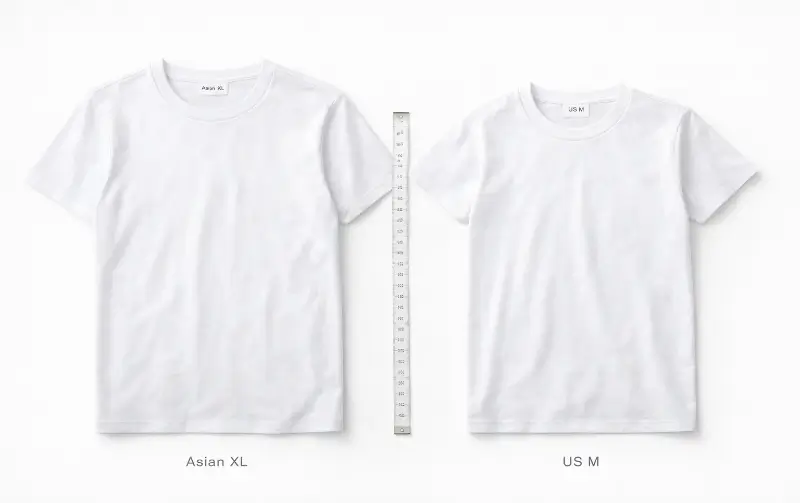
The most direct reason is that the average Asian body frame is smaller than the average American one. According to data from national health surveys across East Asia, the average adult height in China, Japan, and South Korea is approximately 5–8cm shorter than in the United States, with correspondingly narrower shoulders, a smaller chest circumference, and a slimmer waist.
Fashion Preferences
Beyond body measurements, the way garments are cut reflects local fashion preferences. East Asian markets, particularly Japan and South Korea, have a strong cultural preference for slim, body-hugging fits. This means that even when the underlying body measurements are similar, an Asian-cut garment will feel tighter on a US consumer than a US-cut garment of the same nominal size.
Chinese streetwear and fast fashion follow a similar pattern. Garments produced for the domestic Chinese market are routinely cut with less ease allowance than their Western equivalents. A Chinese XL may have the same chest measurement as a US Medium, but the silhouette is cut closer to the body, leaving less room for movement.
Measurement Systems
Most Asian countries use centimeters as the primary unit for garment measurements. The US uses inches. It is not merely a unit conversion issue, but also reflects two fundamentally different approaches to how size information is communicated across the supply chain.
Chinese factories specify garments in centimeters. US buyers and Amazon listings are expected to provide measurements in inches. When neither side explicitly converts, the result is ambiguity at every stage: sampling, production approval, listing setup, and customer fit.
A factory that receives a size brief in alpha labels only (S/M/L) will interpret those labels against Chinese domestic standards unless explicitly instructed otherwise.
A Note on Sizing in Yiwu: What Importers Need to Know
HiSourcing is based in Yiwu, which is both the world’s largest small commodities wholesale market and a major garment and footwear export hub. The following reflects direct operational experience.
Factory size labeling varies significantly
In Yiwu’s wholesale market, size labeling varies between stalls and factories. Some use the national GB/T standard. Many use their own factory standard, which may be calibrated to a specific domestic retailer’s spec.
Two stalls selling what appears to be the same product may use completely different sizing references. A garment labeled ‘L’ in one stall may have a chest measurement of 100cm, while the same label next door measures 104cm. For a buyer importing 2,000 units, this discrepancy translates directly into returns and negative reviews.
The 2–3cm tolerance reality
Chinese factories commonly cite a 2–3cm manufacturing tolerance as acceptable. For US consumers buying online without the ability to try on, a 3cm error on a borderline size creates a fit failure.
HiSourcing’s approach is to specify garment measurements in centimeters and inches at the contract stage, with explicit tolerance limits, and to conduct flat lay measurements on a sample from each production run before approving shipment.
How to request US-standard sizing from a Chinese factory
- Provide a Tech Pack with measurements in both centimeters and inches for every key dimension.
- Specify the sizing standard explicitly: ‘US market sizing, not Chinese domestic standard.’
- Request a signed Golden Sample with confirmed flat lay measurements before bulk production starts.
- Include a measurement tolerance clause in your purchase order like 1cm for woven garments, 2cm for knitwear.
What Is ‘One Size’ or ‘Free Size’ in Asian Clothing?
‘One Size’ (均码) and ‘Free Size’ are among the most common labels on 1688 and Alibaba listings. There is no standardized definition under Chinese national standards.
In practice, most Chinese factories producing One Size items target a domestic consumer profile of height 155–165cm and bust circumference 83–95cm — typically a US Small to US Medium.
For importers, this means One Size items will not comfortably fit US Large or above. Always request the factory’s flat lay measurement sheet before placing any bulk order on One Size products. No legitimate factory will refuse to provide this.
How to Find Your Asian Size
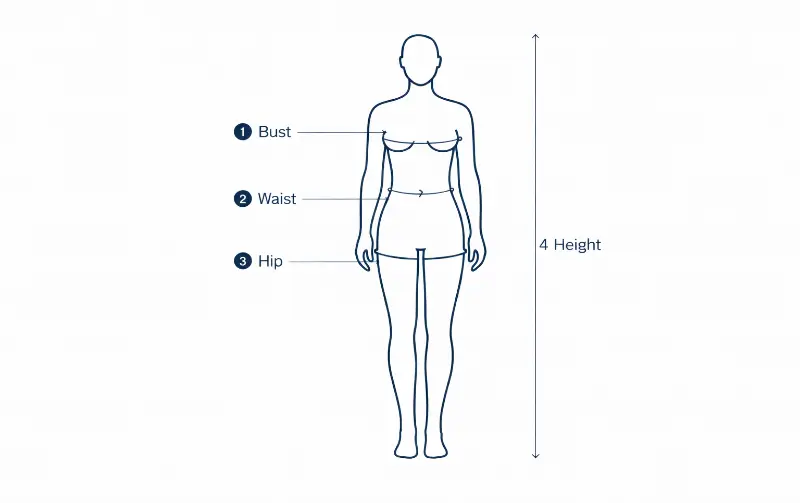
If you need to verify a customer’s Asian size or set up a size chart for your US listing, take four measurements and cross-reference with the tables above.
- Bust / Chest: Wrap a soft tape measure around the fullest part of the chest, keeping it horizontal.
- Waist: Measure around the narrowest part of the torso, typically 2–3cm above the navel.
- Hip: Measure around the widest part of the hips and seat.
- Height: Stand without shoes against a flat wall. Measure from floor to the top of the head.
For tops, prioritise the bust or chest measurement.
For pants, prioritise the waist.
For shoes, measure foot length from heel to the tip of the longest toe in millimeters.
When a measurement falls between two sizes, always size up. Asian garments are cut closer to the body than US equivalents.
Size Conversion Tips for Clothing and Footwear Importers
1. Request flat lay measurements, not just size labels
The single most effective step is to ask your supplier for the garment’s actual flat lay measurements in centimeters before placing any order. Most factories have this data and will provide it on request.
2. Order samples and measure every key dimension
Before placing any bulk order for a new style, order a sample and measure it against your US market size spec. Key dimensions for tops: bust, waist, shoulder width, sleeve length, and garment length.
For pants: waist, hip, inseam, and rise.
For shoes: inner length, inner width, and heel height.
3. Set up your Amazon listing with actual measurements
Amazon’s Seller Central guidelines require apparel listings to include actual body measurements in both inches and centimeters. Listings that rely solely on alpha labels (S/M/L) without measurement data generate higher return rates, which Amazon tracks through the Voice of the Customer dashboard. Sustained poor fit return rates can result in listing suppression.
4. Sourcing from 1688: what to watch for
- Look for ‘亚码’ (yà mǎ, Asian size) in the listing — this explicitly signals that sizes run smaller than international standards.
- If only S/M/L labels are shown with no measurements, request the flat lay spec sheet before ordering.
- For shoes, ask for the inner length in millimeters — this maps directly to the International (mm) column in the shoe charts above.
Frequently Asked Questions
Is Asian XL the same as US XL?
No. Asian XL to US size is not a direct match. Asian XL typically corresponds to US Medium or US Large depending on the garment type. In women’s clothing, Asian XL is generally a US 14 (US L). In men’s clothing, Asian XL is often a US Large but with a narrower shoulder and shorter sleeve. Asian XXL to US size is typically US 1X or US 16 in women’s, and US XXL in men’s — but always check the actual bust or chest measurement rather than relying on the label.
What is Asian large size to US?
Asian Large (L) generally corresponds to US Medium. In women’s clothing, Asian L (170/92A) maps to US 10–12. In men’s clothing, Asian L (175/92A) maps to US Large, but with a narrower cut than a US Large from an American brand.
What is 3XL, 4XL, or 5XL in Asian sizing?
Asian 3XL corresponds to US 2X (women’s plus) or US XXL–3XL in men’s. Asian 4XL corresponds to US 3X or 3XL. Asian 5XL and 6XL cover US 4X and 5X. Use the extended rows in the clothing tables above for specific measurements.
What does Asian size 140 or 150 mean?
These numbers represent the child’s height in centimeters, not an arbitrary code. Asian size 140 is designed for a child approximately 140cm tall (ages 10–11), corresponding to US Kids 10–12. Asian size 150 fits a child approximately 150cm tall (ages 12–13), corresponding to US Kids 14.
How do I convert Asian shoe size to US?
Find your foot length in millimeters in the China (mm) column of the shoe chart above. Read across to the US size. Chinese size 260mm = US Men’s 8 = US Women’s 9. For shoe width, Asian shoes run wider than European brands — specify the width requirement explicitly when placing your order.
What is Asian bra size in US sizing?
Divide the Chinese band number (in cm) by 2.54 to get the approximate US band size. Cup letters are the same from A through D. Chinese E = US DD. Chinese F = US DDD. Always confirm with actual underbust and full bust measurements in centimeters rather than relying on the label.
Why do factory sizes differ between Chinese suppliers?
China’s GB/T 1335 provides a framework, but individual factories set their own patterns within it. A ‘Large’ in a Guangzhou knitwear factory can measure 4–6cm differently from a ‘Large’ in a Zhejiang woven factory. Specify measurements in your purchase order, not labels.
Final Thoughts
Asian sizes are consistently and predictably smaller than US sizes, by approximately 2 full sizes in clothing and a clear numeric offset in shoes and bras. Once you understand the measurement systems behind the labels, the conversion is straightforward.
Three things that make the difference in practice: measurements always beat labels, samples always beat assumptions, and a sourcing partner with direct factory access is the most cost-effective quality control tool available before bulk production starts.
Source apparel and footwear from China with size accuracy built in.
HiSourcing is based in Yiwu and works directly with garment and footwear factories across China. We conduct flat lay measurement verification on every sample and pre-shipment inspection before bulk orders leave the factory. If you are building a clothing or footwear line and need sizes confirmed before production starts, send us your product brief.


