
Choosing between a sourcing agent and a trading company is one of the most important decisions you will make when building a supply chain. The wrong choice can cost you money, reduce your control over product quality, and limit your ability to scale.
This guide breaks down exactly how a sourcing agent vs trading company differs, compares the real costs, and gives you a clear framework for deciding which option fits your business.
Sourcing Agent vs Trading Company: Quick Comparison
A sourcing agent represents the buyer. They help you find factories, negotiate prices, manage production, and coordinate shipping, all on your behalf.
A trading company acts as a seller. They buy products from factories and resell them to you at a higher price. They work for their own profit, not yours.
| Feature | Sourcing Agent | Trading Company |
|---|---|---|
| Role | Represents the buyer | Acts as the seller |
| Business model | Service provider | Product reseller |
| Revenue model | Commission or service fee | Profit margin on product |
| Factory transparency | High | Usually hidden |
| Customization | Flexible | Often limited |
| Pricing | Factory price + fee | Marked up |
| Best for | Custom products & large orders | Ready-made goods & small orders |
What Is a Sourcing Agent?
A sourcing agent is a professional or company that works on behalf of overseas buyers. Their job is to find the right factory for your product, get you the best price, and make sure the order is completed correctly.
Sourcing agents do not own the products, they help you source. They earn money through a service fee or commission, usually 5 to 10% of the order value.
Typical services a sourcing agent provides:
- Supplier search and shortlisting
- Factory verification and on-site visits
- Price negotiation with manufacturers
- Sample coordination and inspection
- Production monitoring and follow-up
- Quality inspection before shipment
- Shipping and logistics coordination
How a sourcing agent works in practice:
You provide your product requirements → the agent identifies qualified factories → gets quotes → arranges samples → monitors production → inspects finished goods → coordinates shipment to your warehouse.
Because the agent earns a fixed fee rather than a markup on the product, their financial incentive is aligned with finding you the best factory at the best price.
For a detailed breakdown of everything a sourcing agent does, see:
🌟 What Is a China Sourcing Agent? Complete Guide for Importers [2026]
🌟 15 Best China Sourcing Agents for 2026 | Expert Comparison Guide
🌟 15 Best Sourcing Agencies in Asia: Verified & Compared (2026)
🌟 Top 20 Product Sourcing Companies You Need to Know in 2026 (Updated List)
What Is a Trading Company?
A trading company is a business that buys products from manufacturers and resells them to overseas buyers at a higher price. They are the middleman between the factory and the buyer.
Trading companies typically:
- Maintain relationships with a limited range of factories
- Purchase products in bulk and hold inventory
- Add a markup — usually 15 to 40% — on top of the factory price
- Handle export documentation and shipping on your behalf
Trading companies are easy to work with. They respond quickly and handle most of the paperwork. The tradeoff is that you are paying more per unit, and you often have little visibility into where the product actually comes from.
Common advantages of trading companies:
- Simple purchasing process — one point of contact
- Lower MOQ sometimes available for ready-made products
- Faster communication than dealing with factories directly
- Useful for buyers who want a hands-off experience
Key Differences Between a Sourcing Agent and a Trading Company
| Aspect | Sourcing Agent | Trading Company |
|---|---|---|
| Who they work for | The buyer | Themselves |
| Pricing transparency | High – you know the factory price | Low – markup is hidden |
| Factory access | Direct – you can know which factory | Indirect – often undisclosed |
| MOQ flexibility | Often negotiable with the factory | Usually fixed |
| Product customization | High – agent works with factory on your specs | Limited – often restricted to existing products |
| Supplier network | Multiple factories across categories | Usually limited to their own suppliers |
| Quality oversight | Active – agent monitors on your behalf | Passive – trading company manages internally |
| Long-term cost | Lower – factory price plus small fee | Higher – markup compounds over time |
The most important difference is transparency. With a sourcing agent, you know which factory makes your product, what the factory price is, and what the agent earns. With a trading company, none of that is visible to you.
This matters most when something goes wrong. If there is a quality problem, a sourcing agent negotiates directly with the factory on your behalf, representing your interests at every stage of the dispute.
A trading company manages the same situation on its own terms, which may not align with yours.
Cost Comparison: Which Option Is Cheaper?
Trading companies appear simpler and sometimes feel cheaper. But the numbers usually tell a different story.
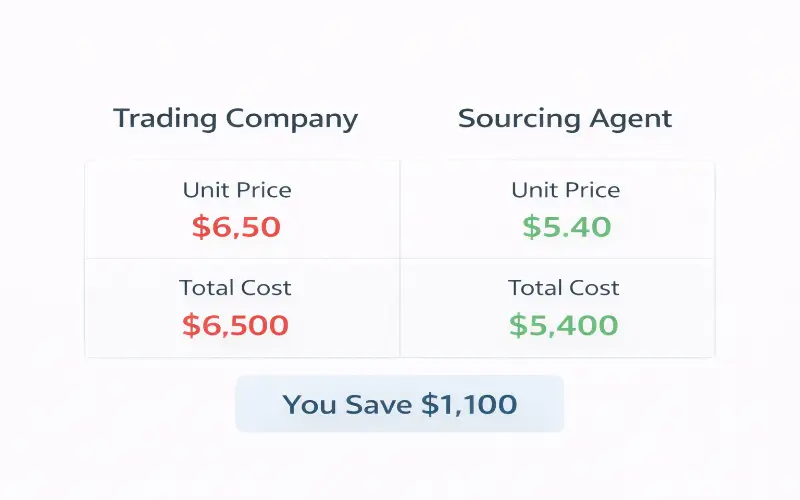
Example scenario: Ordering 1,000 units at a factory price of $5.00 per unit
Option A — Trading Company:
- Trading company adds 30% markup
- Your price per unit: $6.50
- Total order cost: $6,500
Option B — Sourcing Agent:
- You pay factory price directly
- Agent charges 8% commission
- Your price per unit: $5.40
- Total order cost: $5,400
Difference: $1,100 saved using a sourcing agent.
The gap grows with order size. On a $20,000 factory-price order, the same comparison produces a difference of over $4,000.
It is also worth noting that trading company costs are rarely limited to the product markup alone. Additional charges for packaging changes, shipment consolidation, and documentation fees are common — and are often not disclosed upfront. Fees of sourcing agents are more straightforward compared to it. These hidden costs can add a further 5 to 15% on top of the product price.
There are situations where the calculation looks different.
For very small orders, like under $500, a sourcing agent’s minimum fee may make the trading company option comparably priced.
For ready-made products with no customization required, the trading company’s convenience may justify the premium.
But for any order above $2,000 with a repeating cycle, a sourcing agent almost always delivers better total value.
Pros and Cons of Using a Sourcing Agent
✅ Advantages:
- Transparent pricing — you know exactly what the factory charges and what the agent earns
- Access to multiple factories — not limited to one supplier’s product range
- Better customization — agent works directly with the factory on your specifications
- Active quality oversight — mid-production and pre-shipment quality inspections on your behalf
- Lower long-term cost — factory pricing compounds into significant savings over time
- Your interests come first — the agent is paid to serve you, not to sell you their inventory
❌ Disadvantages:
- Service fee — adds 5–10% on top of the factory price
- More communication required — you are more involved in the process
- Quality varies by agent — finding a trustworthy agent requires due diligence
- Less suitable for very small orders — minimum fees may reduce cost advantage
Pros and Cons of Using a Trading Company
✅ Advantages:
- Simple purchasing process — one point of contact, less supplier management
- Faster turnaround for ready-made products — no factory search required
- Lower MOQ sometimes — trading companies can aggregate orders across buyers
- Handles export documentation — useful for buyers with limited logistics experience
❌ Disadvantages:
- Hidden factory — you often cannot verify where your product is made
- Higher long-term cost — markup compounds significantly over multiple orders
- Less flexibility — customization is limited to what their factories already produce
- Less control in disputes — trading company manages quality issues on its terms
- Conflict of interest — their profit comes from selling to you, not from serving you
When Should You Use a Sourcing Agent?
A sourcing agent is the better choice in most of the following situations:
You are ordering custom or private label products. Custom manufacturing requires close factory collaboration, multiple sampling rounds, and strict quality standards. A sourcing agent manages product customization directly with the factory on your behalf.
You are an Amazon FBA seller or e-commerce brand. Consistent quality, reliable lead times, and competitive pricing are critical at scale. A sourcing agent delivers all three more reliably than a trading company.
Your order value exceeds $2,000. Above this threshold, the cost savings from factory pricing almost always outweigh the agent’s fee.
You are sourcing across multiple product categories. A sourcing agent can work with different factories across categories. A trading company is limited to its own supplier network.
You have had problems with a previous supplier. Working with a China sourcing agent provides the oversight and direct factory access needed to identify and resolve problems before they repeat.
You are planning to scale. Building a direct factory relationship through a sourcing agent creates long-term supply chain stability that a trading company cannot offer.
When Should You Use a Trading Company?
A trading company makes more sense in these specific situations:
You are placing a very small test order. For orders under $500, the convenience of a trading company may outweigh the agent’s minimum fee.
You need ready-made products with no customization. If you are ordering standard off-the-shelf products exactly as manufactured, a trading company’s existing inventory can deliver faster.
You are new to importing and want a hands-off first experience. Trading companies handle most of the process for you, which can be a reasonable starting point before you build more supply chain knowledge.
Speed is the priority. Trading companies with existing stock can ship faster than going through a full sourcing process.
Can a Trading Company Also Act as a Sourcing Agent?
This is a question that comes up often, and the honest answer is:
Sometimes in practice, but not in principle.
Some trading companies do offer product sourcing services. They will help you find products outside their existing catalogue, communicate with factories on your behalf, and present themselves as a hybrid option.
The problem is structural. A trading company’s business model is built on buying low and selling high. Even when they offer sourcing services, they remain a product reseller at their core. This means their incentive is still to sell you products at the best margin for them, not necessarily to find you the best factory at the lowest price.
A genuine sourcing agent, by contrast, earns a transparent service fee and has no financial interest in which factory you use. That structural difference is what makes the two fundamentally different, regardless of what services a trading company claims to offer.
If a trading company offers to ‘source’ a product for you, always ask: what is your fee, and do you earn any margin on the product itself? The answer will tell you quickly whether you are dealing with a sourcing agent or a reseller wearing a different hat.
Common Mistakes Importers Make
Choosing only based on price. The lowest quote is not always the best deal. Always do the full cost calculation before committing.
Not verifying who you are actually dealing with. Many trading companies present themselves as factories. Before placing any order, verify the business license and production capacity. A sourcing agent does this verification on your behalf.
Skipping quality inspection. Whether you use an agent or a trading company, never skip a pre-shipment inspection. Issues discovered after delivery are your problem to absorb.
Confusing trading companies with manufacturers. A trading company that claims to have its own factory may or may not be telling the truth. Request proof. A real factory can provide a business license showing manufacturing as its registered business scope.
Staying with a trading company out of habit. Many importers start with a trading company for convenience and stay there long after the economics have shifted in favour of a sourcing agent.
Conclusion
In short, the decision between a sourcing agent vs trading company depends on your sourcing strategy, order size, and need for transparency.
Trading companies offer convenience — but you pay for it in markup, limited flexibility, and reduced visibility over your supply chain. Sourcing agents offer transparency and control, with cost savings that compound significantly over time.
For most importers placing orders above $2,000, sourcing custom or private label products, or planning to scale, working with an experienced sourcing agent such as HiSourcing can provide better long-term value. A trading company remains a reasonable option for small, one-time orders of ready-made products where speed and simplicity matter more than cost.
Frequently Asked Questions
Is a sourcing agent cheaper than a trading company?
In most cases, yes. A sourcing agent charges a commission of 5–10% on the factory price. A trading company adds a markup of 15–40% on top of the factory price. For orders above $2,000, the sourcing agent model is almost always cheaper in total cost.
Do trading companies own their own factories?
Some do, but most do not. Many trading companies source from multiple factories and present themselves as manufacturers. Always verify by requesting a business license showing manufacturing as the registered business scope.
Can I work with both a sourcing agent and a trading company?
Yes. Some importers use a trading company for small, ready-made orders and a sourcing agent for custom or high-volume products. The two are not mutually exclusive.
How do sourcing agents get paid?
Most sourcing agents charge a commission of 5–10% of the total order value. Some charge a flat fee per project. Always clarify the fee structure upfront and ask whether the agent receives any additional compensation from suppliers.
Is it safe to use a sourcing agent?
Yes, provided you choose carefully. Verify their physical presence, request client references, clarify the fee structure in writing, and start with a small test order. A reputable agent will welcome this process.
What is the difference between a sourcing agent and a manufacturer?
A manufacturer produces the goods directly. A sourcing agent helps you find and work with manufacturers. Sourcing agents do not make products — they manage the relationship between you and the factory on your behalf.


