
You find the perfect supplier on Alibaba. The price looks right. You message them, ready to order 200 units. They reply: MOQ 500 pcs.
That three-letter abbreviation stops more first-time importers in their tracks than any other term in Chinese manufacturing. And most online guides explain MOQ from the factory’s perspective. Why they set it, how they calculate it, and how it helps their inventory management.
That is not what you need to know. You need to know what MOQ means for your wallet, whether you can negotiate it, and what to do when you cannot meet it.
This guide explains MOQ from the buyer’s side. You will learn what drives a factory’s minimum, see real MOQ ranges across 10 product categories, and get 7 tested negotiation tactics that actually work with Chinese suppliers.
What Does MOQ Mean?
MOQ stands for Minimum Order Quantity. It is the smallest number of units, or the lowest dollar amount, that a supplier will accept for a single order.
If a factory’s MOQ is 500 pieces, you cannot order 200. You either buy 500 or find another supplier.
MOQ is not a negotiation tactic. It is a reflection of the factory’s production economics. Setting up a production line, preparing molds, sourcing raw materials, and running quality checks all cost money. Manufacturers need a certain volume to achieve economies of scale and keep the production line efficient. Below a certain volume, the factory loses money on your order.
MOQ in Units vs. MOQ in Dollar Amount
Most Chinese factories set MOQ as a unit count: MOQ 1,000 pcs.
But some set it as a minimum spend: MOQ $5,000 per order.
A dollar-based MOQ gives you more flexibility. If the unit price is $10, a $5,000 MOQ means 500 units. But if you choose a simpler variant at $8, the same $5,000 gets you 625 units. Unit-based MOQs are rigid. 500 means 500, regardless of price.
What Does MOQ 500 pcs Mean on Alibaba?
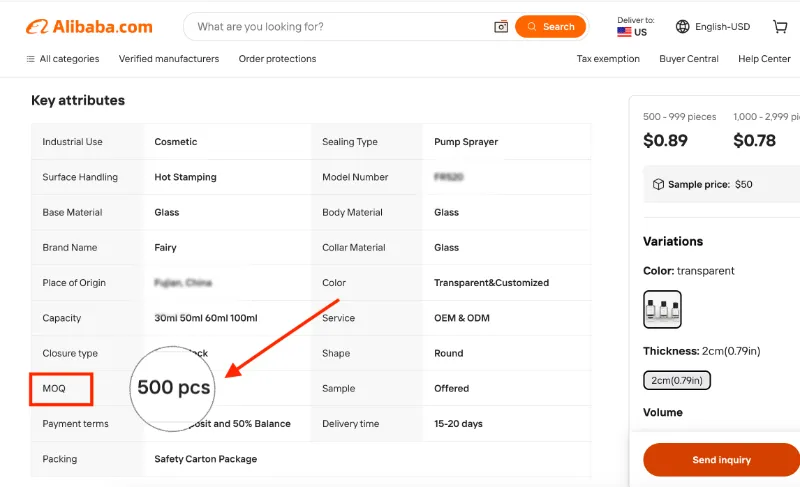
When you see “MOQ 500” on an Alibaba product listing, it means the supplier will not process an order below 500 units of that specific product.
But here is what most guides do not tell you: the MOQ listed on Alibaba is often the starting point, not the final number. Many suppliers list a higher MOQ on their public page to filter out small buyers, then negotiate lower quantities in private messages. It is always worth asking.
Why Do Chinese Factories Set MOQs?
Understanding the reason behind a factory’s MOQ helps you negotiate it. There are four main cost drivers.
Raw material minimums
Factories buy materials in bulk from their own suppliers, who also have MOQs. A fabric mill might require a minimum 500-meter roll order. If your order only needs 100 meters, the factory either buys the full roll and wastes 400 meters, or they refuse the order.
Production setup costs
Every production run requires machine setup, color matching, mold installation, and line calibration. These fixed costs are the same whether you order 100 units or 10,000. Spreading them over more units makes each unit cheaper.
Labor efficiency
Chinese factory workers are often paid per piece, and short lead times on small orders disrupt their workflow. A small order means constant switching between products, which kills efficiency. Factories prefer longer runs of the same product.
Quality consistency
The first 50–100 units in any production run often have higher defect rates as the line stabilizes. With a larger order, those startup rejects are a small percentage. With a 200-unit order, they could be 25–50% of your total.
In our experience, the single biggest factor is raw material minimums. A factory might be willing to run 300 pieces of your custom silicone phone case, but their silicone supplier requires a 500kg minimum. That material minimum becomes your effective MOQ — and it is the hardest to negotiate down.
Typical MOQ Ranges by Product Category
This is the reference table no other guide provides. These ranges are based on standard catalog products from Chinese factories. Typically, custom products with your own molds, colors, or materials will have higher MOQs.
| Product Category | Stock / Catalog MOQ | Custom Product MOQ | Key Factor |
|---|---|---|---|
| Consumer electronics (earbuds, chargers) | 50–200 pcs | 500–1,000 pcs | Certification costs (FCC, CE) |
| Silicone/plastic products | 500–1,000 pcs | 1,000–3,000 pcs | Mold setup costs |
| Stainless steel items (bottles, utensils) | 300–500 pcs | 500–2,000 pcs | Material grade minimums |
| Textiles/apparel | 100–300 pcs per color | 300–500 pcs per color | Fabric roll minimums, color matching |
| Bags and luggage | 200–500 pcs | 500–1,000 pcs | Material + hardware variety |
| Ceramic and glassware | 500–1,000 pcs | 1,000–3,000 pcs | Kiln batch size |
| Packaging (boxes, pouches, labels) | 1,000–5,000 pcs | 3,000–10,000 pcs | Printing plate setup |
| Toys and games | 500–1,000 pcs | 2,000–5,000 pcs | Safety testing costs (CPSIA, EN71) |
| Furniture and home decor | 50–100 pcs | 100–300 pcs | Large per-unit volume, shipping cost |
| Jewelry and accessories | 50–200 pcs per SKU | 200–500 pcs per SKU | Per-SKU variety, small unit size |
Why MOQ Varies So Much Between Products
The difference between a 50-piece MOQ for jewelry and a 5,000-piece MOQ for packaging comes down to one thing: how much of the production cost is fixed versus variable.
Jewelry has low fixed costs, the same tools make earrings and necklaces with minor adjustments. Custom packaging has high fixed costs, every new design needs a new printing plate, which costs $200–$800, regardless of how many boxes you print.
When a factory tells you their MOQ, ask why. If the answer is “mold cost” or “printing plate,” you can potentially pay for the tooling separately and negotiate a lower unit MOQ. If the answer is “material supplier minimum,” you have less room.
How MOQ Affects Your Unit Price
The relationship between MOQ and price is simple: the more you order, the cheaper each unit gets. This is not a sales trick. It is math. Fixed costs spread over more units make each unit cheaper.
Here is a real example. Same silicone kitchen spatula from the same Yiwu factory, different order quantities:
| Order Quantity | Unit Price | Total Cost | Setup Cost / Unit | vs. 3,000 pcs Price |
|---|---|---|---|---|
| 200 pcs (below MOQ) | $3.20 | $640 | $0.75 | +31% more expensive |
| 500 pcs (at MOQ) | $2.80 | $1,400 | $0.30 | +15% |
| 1,000 pcs | $2.55 | $2,550 | $0.15 | +4% |
| 3,000 pcs | $2.45 | $7,350 | $0.05 | Baseline |
| 5,000 pcs | $2.35 | $11,750 | $0.03 | −4% |
Notice the steepest price drop is from 200 to 500 — going from below MOQ to at MOQ. After that, each jump gives you a smaller discount. This means the biggest savings come from simply meeting the MOQ, not from ordering 10 times the MOQ.
We always tell first-time importers: do not chase the lowest unit price by ordering 5,000 pieces of an untested product. Order the MOQ, test the market, then scale. The $0.10 you save per unit is meaningless if 3,000 units sit in your warehouse for a year.
7 Ways to Negotiate Lower MOQ with Chinese Suppliers
MOQ is negotiable more often than you think. Here are seven tactics that work, ranked from easiest to most advanced.
1. Just Ask
This sounds obvious, but most buyers accept the listed MOQ without question. Send a message: “We are interested in 300 pieces. Your listing says MOQ 500. Can you accommodate a smaller first order?”
About half the time, the answer is yes. Especially if the product is a stock item that does not require custom tooling.
2. Offer to Pay a Higher Unit Price
If the factory’s concern is profitability, remove the concern. Say: “We understand 300 pieces cost more per unit. What would the price be at 300 instead of 500?”
Most factories will quote a 10–25% price increase for below-MOQ orders. Run the math. Sometimes paying $0.30 more per unit on 300 pieces is smarter than buying 500 pieces you might not sell.
3. Pay for Tooling Separately
For custom products, a big chunk of the MOQ exists because the factory spreads mold or tooling costs across units. Ask them to separate the tooling cost.
Instead of “MOQ 1,000 pcs at $4.50,” you might get “Mold fee $800 + MOQ 300 pcs at $3.80.” Your total cost is higher, but you are not stuck with 1,000 units of an unproven product.
4. Start with a Stock Product, Customize Later
Factories have much lower MOQs for existing catalog products than for fully custom items. Order the stock version first to test the market. Once you have sales data, place a larger custom order.
A factory that requires MOQ 2,000 for a custom silicone phone case might accept MOQ 200 for their standard design.
5. Commit to a Second Order
Tell the supplier: “We want to start with 300 pieces. If quality and market response are good, our second order will be 5,000 pieces.”
This works because factories value long-term relationships. They are more willing to take a small first order if they believe larger orders are coming. Be genuine — if you make the promise, follow through.
6. Consolidate Across SKUs
If the MOQ is 500 per SKU but you sell 3 variants, ask if you can split: 200 of variant A, 150 of variant B, 150 of variant C — totaling 500 pieces across all SKUs.
Many factories accept this because their total production volume stays the same. It works best when the variants use the same base materials and differ only in color, size, or print.
7. Use a Sourcing Agent
A sourcing agent based in China can often negotiate lower MOQs than you can on your own. They have existing relationships with factories, order volume across multiple clients, and knowledge of which factories are flexible.
At HiSourcing, we regularly consolidate orders from multiple buyers to meet factory MOQs that individual buyers could not reach alone.
What to Do When You Cannot Meet the MOQ
Sometimes negotiation does not work. The factory’s MOQ is firm, and you are not ready to commit to that volume. Here are your alternatives.
Buy from a trading company instead of a factory
Trading companies source from multiple factories and hold inventory. Their MOQs are typically 50–70% lower than factory-direct MOQs, though unit prices are 10–20% higher. For first orders and market testing, this trade-off is usually worth it.
Further reading:
Sourcing Agent vs Trading Company: Key Differences, Costs & Which Is Better
Shop at wholesale markets in person
In Yiwu, Guangzhou, and Shenzhen, wholesale markets sell ready-made products with MOQs as low as 1 carton (often 50–100 pieces). You pay more per unit, but you can touch and inspect the product before buying.
Use 1688.com with a buying agent
1688 is Alibaba’s domestic Chinese marketplace. Some 1688 suppliers have MOQs as low as 2–10 pieces because they sell to local Chinese businesses.
If you can’t make it to China, a China sourcing agent can help you with placing orders, consolidating samples, and handling logistics.
Order samples first
Every factory sells samples, typically 1–5 pieces at a higher per-unit price ($15–$50 depending on the product). Samples let you evaluate quality, test the market on a tiny scale, and build a relationship with the factory before committing to the MOQ.
MOQ on Alibaba and 1688: How to Read Supplier Listings
On Alibaba, the MOQ is displayed directly on the product listing page, usually next to the price tiers. Here is how to interpret what you see.
Price tiers indicate volume discounts
A listing showing
3–199 pcs: $22 | 200–499 pcs: $21 | 500+ pcs: $19
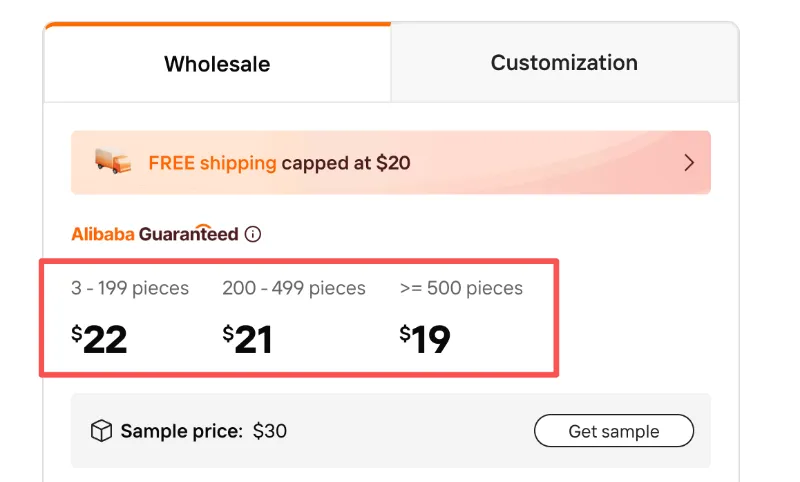
means the supplier accepts orders as low as 3 pieces, but the best price only kicks in at 500+. The listed MOQ might say “50 pcs” even though smaller quantities show a price — this means the factory prefers 50+ but may accept less at a premium.
Verified vs. unverified MOQ
Alibaba’s “Verified” badge does not verify the MOQ. The listed MOQ is self-reported by the supplier. Always confirm directly in messages before placing an order.
1688 MOQs are typically much lower
Because 1688 targets domestic Chinese buyers who order smaller quantities more frequently, you will often see MOQs of 2–50 pieces. The catch: product listings are in Chinese, payment is in RMB, and shipping to overseas addresses requires a buying agent or freight forwarder.
A common mistake we see: buyers treat the lowest Alibaba price tier as the “real” price. It is not. That is the price at maximum volume. Your actual cost depends on your actual order quantity. Always ask for a formal quotation at your specific quantity before budgeting.
Final Thoughts
MOQ is not a wall. It is a starting point for negotiation. Understanding why a factory sets their minimum — raw material constraints, setup costs, labor efficiency — gives you the leverage to negotiate it down or find creative alternatives. The most important rule: never let MOQ pressure you into ordering more than you can sell. A $0.10 per-unit discount means nothing if 2,000 unsold units sit in your warehouse for a year.
At HiSourcing, we help importers navigate MOQ negotiations with Chinese factories every day. Whether you need help finding suppliers with lower minimums, consolidating orders to meet factory MOQs, or sourcing samples before committing to a full production run, our team in Yiwu is here to help. Feel free to Contact Us for a free consultation.
Frequently Asked Questions
What does FOB and MOQ mean?
MOQ is the minimum number of units a supplier will sell in one order. FOB (Free On Board) is a pricing term that tells you the cost includes everything up to loading the goods onto a ship at the origin port. When a supplier quotes “MOQ 500 pcs, FOB Ningbo $4.50/unit,” it means you must order at least 500 pieces, and the $4.50 price includes production, packaging, inland transport, and port loading — but not ocean freight or import duties.
What does MOQ 500 mean?
It means you must purchase at least 500 units in a single order. If you need fewer, you can try negotiating a lower quantity at a higher unit price, or look for a supplier with a lower MOQ.
What is MOQ pricing?
MOQ pricing refers to the tiered pricing structure suppliers use based on order volume. The unit price typically decreases as order quantity increases. For example: 500 pcs at $2.80/unit, 1,000 pcs at $2.55/unit, 3,000 pcs at $2.45/unit. The MOQ is the minimum quantity at which the supplier will start accepting orders.
What is the difference between SKU and MOQ?
A SKU (Stock Keeping Unit) is a unique identifier for a specific product variant — for example, a red t-shirt in size M is a different SKU from a blue t-shirt in size L. MOQ is the minimum order quantity required per order or per SKU. If a factory has an MOQ of 100 per SKU, and you sell 5 SKUs, your total minimum order is 500 units.
What is considered a low MOQ?
It depends on the product category. For consumer electronics, 50–100 pieces is low. For apparel, 100–200 pieces per color is low. For packaging and printed materials, anything under 1,000 is low. In the Yiwu wholesale market, you can find products with MOQs as low as 1 carton (50–100 pieces), which is considered very low for factory-direct sourcing.
Can I order below MOQ from a Chinese factory?
Sometimes, yes. Many factories will accept below-MOQ orders at a higher unit price, especially for stock products that do not require custom tooling. For custom products with molds or printing plates, below-MOQ orders are harder to negotiate. Your best options are paying for tooling separately, starting with a stock product, or using a sourcing agent who can consolidate your order with other buyers.


