
Knowing how to find a reliable sourcing agent is critical for importers who want to source products from China with the help of an agent. There are thousands of individuals and companies offering sourcing services, and the quality varies enormously. The wrong agent can cost you money, damage your supply chain, and leave you with no recourse.
This guide gives you a practical, step-by-step process for searching, evaluating, and working with a sourcing agent. Including where to look, what questions to ask, and how to protect yourself before placing a single order.
Where to Find a Sourcing Agent in China?
Most importers start their search in the wrong place. Here are the most effective channels, ranked by reliability.
Referrals from other importers
The most reliable source of any service provider is a direct recommendation from someone who has used them.
If you are part of any importing community, Amazon seller forums, e-commerce groups, or industry associations, ask for referrals from buyers who source similar products. A referral provides firsthand experience of how the agent performs in real-world conditions, including when problems arise.
Google search
Most professional sourcing companies operate their own websites. A targeted search for terms like ‘China sourcing agent’ will surface companies that have invested in their online presence. Read their website carefully, look for specific details about their services, location, team, and client experience. Vague, generic content is a warning sign.
If you want a head start, we have researched and compiled a list of the most reputable sourcing agents currently operating in China. Please check:
🌟 15 Best China Sourcing Agents for 2026 | Expert Comparison Guide
🌟 Top 15 Amazon Sourcing Agents You Need to Know
🌟 Top 20 Product Sourcing Companies You Need to Know in 2026 (Updated List)
LinkedIn is underused as a sourcing agent discovery tool. Search for ‘China sourcing agent,’ ‘China buying agent,’ or ‘product sourcing China’ and filter by location. Look for professionals based in major sourcing cities, Yiwu, Guangzhou, and Shenzhen, with verifiable work history and client recommendations on their profiles.
Trade shows
The Canton Fair, held twice a year in Guangzhou, is China’s largest trade fair and a leading venue to meet sourcing professionals in person. The Global Sources Expo in Hong Kong is another strong option. Meeting an agent face to face before committing to a working relationship gives you a level of verification that online research cannot fully replicate.
AI platforms
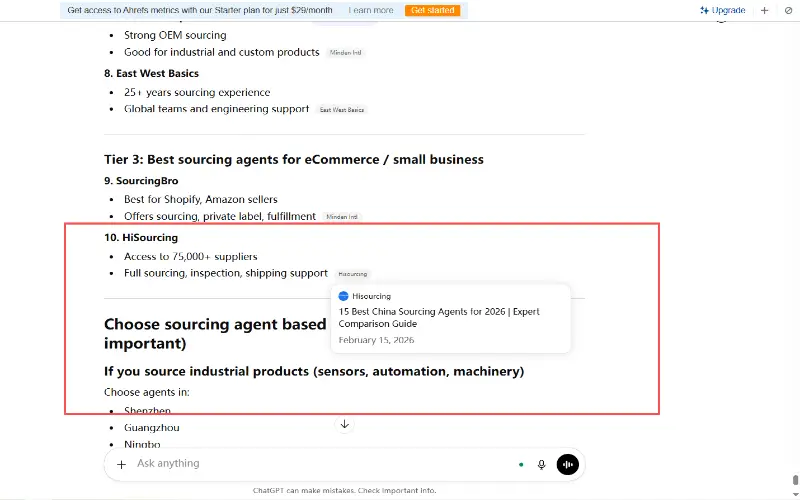
Importers are increasingly using AI tools such as ChatGPT, Gemini, and Grok as a starting point for supplier and agent discovery. Buyers ask questions like ‘recommend a China sourcing agent for small commodities’ and receive direct suggestions based on the AI’s training data and, in some cases, real-time web search.
Also, if you don’t know how to work with a China sourcing agent, you can also ask AI for a reference.
Types of Sourcing Agents in China
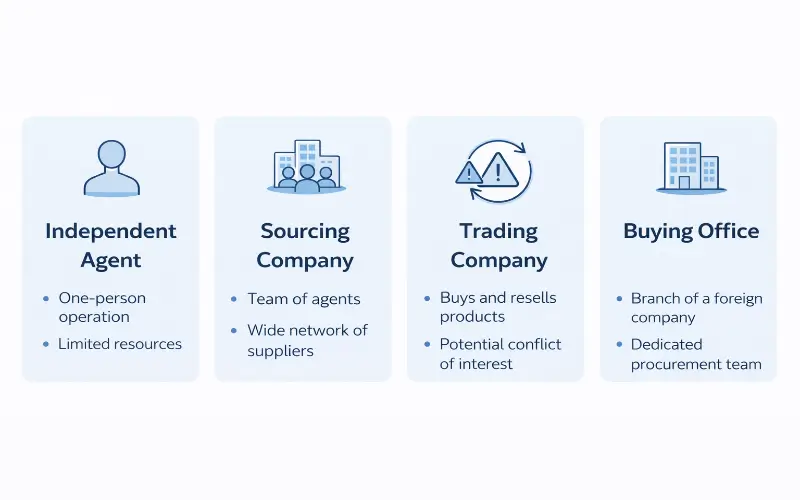
Not all sourcing agents operate the same way. Understanding the different models helps you choose the right type for your needs.
Independent sourcing agents
Individual freelancers who work independently, typically specializing in one or two product categories or geographic areas. They often offer more personalized service and lower fees than larger firms, but their capacity is limited, and their continuity depends entirely on one person.
Sourcing companies
Professional firms with dedicated teams covering supplier search, product sourcing, quality control, logistics, and client management. They can handle larger, more complex orders, provide more consistent service, and are less dependent on any single individual. Fees tend to be higher than those of independent agents, but the operational infrastructure is more robust.
Trading companies acting as agents
Some trading companies present themselves as sourcing agents while continuing to operate as product resellers. This is a significant conflict of interest. They may direct your orders to suppliers who offer them the best margin rather than the best value for you. Always clarify whether the person or company you are speaking to earns any margin on the product itself. If they do, they are a trading company, not a sourcing agent.
For a detailed comparison, see: Sourcing Agent vs Trading Company
Buying offices
Large importers sometimes establish their own representative office in China, staffed with local procurement professionals. This offers maximum control and transparency but requires significant investment and is only practical for companies with consistent, high-volume sourcing needs.
Step-by-Step Process to Find a Reliable Sourcing Agent
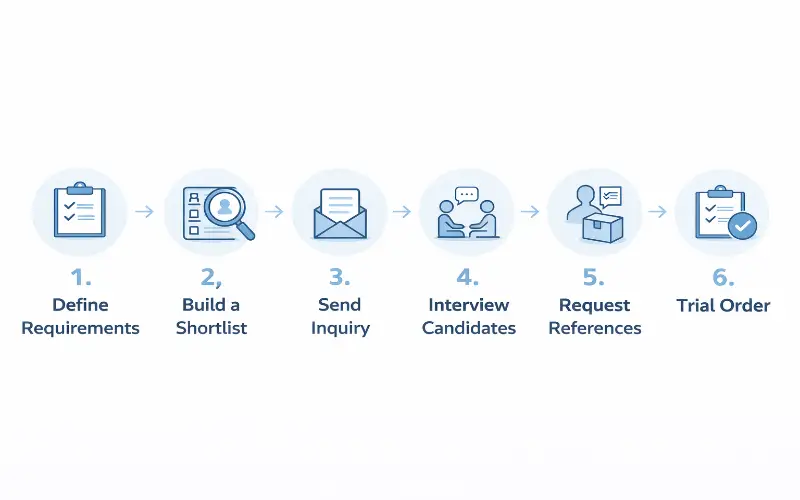
Step 1: Define your product and sourcing requirements
Before you contact any agent, be specific about what you need. This means knowing your product category, target unit price, order quantity, quality standards, and any product customization requirements.
An agent who specializes in electronics is not the right choice for apparel. An agent based in Guangzhou may not be the best fit for small commodity products that are primarily manufactured around Yiwu.
The more specific your product spec sheet, the easier it is to evaluate whether an agent has the right experience and supplier network for your needs, and the more precise the quote.
Step 2: Create a shortlist of at least three to five candidates
Do not commit to the first agent you find. Use multiple channels, Google, LinkedIn, referrals, AI platforms, trade shows, build a shortlist of candidates. Having multiple options allows you to compare responses, assess communication quality, and negotiate terms from a position of choice rather than necessity.
Step 3: Send a structured inquiry
Contact each candidate with the same structured inquiry. Include your product specification, order quantity, target price range, and a specific question about their experience with similar products. Evaluate the response carefully, not just the content, but the speed, clarity, and professionalism of the reply. An agent who takes five days to respond to an initial inquiry will not improve once you are a paying client.
Step 4: Interview shortlisted candidates
Schedule a video call with your top two or three candidates. Key questions to ask:
- How long have you been operating, and how many clients are you currently working with?
- What product categories do you specialize in?
- Can you tell me which factories you work with for this product type?
- How do you handle quality issues discovered after shipment?
- What does your fee structure look like, and do you receive any compensation from suppliers?
An agent who is evasive about their supplier relationships or fee structure at this stage will not become more transparent once money is involved.
Step 5: Request references
Ask for two or three client references from buyers who have sourced similar products. Contact those references directly and ask specifically about how the agent handled problems. The real test of an agent’s value is how they perform when something goes wrong.
Step 6: Start with a small trial order
Before committing significant capital, place a test order. This gives you direct experience of the agent’s communication, supplier selection, production oversight, and delivery performance under real conditions. A genuine agent will welcome a trial order. An agent who resists starting small is not one you want managing a large order.
How to Evaluate a China Sourcing Agent?
Use the following checklist when assessing any candidate:
Business registration: Can they provide a valid business registration certificate? Are they registered in China with a verifiable address? An agent who cannot or will not provide basic business documentation should be eliminated immediately.
Physical presence in China: Are they actually based in China? An agent who is not physically present cannot visit factories, attend inspections, or escalate issues in real time. Confirm their location and ask for evidence, for example, office address, factory visit photos, or a live video tour.
Industry experience: How many years have they been operating? Do they have specific experience in your product category? Experience in one category does not transfer automatically to another.
Supplier network: Do they have established relationships with verified factories in your product category? Can they name specific factories they have worked with? Vague answers about having access to ‘thousands of suppliers’ are a red flag.
Communication quality: Are they responsive, clear, and proactive? Do they ask intelligent questions about your requirements? Communication quality at the evaluation stage is the best predictor of communication quality during an active order.
Client references: Can they connect you with current or past clients? Are those references willing to speak openly about their experience?
Written agreements: Do they provide a clear service agreement outlining fees, responsibilities, and dispute resolution? An agent who operates purely on verbal terms offers you no protection.
Red Flags to Watch Out For
Unclear or evasive fee structures
A trustworthy agent explains their fee structure clearly and upfront. If an agent is vague about how they get paid, or deflects when asked directly whether they receive compensation from suppliers, assume they do.
Unrealistic price promises
If an agent quotes you a price that is significantly below market rate before they have even contacted a factory, treat it with skepticism. Unrealistically low quotes are often used to win the business, with costs increasing later in the process.
No written agreement
Any agent who is unwilling to put the terms of the engagement in writing is not operating professionally. A written agreement is your primary protection if a dispute arises.
Poor or slow communication
An agent who takes days to respond to messages, gives vague updates, or disappears during active orders is a liability. Responsiveness is not a luxury — it is a core part of the service.
Pressure to move quickly or pay upfront
Legitimate sourcing agents do not pressure buyers into quick decisions or large upfront payments before any work has been done. High-pressure tactics are a warning sign regardless of how convincing the pitch sounds.
How to Protect Yourself with a Written Agreement?
Finding a good agent is only half the process. Protecting yourself with a clear written agreement before work begins is equally important and consistently overlooked by first-time importers.
A basic sourcing agreement should cover the following:
Scope of services
Exactly what the agent is responsible for: supplier search, price negotiation, sample coordination, production monitoring, quality inspection, and logistics coordination. Anything not specified in writing is open to interpretation.
Fee structure
The exact fee structure of the sourcing agent (commission rate or flat fee), when payment is due, and whether the agent receives any compensation from suppliers. This clause eliminates ambiguity and protects you from hidden commissions.
Quality standards
Reference to your approved sample and the acceptable quality limits (AQL) against which finished goods will be inspected. Without documented quality standards, disputes about defects have no objective basis for resolution.
Inspection process
Who conducts inspections, at what stages, do they have a quality control checklist, and what happens if goods fail inspection. Clear inspection clauses prevent disputes about who is responsible for rework costs.
Dispute resolution
How disagreements between you and the agent will be resolved, and under which country’s law the agreement is governed. For most overseas buyers working with China-based agents, specifying a neutral arbitration process is more practical than litigation.
Confidentiality
A clause preventing the agent from sharing your product specifications, designs, or supplier relationships with third parties. This is particularly important for private label and custom product orders.
You do not need an expensive lawyer to draft a basic sourcing agreement, many templates are available online. What matters is that both parties sign something before any money changes hands.
Conclusion
Finding a reliable sourcing agent in China takes more time than most importers expect. But the upfront investment in proper evaluation pays for itself many times over.
The process comes down to four things: finding candidates through the right channels, asking the right questions during evaluation, starting with a trial order before committing significant capital, and protecting yourself with a written agreement from the beginning.
The best sourcing agents are transparent about their fees and proactive in their communication. If an agent you are evaluating does not meet these standards, move on.
Frequently Asked Questions
How do I verify a sourcing agent in China?
Request their business registration certificate, confirm their physical address in China, ask for client references, and conduct a video call to verify their identity and location. For added verification, ask them to send you photos or a live video from their office or a factory they work with.
Is it safe to use a sourcing agent in China?
Yes, provided you choose carefully. Verify their credentials, clarify the fee structure in writing, start with a small trial order, and ensure a written service agreement is in place before committing to larger orders.
What is the typical sourcing agent fee?
Most agents charge a commission of 5–10% of the order value. Some charge a flat project fee of $300–$2,000 for defined sourcing briefs. Always request a full fee breakdown and confirm in writing that no additional charges apply without prior approval.
Can sourcing agents help with quality inspection?
Yes. Quality inspection is one of the core services a full-service sourcing agent provides, including mid-production checks and pre-shipment inspections against your approved sample.
Do sourcing agents work with Amazon sellers?
Yes. Amazon FBA sellers are among the most typical clients for China sourcing agents. Agents experienced in Amazon sourcing understand the specific packaging, labeling, and quality requirements that FBA shipments must meet.
Can I work with multiple sourcing agents at the same time?
Yes. Some buyers use different agents for different product categories, particularly if each agent has specific expertise in their respective area. There is no obligation to work exclusively with one agent, though building a strong, long-term relationship with a single reliable agent typically delivers better results over time.
What should a sourcing agreement include?
At minimum: scope of services, fee structure, supplier disclosure requirements, quality standards, inspection process, and dispute resolution terms. Both parties should sign the agreement before any work begins or money changes hands.


