
Learning how to work with a sourcing agent effectively is the difference between a smooth importing experience and a costly, frustrating one. Finding the right agent is only the first step. How you communicate your requirements, manage the production process, and maintain the relationship determines whether you consistently receive the products you want at the agreed price.
This guide walks you through the complete process, from first contact to final delivery, with practical frameworks you can use from your first order. Whether you are new to working with an agent in China or looking to improve an existing arrangement, the steps below apply.
How to Work with a Sourcing Agent?
Step 1: Prepare Before You Contact an Agent
Write a Clear Product Brief

The single biggest reason sourcing engagements go wrong is vague requirements. A China sourcing agent can only find what you clearly describe. Before reaching out, prepare a product spec sheet that covers:
| Required Information | Notes |
|---|---|
| Product name and category | Be specific – ‘travel backpack 30L nylon’, not ‘bag’ |
| Target dimensions and weight | Include tolerances where relevant |
| Materials and finish | Specify grade if critical (e.g., 304 stainless steel) |
| Colour options | Use Pantone codes where possible |
| Required certifications | CE / FCC / FDA / REACH – depends on destination market |
| Target unit price | Make it clear, EXW, FOB, CIF, or… |
| MOQ (Minimum order quantity) | State your ideal QTY and your maximum acceptable MOQ |
| Required lead time | Weeks from order confirmation to delivery ready |
| Reference product or sample | Link to Alibaba, Amazon, or attach photos |
| Destination market | US / EU / AU – affects labelling and compliance requirements |
The more complete your brief, the more accurate the quotes you receive. Also, less time is wasted on back-and-forth clarification in the early stages.
If you have special packaging requirements, like component assembly or designated shipping marks on cartons, remember to let the agent know in advance.
If you are an Amazon seller needing kitting and assembly services, you should share your sourcing plan with your Amazon FBA sourcing agent as descriptively as possible.
Know Your Numbers Before the Conversation
Before your first call or message with a sourcing agent, be clear on three numbers:
- Your target unit price
- Your maximum acceptable MOQ
- Your hard deadline
These three constraints define the scope of what your agent is working with. If you do not have clear numbers, you will get vague quotes in return.
Step 2: Brief Your China Sourcing Agent
How to Share Requirements Clearly
Use a combination of written description, reference images, and sample links. Text alone is rarely sufficient for product specifications.
Chinese factories work with visual references as a matter of course. A photo of a comparable product on Amazon or Alibaba, combined with your brief, gives your agent the full picture.
Define what is non-negotiable versus what is flexible. Telling your agent which requirements are absolute and which are open to alternatives saves considerable time in supplier matching.
Which Communication Channel to Use
| Channel | Best Used For | Notes |
|---|---|---|
| Formal instructions, contracts, briefs, order confirmations | Always document key decisions by email, even if discussed verbally | |
| Quick questions, photo sharing, urgent follow-ups | Preferred by most China-based agents for day-to-day communication | |
| Direct factory communication, if the agent facilitates this | Less common for initial contact unless the agent specifically requests it |
China Standard Time (CST) is UTC+8. A message sent at 9am in New York arrives at 10pm in China. Set realistic expectations for response times. Same-day replies across time zones are the exception, not the rule.
What a Professional Agent Will Ask You in Return
A good sourcing agent will not simply say ‘yes’ to everything and proceed. Expect them to ask questions about your target market, your current supplier situation, your quality tolerance, and your timeline flexibility.
An agent who asks nothing is either too inexperienced to know what to ask or too uninterested to do thorough work.
Step 3: Reviewing Quotes and Selecting a Supplier
How to Read a Quote from China
Always confirm whether a quote is EXW (ex-works, from the factory door) or FOB (freight on board, loaded onto the vessel at the origin port). These two prices can differ by 5–15% depending on the product and the location of the factory. Ask your agent to standardise all quotes to one Incoterms for accurate comparison.
Understanding how your agent charges, whether through a commission, a flat fee, or a markup model, also helps you interpret quotes more accurately, since the agent’s margin may or may not be visible in the figure you receive.
Watch for missing cost items. Packaging, inner carton, export carton, and palletisation are sometimes excluded from the unit price and added later. Ask explicitly whether the quoted price includes all packaging for your shipment-ready specification.
Five Questions to Ask When You Receive a Quote
- Does this price include packaging to an export-ready standard?
- What is the sample cost and lead time, and is it refundable on bulk order?
- What is the production lead time after order confirmation?
- What payment terms does the factory require?
- Can MOQ be reduced for a first order, and at what price adjustment?
Your agent’s job is not just to pass quotes along. They should be cross-checking supplier credentials, visiting the factory if warranted, and flagging any concerns before you commit to a sample order.
Step 4: Ordering and Approving Samples
The sample stage is the first genuine test of both the supplier and your sourcing agent. Never skip it, regardless of time pressure or how compelling the price looks.
The Golden Sample Concept
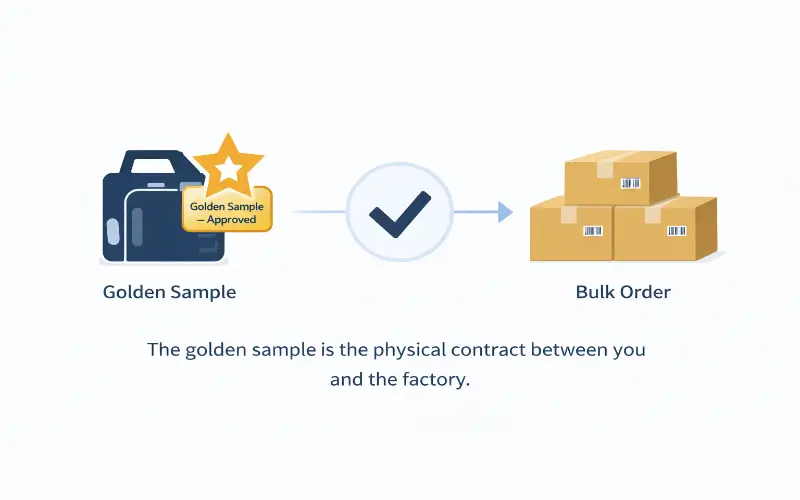
A golden sample is a fully approved, signed-off sample that becomes the physical reference standard for bulk production. Once approved, photograph it thoroughly from every angle and dimension, and instruct your agent to have the factory retain an identical copy. Any deviation from the golden sample in bulk production is a documented contractual failure, not a matter of opinion.
When the Sample Falls Short
If the first sample does not meet your requirements, document every deviation clearly with photographs and written notes, and communicate this to your agent in writing. A competent agent will relay your feedback to the factory with precision and manage the revision process. Vague feedback like ‘the quality isn’t right’ produces vague revisions. Specific feedback produces specific corrections.
Step 5: Managing Production
Set Production Milestones, Not Just a Final Deadline
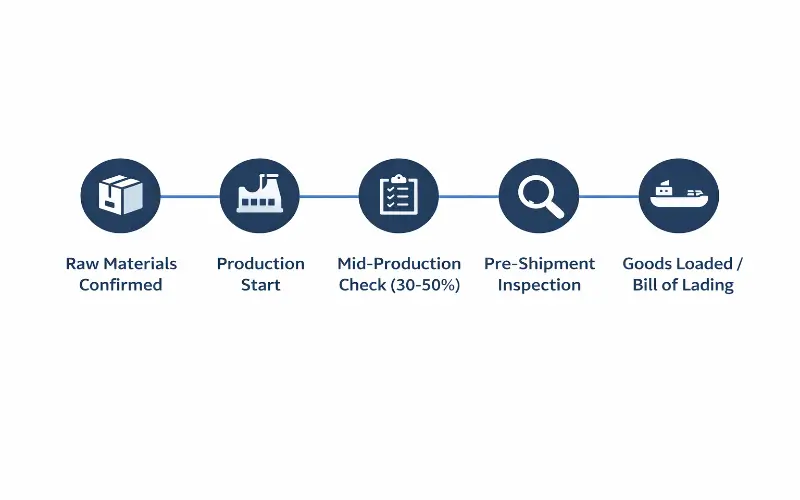
A single delivery deadline gives you no visibility into problems until it is too late to fix them. Instead, agree on milestone checkpoints with your sourcing agent at the following stages:
- Raw materials confirmed and in stock
- Production start confirmed
- 30–50% of production complete – request photo update
- Production complete – pre-shipment inspection scheduled
- Goods loaded and Bill of Lading issued
Ask your agent to send a brief update at each milestone. This does not need to be a formal report. A short WhatsApp message with one or two photos is sufficient. The goal is to ensure problems surface during production, when they are fixable, rather than at the port.
How to Handle Problems During Production
Production problems are not a sign of a bad agent. They are a normal feature of manufacturing.
What distinguishes a good agent is how quickly they identify and communicate issues, and whether they propose solutions rather than just relaying bad news.
If your agent reports a problem, your first response should always be to ask:
- What are the options?
- Can the affected units be reworked?
- Can the timeline be compressed elsewhere to compensate?
- Is this a quality issue that affects the entire batch or only a portion?
Getting clear answers before reacting prevents overcorrection and maintains the working relationship.
Quality Inspection Before Shipment
Pre-shipment inspection is your last practical opportunity to catch quality issues before goods leave China. For most orders, this means a third-party inspection at the factory after production is complete but before the goods are loaded.
Instruct your sourcing agent to facilitate the inspection. Either arrange it themselves or allow access for a third-party inspector you appoint. The inspection report should be based on a detailed QC checklist, cover AQL sampling results, packaging compliance, labelling, and any visible defects. Do not release the final payment until you have reviewed and accepted the inspection report.
Step 6: Shipping and Final Delivery
A China sourcing agent typically handles the supply side of the transaction – supplier management, production, and pre-shipment. Best China sourcing agents like HiSourcing also take care of freight coordination and customs clearance. If you have a trusted freight forwarder, you can appoint it to handle the rest as well.
Confirm this division of responsibility clearly at the start of your engagement. Assumptions about who is handling what at the shipping stage are a common source of last-minute confusion.
Once goods arrive, conduct a receiving check against your golden sample and purchase order. Document any discrepancies immediately, before the goods leave your receiving dock. This preserves your ability to make a warranty claim if needed.
Common Mistakes When Working with a China Sourcing Agent
Sending an incomplete brief.
Vague requirements produce vague quotes and mismatched samples. Invest time in the brief before the conversation starts.
Going silent after placing the order.
Production requires active oversight. Disappearing after order confirmation and reappearing at the shipping stage is a reliable way to receive disappointing goods.
Skipping samples under time pressure.
The cost of a sample is a fraction of the cost of a failed bulk order. There is no scenario where skipping samples is the right decision.
Poor sourcing agent communication discipline.
Confirming instructions across WhatsApp, email, and phone with no consolidated record makes disputes impossible to resolve. Always confirm key decisions in writing. This applies whether you are learning how to use a China sourcing agent for the first time or have placed dozens of orders.
Treating the agent as a search engine rather than a partner.
Asking your agent to find fifty suppliers with no context, then disappearing, is not a productive working model. The more context you give, the better the output.
Building a Long-Term Relationship with Your Sourcing Agent
The economics of sourcing improve significantly over time. An agent who knows your business, your quality standards, and your product categories becomes progressively more valuable with each order. They anticipate issues you have not thought to ask about, leverage existing supplier relationships on your behalf, and become a genuine asset rather than a transaction service.
To build this relationship effectively, pay on time and without friction, provide clear and constructive feedback on every order, share your upcoming product roadmap where possible so your agent can plan ahead, and treat quality failures as problems to solve together rather than reasons for blame. Agents who feel like genuine partners — rather than vendors being squeezed on price — consistently deliver better results.
Also, if you have not yet selected an agent, the process of finding a reliable China sourcing agent is a separate but equally important step.
Final Thoughts
Working effectively with a China sourcing agent is a skill that improves with each order. The most common difficulties, like miscommunication, quality surprises, and timeline slippage, are almost always preventable with clear upfront briefing, structured milestones, and active oversight at the right stages.
The agents who consistently deliver results are the ones whose clients communicate clearly, pay fairly, and treat the relationship as a long-term partnership. The approach you bring to the collaboration shapes the results you get back.
Frequently Asked Questions
How do I brief a China sourcing agent for the first time?
Prepare a written product brief covering your product specification, target price, MOQ, timeline, and destination market before your first contact. Include reference images or product links. The more detail you provide upfront, the more accurate and useful the initial response will be.
What should I expect from a sourcing agent during production?
Expect regular milestone updates, proactive communication if problems arise, facilitation of the pre-shipment inspection, and coordination of the shipping documentation. You should not need to chase your agent for basic updates — if you do, it is a sign of either a capacity problem or a prioritisation issue on their end.
How often should I communicate with my China sourcing agent?
During the active production phase, a brief update every one to two weeks is reasonable for most orders. At key milestones — order confirmation, production start, mid-production, and pre-shipment — communication should be more frequent. Outside of active orders, a monthly check-in maintains the relationship without unnecessary overhead.
Can a sourcing agent work on multiple products at the same time?
Yes, and this is often an advantage. A sourcing agent with an established supplier network can run parallel sourcing enquiries across product categories simultaneously. Be clear about which products are a priority and share your full product roadmap where possible — it helps your agent manage their workload and factory relationships more effectively.
How to use a China sourcing agent effectively?
Knowing how to use a China sourcing agent effectively means providing a complete product brief before work begins, staying engaged at key production milestones, and treating the relationship as an ongoing partnership rather than a single transaction. If you are consistently getting accurate quotes, timely updates, and products that match your approved sample, the working model is functioning well.
What if my sourcing agent stops responding?
Unresponsiveness after order placement is a serious red flag. Send a formal written communication by email (not only WhatsApp) documenting your attempts to make contact and the information you require. If you cannot reach your agent within 48–72 hours during active production, escalate immediately. Do not wait. If the issue persists, consult your service agreement regarding next steps.


