
Yiwu Market, officially the China Yiwu International Trade Market, is the world’s largest small commodities wholesale market. It spans over 8 million square meters across five main districts plus one global digital trade center, with more than 80,000 shops and booths selling everything from Christmas ornaments to stainless steel kitchenware according to Chinagoods.com, the Yiwu market official website.
Foreign buyers can purchase directly from Yiwu in two ways: visiting in person, or buying remotely through its official platform or a local sourcing agent. In this guide, we’ll walk you through what is Yiwu market, how it organized, and how to buy from Yiwu Market online and offline. Without further ado, let’s dive in.
What is Yiwu Market?
Yiwu International Trade Market is a permanent physical wholesale market in Yiwu City, Zhejiang Province, China. It operates year-round, Monday through Saturday (except to the 15-day CNY holiday), and attracts over 500,000 overseas buyers annually from more than 210 countries, according to the Yiwu municipal government.

Unlike the perception of most importers, it is not a manufacturing hub. Booth operators in Yiwu are mostly wholesalers who source from nearby factories and resell. That means you are buying from an intermediary rather than directly from the production line. The trade-off is lower MOQs and the ability to source across dozens of product categories in a single shipment.
Yiwu is primarily suited for:
- Small and medium importers looking for mixed product orders
- Retail store owners sourcing new products for resale
- E-commerce sellers building products to import from China for release and FBA catalogs
- Buyers who want to place orders across multiple categories in one location
It is less suited for buyers who need large-scale manufacturing, custom OEM production, or highly technical products. For those needs, manufacturing hubs in Guangdong or Jiangsu province are more appropriate.
How is Yiwu Market Organized?
Since Yiwu market has 5 districts and spans over 8 million square meters, it takes you 1 year to walk if you visit every booth for 5 mins one by one. So, understanding the district layout helps you plan your route ahead and avoid wasting time walking the wrong halls.
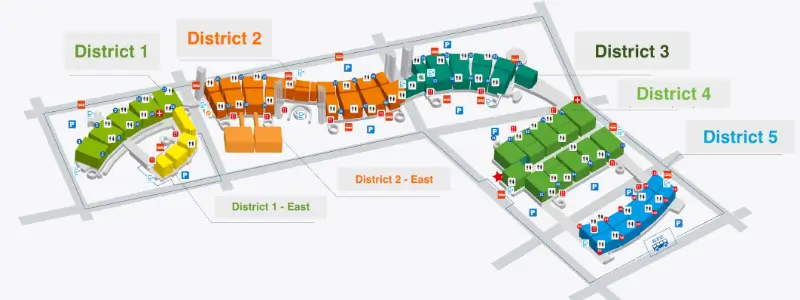
Check the Yiwu market district overview below.
Yiwu Market District Overview
| District | Main categories (examples) |
| District 1 | Fashion accessories, jewelry, toys, holiday & party items, crafts, cosmetics, hair accessories. |
| District 2 | Hardware, tools, electrical products, small appliances, locks, kitchenware, lighting. |
| District 3 | Stationery, office supplies, sports goods, glasses & eyewear, cultural and educational products. |
| District 4 | Socks, underwear, leggings, scarves, home textiles, towels, bedding. |
| District 5 | Imported food and beverages, imported daily necessities, specialty products, some pet supplies. |
Understanding this structure before you visit, or before you brief a local agent. It saves significant time. Buyers who arrive without a plan often spend days covering ground they could have covered in hours.
How to Buy from Yiwu Market?
To buy from Yiwu market, you can either visit Yiwu and make an order with booth owners there, or buy the wanted product in official online platform of the Yiwu International Trade Market. Also, hiring a local Yiwu sourcing agent to work for you is a good choice sometimes.
Option 1: Visit Yiwu Market in Person
Visiting Yiwu directly gives you the ability to inspect products hands-on, negotiate face-to-face, and compare quality across multiple booths on the same day.
Before your trip:
Foreign nationals require a valid Chinese visa if they want to visit and source products from China. Most buyers use a standard business visa (M visa). Visa requirements vary by nationality. Remember to confirm with your nearest Chinese embassy before booking travel.
Prepare a clear product list organized by district. Without a plan, the scale of the market becomes a liability rather than an advantage. Set up WeChat before you arrive, which is the primary channel for follow-up orders and supplier contact, not email or WhatsApp (most booth owners don’t know how to use it). Bring business cards; booth operators take them seriously, and they signal you are a legitimate buyer.
At the booths:
Most booth operators are wholesalers, not manufacturers. Prices shown are rarely final. Bargain for the BEST price as hard as you can. Though most of the time, your leverage depends on order volume. But at times, if they have inventory or retail-ready products that are exactly what you want, the final price may be lower than your expectation.
Unlike factories, which prefer big and fewer-item orders, minimum order quantities for booth operators/wholesalers are generally lower than factory-direct MOQs. Try starting with one carton or a few dozen units per style.
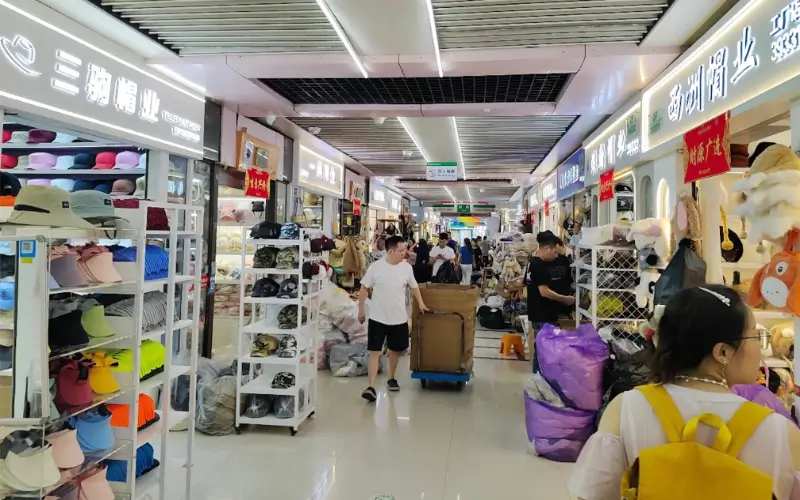
Most booth staff speak limited English (even the operator of Yiwu Market regularly organizes English training for them since 2024). A translation app covers basic communication, but for complex product specifications or serious negotiations, a local interpreter may be worth the cost.
Confirming your order:
Before leaving a booth, confirm product specifications, unit price, total quantity, packaging requirements, and delivery timeline in writing. Verbal agreements and WeChat messages are not sufficient. Discrepancies between what was agreed verbally and what ships later are one of the most common problems first-time Yiwu buyers face.
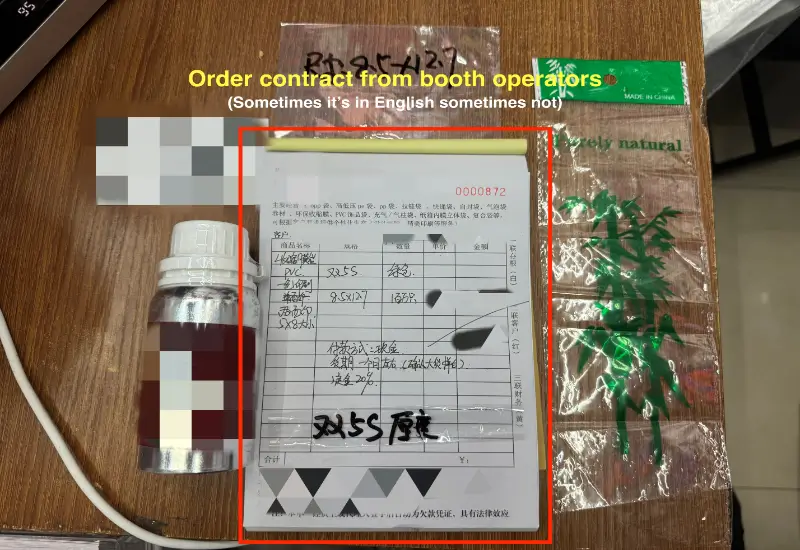
And ask for the official contract/invoice. Because booth operators tend to write all product details on a random ‘paper’, which differs from booth to booth. If issues are found after production, it’s hard to protect your own rights.
Option 2: Buy online via Yiwugo
For buyers who cannot travel, Yiwugo.com is the official online platform of Yiwu International Trade Market. It lists verified booths from across all five districts and allows remote inquiry, negotiation, and order placement.
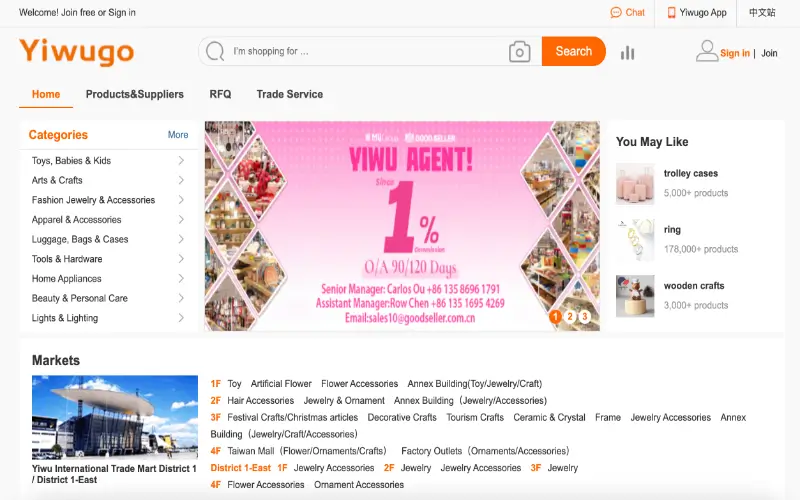
Yiwugo accepts multiple payment methods, including credit card, T/T bank transfer, PayPal, and Alipay — making it accessible to international buyers without requiring a Chinese bank account.
The practical limitation of Yiwugo is that you cannot physically inspect goods before committing. You are relying on photos, product descriptions, and the booth’s rating history. For buyers who have already established a relationship with a specific booth through a prior visit, Yiwugo works well for repeat orders. For first-time buyers in a new category, the inability to inspect samples is a meaningful risk.
Option 3: Work with a Yiwu Sourcing Agent
Find a China sourcing agent based in Yiwu to work with combines the benefits of both approaches.
Don’t need to visit Yiwu, book the hotel, consider where to eat, or worry about the language barrier, the agent is born to be your worry eliminator. It can physically be there, help you hunt for wanted products, bargain for the best price, and handle follow-up errands such as sample checking, quality inspection, logistics, and more. All you need to focus on is selling.
Minimum Orders: What to Expect
One advantage of Yiwu over pure factory clusters is that many booths accept relatively low MOQs per style compared with direct factory orders. For common items, suppliers may agree to one carton per color or design, which allows you to mix many SKUs into a single consolidated shipment.
In practice, you can technically place orders of less than 1,000 USD in total value, but international freight, customs clearance, and domestic handling fees will quickly erode margins at that scale. For most overseas buyers, a more realistic starting budget for a first Yiwu shipment is around 1,000–5,000 USD, which spreads fixed logistics costs across more units.
As a general benchmark:
- Under $1,000 USD — possible, but shipping costs frequently make these orders uneconomical. A $600 order that costs $300 to ship looks very different once the landed cost is calculated.
- $1,000–$5,000 USD — the practical entry point for most first-time importers. Sufficient to justify sea freight and test multiple product lines.
- Above $5,000 USD — sufficient to negotiate better pricing and priority handling at most booths.
Many booths charge for samples (usually one to three times the unit price), especially if they think you are not a true buyer, but will offset the sample cost against your subsequent bulk order once you confirm the purchase.
Always clarify whether sample fees, courier costs, and any tooling charges will be deducted from future invoices, and make sure this is written into your order documents.
Yiwu vs Guangzhou: Which Is Right for You?
| Dimension | Yiwu | Guangzhou |
|---|---|---|
| Main categories | Small commodities, accessories, toys, homeware, stationery, low‑to‑mid price consumer goods. | Fashion and garments, leather goods, shoes, electronics, furniture and higher‑value items in specialized clusters. |
| Typical MOQ | Generally lower; many booths accept carton‑level MOQs and allow mixed SKUs in one shipment. | Often higher, especially for branded or fashion items, with factory‑style MOQs for each design or size run. |
| Price level | Competitive for mass‑market, small commodities with strong price sensitivity. | Competitive for higher‑value categories and specialized products, often with more emphasis on branding or fashion cycles. |
| Best for | Mixed categories, variety sourcing, testing multiple products in small batches. | Deep sourcing in a single category (e.g., clothing or electronics) with higher volume per SKU. |
| Representative markets | Yiwu International Trade City (Futian). | BaiMa clothing market, Shahe garment markets, Panyu and other specialized wholesale clusters. |
If your business relies on many different small products, something like gift shops, online marketplaces, variety stores, or general merchandise, Yiwu is usually the more efficient base.
If you need deep specialization and higher perceived quality in one category, such as apparel, leather, or furniture, Guangzhou’s niche markets like Guangzhou electronic markets and factory networks may be a better fit.
Shipping from Yiwu: Key Considerations
Yiwu is inland and does not have its own international seaport, so export shipments are normally trucked to coastal ports such as Ningbo, Shanghai, Zhangjiagang before loading onto vessels. Many local logistics providers operate daily consolidation trucks from Yiwu warehouses to these ports for both LCL (less than container load) and FCL (full container load) shipments.
Because most buyers source from multiple booths and even different districts, freight forwarders or sourcing agents usually consolidate all purchased goods into a central warehouse in Yiwu. There, they perform counting, basic quality checks, and labeling (including shipping marks for cartons) before building one export shipment under a single bill of lading.
When deciding between LCL and FCL, consider not only total cubic meters but also damage risk, per‑unit freight cost, and customs handling at destination. FCL is typically more cost‑effective and secure once your total volume approaches a 20‑foot container, while LCL works better for first‑time orders, smaller volumes or multi‑category tests.
Typical sea‑freight transit times from East China ports
You should also clarify with suppliers which Incoterms will be used. Many Yiwu quotes are on EXW or FOB prices, and align them with your own shipping strategy.
Common Mistakes First-Time Yiwu Buyers Make
New buyers often focus on unit price first and only check product quality later, which can lead to shipments that technically match price expectations but fail in performance or finish. A safer sequence is to confirm samples and quality benchmarks before pushing for the lowest possible price.
Another frequent mistake is underestimating total landed cost by ignoring inland trucking, export documentation, shipping solutions like sea freight, insurance, import duties, and local delivery charges. The true decision point is your all‑in landed cost per unit, not just the factory or booth price printed on the quotation.
Relying solely on photos for product approval without ordering samples or defining quality standards can cause unpleasant surprises when goods arrive. For any new supplier or product, requesting physical samples or on‑site quality inspections before shipment significantly reduces risk.
Oral agreements, casual chat records, and WeChat screenshots are not a substitute for a written purchase order that clearly lists product specs, quantities, unit prices, delivery dates, and quality criteria. Always convert discussions into a formal PI or PO that both sides confirm, and keep it as the reference for inspections and dispute resolution.
Finally, many visitors try to ‘do Yiwu in one day’, rushing through multiple districts and ending up with incomplete supplier lists and poorly documented quotes. Realistically, covering all five districts with meaningful discussions will take several days, so plan enough time for follow‑up visits and sample reviews.
Frequently Asked Questions
Can I order products directly from Yiwu Market?
Yes. Foreign buyers can purchase through two routes: visiting in person or placing orders remotely through Yiwugo.com. Both allow direct transactions with booth operators. A local agent is optional but useful for buyers who want on-the-ground support.
What payment methods does Yiwugo accept?
Yiwugo accepts credit cards, T/T bank transfer, PayPal, and Alipay. Available methods may vary by supplier — confirm directly with the booth operator before placing an order.
Which is better for sourcing, Yiwu or Guangzhou?
Yiwu is more efficient for mixed-category orders. Guangzhou is better for buyers who need depth within a specific category. Many importers use both. See the comparison section above.
Is Yiwu Market the same as 1688?
No. Yiwu Market is a physical wholesale market — you visit booths in person or place orders through Yiwugo.com. 1688.com is an online B2B platform owned by Alibaba Group that connects buyers with suppliers across China. They serve overlapping needs but operate entirely differently.
Do I need a sourcing agent to buy from Yiwu?
It depends. Many buyers visit independently or use Yiwugo directly. An agent becomes valuable when you cannot travel, need someone to inspect and negotiate in person, or want to consolidate orders from multiple booths into a single shipment.
What is the best time to visit Yiwu Market?
The market operates year-round, Monday through Saturday. Avoid the two to four weeks before and after the Chinese New Year (typically late January to mid-February) when many booths close. Outside this period, any time works for a buying trip.
Final Thoughts
In Yiwu, the hardest part is not finding products—there are millions—but selecting the right suppliers and managing every step from booth quotation to arrival at your destination port.
If you are planning a Yiwu sourcing trip or remote buying program and want help coordinating suppliers, consolidating shipments, and supervising quality from end to end, consider working with a China sourcing agent based in Yiwu like HiSourcing.


