
Sourcing agent fees are one of the first things any importer needs to understand before placing an order. Most agents charge between 3% and 10% of the total order value as a commission, or a flat fee ranging from $100 to $500 for smaller shipments.
But the full picture is more nuanced. Fee structures vary depending on the agent’s model, your order size, and what services are included. Understanding how sourcing agent fees work before you sign any agreement can save you thousands of dollars and help you avoid agents who make money at your expense.
This guide covers every fee structure, gives you a practical fee estimator, explains what is and isn’t included, and shows you the red flags that signal an agent you should walk away from.
How Do China Sourcing Agents Charge?
China sourcing agents use several different pricing models. The most common is a sourcing agent commission calculated as a percentage of the order value, but other structures exist. Some agents use only one model; others offer a choice based on your needs.
| Fee Model | How You’re Charged | Best For | Typical Cost |
|---|---|---|---|
| Commission-Based | Percentage of total order value (FOB) | Most importers place irregular orders | 3% – 10% |
| Flat Fee | Fixed dollar amount per order | Small orders, standardised products, Amazon FBA sellers | $100 – $500 |
| Monthly Retainer | Fixed monthly fee regardless of order volume | Brands with ongoing sourcing needs and multiple SKUs | $500 – $3,000 / mo |
| Hourly Rate | Per hour of work logged | Consulting, factory audit reviews, and one-time market research | $30 – $80 / hr |
| Hybrid Model | Reduced commission combined with a flat service fee | Buyers who want predictable base costs with aligned incentives | Varies |
1. Commission-Based Fee (Most Common)
This is the most widely used model. The agent charges a percentage of your total order value as their service fee. The percentage typically ranges from 3% to 10%, with the rate usually decreasing as your order size grows.
This model works well for buyers who place irregular orders, since you only pay when you buy. However, it creates a potential conflict of interest — an agent on commission has an incentive to push you toward higher-priced suppliers.
2. Flat Fee Per Order
Some agents charge a fixed dollar amount per order regardless of the order value. This is common for small or standardized orders where the agent’s workload is predictable. Typical flat fees range from $100 to $500 per order or higher, depending on complexity.
This model is transparent and easy to budget for, making it popular with Amazon FBA sellers who place frequent, smaller repeat orders.
3. Monthly Retainer
Larger brands and importers with ongoing sourcing needs often work with agents on a monthly retainer. The buyer pays a fixed monthly fee — typically $500 to $3,000 per month depending on the scope of work — and the agent provides continuous support: supplier management, quality follow-ups, new product sourcing, and communication.
This model suits businesses that need a dedicated sourcing resource rather than a one-off transaction service. For buyers researching China sourcing agent fees per month, this retainer structure is the most relevant model to compare.
4. Hourly Rate
Less common but occasionally used for consultation or short-term projects, hourly rates for experienced sourcing agents typically range from $30 to $80 per hour. China sourcing agent fees per hour are rarely applied to full sourcing engagements, but you may encounter this model for factory audit reviews, supplier shortlisting consultations, or one-time market research.
5. Hybrid Model
Some agents combine a reduced commission (e.g., 2%–3%) with a flat service fee per order. This structure is designed to cover the agent’s base costs while aligning their incentive with your order success.
How Much Does a Sourcing Agent Cost? Fee Estimator
Use this table as a quick fee calculator to estimate your China sourcing agent costs based on order value and the typical commission rate applied at that level.
| Order Value (FOB) | Low Rate (3%) | Mid Rate (5%) | High Rate (8%) | Typical Rate |
|---|---|---|---|---|
| $2,000 | $60 | $100 | $160 | 8–10% |
| $5,000 | $150 | $250 | $400 | 7–8% |
| $10,000 | $300 | $500 | $800 | 5–7% |
| $20,000 | $600 | $1,000 | $1,600 | 4–6% |
| $50,000 | $1,500 | $2,500 | $4,000 | 3–5% |
| $100,000+ | $3,000 | $5,000 | $8,000 | 3–4% |
Note: These figures are estimates based on typical market rates. Always confirm the exact fee structure in writing before placing an order.
What’s Included in the Fee & What Costs Extra?
This is where many buyers get surprised. A sourcing agent’s commission or flat fee typically covers a core set of tasks — but not everything.
Knowing what’s included upfront prevents unexpected invoices later.
| ✅ Usually Included in the Fee | ⚠️ Usually Billed Separately |
|---|---|
|
|
Always ask for a written service agreement that clearly defines what is and isn’t covered before working with a sourcing agent.
Is a China Sourcing Agent Worth the Fee?
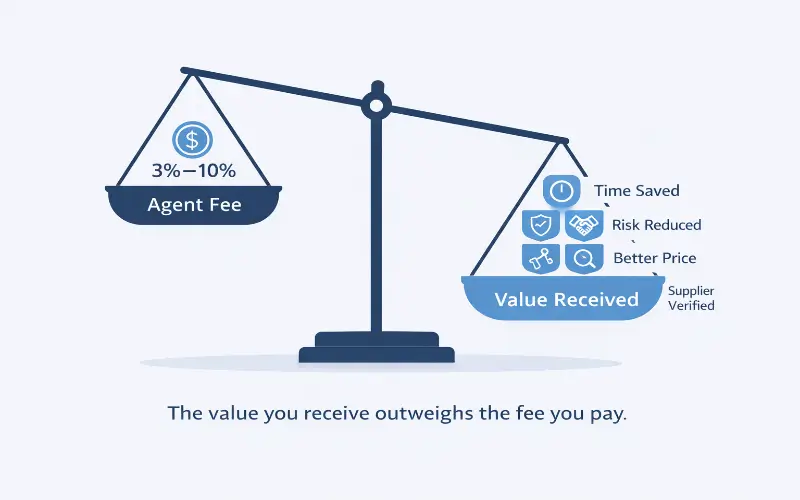
For most importers, especially those without established supplier relationships in China, a sourcing agent is worth the fee.
Here’s why:
- Language and communication barrier elimination. Factory negotiations conducted in Mandarin consistently produce better pricing than email-based English communication.
- Price savings that offset the fee. An experienced agent often negotiates better FOB prices than a buyer working alone, meaning the fee effectively pays for itself.
- Time savings. Building a supplier relationship from scratch through Alibaba, trade shows, or cold outreach can take months. An agent with an existing network can shortlist verified suppliers within days.
- Risk reduction. Agents who carry out quality inspection and factory verification catch production issues before goods leave China — when they are cheapest to fix.
That said, a sourcing agent is less valuable if you already have trusted, verified suppliers, are placing very small orders where the fee exceeds the benefit, or are working in a product category the agent lacks experience in.
Is It Cheaper to Use an Agent or Buy Direct?
This is one of the most common questions new importers ask. The honest answer: it depends on your order size, experience, and the specific product category.
| Factor | Using a Sourcing Agent | Buying Direct (e.g. Alibaba) |
|---|---|---|
| Unit Price | Often lower (agent negotiates) | Higher without leverage |
| Total Cost | FOB price + agent fee | FOB price only |
| Time Investment | Low – agent handles all | High – you manage everything |
| Supplier Verification | Included (if reputable agent) | Your responsibility |
| Quality Control Risk | Lower (agent monitors) | Higher (no oversight) |
| Best For | New importers, complex orders, multiple SKUs | Experienced buyers with verified suppliers |
For first-time importers or buyers sourcing a new product category, the combination of price negotiation, verification, and quality oversight that a good agent provides typically more than justifies the fee.
Further reading:
- Alibaba vs Sourcing Agent, What’s the Difference?
- Sourcing Agent vs Trading Company, Which is Better?
- Top 20 Product Sourcing Companies in 2026
How Some Sourcing Agents Make Money Without Charging a Service Fee?
Not every sourcing agent charges a visible commission or flat fee. A growing number of agents operate on a markup model. And it is worth understanding how this works before you dismiss it or assume it is suspicious.
What Is the Markup Model?
In this model, the agent sources your product at the best factory price they can negotiate, then adds a margin before presenting the final quote to you. You receive one clean price that covers both the product and the agent’s service. There is no separate line item for a sourcing fee.
This structure is common, legitimate, and — when handled transparently — genuinely simpler for buyers. You do not need to calculate percentage fees on top of your total order value. You simply evaluate whether the quoted price is competitive for the product you want.
What Makes This Model Work in the Buyer’s Favour
- Simpler cost structure. One all-inclusive price with no additional invoices or percentage calculations.
- Aligned incentives. The agent earns more by negotiating a better factory price, not by inflating a service fee.
- Easier comparison. You can validate the quote independently by requesting prices from other suppliers or agents.
The One Question You Should Always Ask
Whether an agent charges a visible fee or operates on a markup model, the most important question is the same:
Can you explain how you make money on this order?
A trustworthy agent in either model will answer directly and without hesitation. Transparency is the standard, not the fee structure itself.
Red Flags in Sourcing Agent Fee Structures
The warning signs below matter most when you are still early in the process of deciding who to work with — how to find a sourcing agent in China that is both qualified and transparent is the question that sits behind every red flag on this list.
The Agent Cannot Explain How They Make Money
This is the single most important red flag. A professional sourcing agent should be able to clearly and directly explain their business model when asked. Whether they charge a commission, a flat fee, or earn through a price markup.
An agent who deflects, gives vague answers, or changes their explanation is almost certainly hiding something, typically undisclosed supplier rebates that place their financial interests in direct conflict with yours.
The Fee Seems Unusually Low with No Explanation
A commission quoted well below market rate for a full-service engagement warrants a direct question about how the agent makes up the difference. The answer reveals whether they are subsidising their fee with supplier kickbacks you are not aware of.
No Written Agreement
Any legitimate sourcing agent will provide a written service agreement that clearly outlines their fee structure, scope of work, and payment terms. If an agent resists putting the arrangement in writing, treat this as a serious red flag, regardless of how reasonable their verbal explanation sounds.
Vague or Bundled Invoicing
Invoices should clearly separate product costs from any agent fees or third-party costs, such as inspection and freight. An agent who presents a single unexplained lump-sum figure makes it impossible for you to verify that you are being charged fairly.
Large Upfront Fees Before Any Work Begins
Small deposits to initiate sourcing work are sometimes reasonable. However, agents requesting large upfront payments before providing any supplier contacts, quotes, or deliverables represent a fraud risk. Value should come before significant payment.
Final Thoughts
China sourcing agent fees come in many forms. Commission, flat fee, monthly retainer, hourly rate, or a markup built into the quoted price. None of these models is inherently better or worse. What matters is whether the agent is transparent about how they work and whether the total cost makes sense for the value they deliver.
When evaluating any sourcing agent, focus on three things:
- Can they clearly explain how they make money?
- Can you independently validate the prices they quote you?
- Is everything confirmed in writing before money changes hands?
An agent who scores well on all three is worth working with, though finding the best China sourcing agent for your specific product category and order volume takes a little more due diligence than fee comparison alone.
Looking for a simpler approach to sourcing costs?
HiSourcing operates on a no-service-fee model. We source the right supplier, negotiate the best factory price, and present you with a single all-inclusive quote — no separate commissions, no hidden charges, no percentage calculations on top of your order.
If you’re tired of the various charging models, don’t hesitate to contact us and get a free quote.
Frequently Asked Questions
How much do China sourcing agents charge?
Most China sourcing agents charge between 3% and 10% of the total FOB order value as a commission. For smaller orders, a flat fee of $100–$500 per order is also common. Some agents operate on a no-service-fee markup model, where their margin is built into the quoted price. The right model depends on your order size and how you prefer to manage costs.
What is a typical sourcing agent fee percentage?
The most common commission rate is 5%–8% for orders between $5,000 and $20,000. For high-volume orders above $50,000, rates of 3%–4% are more typical. Always confirm the exact percentage in writing and clarify whether it applies to the FOB price or the total landed cost.
Do China sourcing agents charge upfront fees?
Some agents charge a small upfront sourcing fee (typically $50–$200) to cover initial research work before an order is confirmed. This is a normal practice. Large upfront fees demanded before any work or deliverables are provided should be treated with caution.
Can I negotiate a sourcing agent’s fee?
Yes, especially if you have a high order value or an ongoing repeat business relationship. Agents are often willing to reduce their percentage for larger orders or buyers who commit to regular volume. Having quotes from multiple agents also gives you leverage.
Is a sourcing agent fee tax deductible?
In most countries, fees paid to a sourcing agent for legitimate business purposes are deductible as a business expense. Always consult a local tax advisor for guidance specific to your jurisdiction.


