
Most China sourcing agents charge 5%–10% of the order value, or a flat fee of $300–$1,000 to find and vet suppliers. On large orders, the rate drops to 2%–4%. Some agents charge no separate fee and build their margin into the unit price instead.
The percentage alone tells you less than it seems. An agent quoting 3% can still cost you more per unit than one quoting 8%. Below, you’ll see a detailed breakdown of China sourcing agent fees by model and order size, what they leave out, and how to compare quotes.
China Sourcing Agent Fees at a Glance
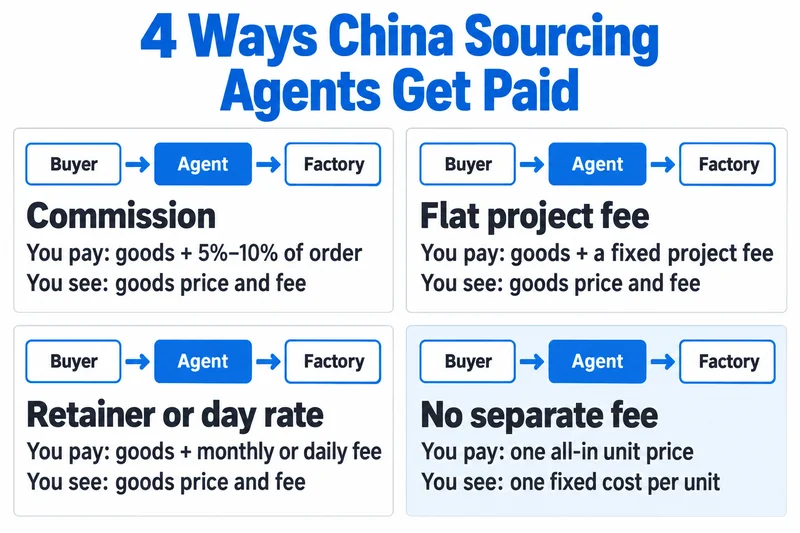
China sourcing agents get paid in four ways: a commission, a flat project fee, a retainer or time-based rate, or a margin built into the unit price. Sourcing fees are what you pay the agent on top of the goods to find suppliers, negotiate, follow production, and check quality.
For most small and mid-size orders, the standard fee is 5%–10% of the order value. Here is how the main fee structures compare:
| Fee model | Typical cost | Best for | Ask first |
|---|---|---|---|
| Commission | 5%–10% of the goods; 2%–4% on large orders | Most orders and repeat orders | The base and the minimum fee |
| Flat project fee | $50–$100 for a few supplier contacts; $300–$1,000 for a vetted shortlist; $800–$3,000 for one product from search to shipment | Supplier searches and one-off projects | What you receive at the end |
| Monthly retainer | $500–$3,000 a month | Ongoing buying across several products | What it covers each month |
| Hourly or day rate | $50–$150 an hour; $100–$200 a day for a factory visit with interpreting, plus travel | Short tasks with a supplier you already have | Who pays for travel |
| No separate fee | 0 service fee; the agent’s margin is included in the unit price | Long-term sourcing cooperation; one-stop sourcing solution | What the price includes, and whether it stays fixed |
The diagram below shows what you pay and what you see under each model.
Three details in the small print change the real cost:
- The base of a commission. A 5% commission on $20,000 of goods is $1,000; charged on $23,000 that includes tooling and domestic freight, it’s $1,150. Agree that it applies to the goods only.
- Minimum fees. Small orders usually pay a minimum instead. A $150 minimum charged per product turns a four-product order into $600 of fees, so ask whether it applies per order or per product.
- The scope of a flat fee or retainer. Get in writing how many suppliers you’ll receive, or how many products and inspection days a retainer covers each month. You still pay a flat fee if you reject every supplier.
How Much Do Sourcing Agents Charge by Order Size?
Sourcing agents charge a lower percentage as the order grows, from 8%–10% under $5,000 down to 2%–4% above $100,000. Finding and vetting a factory takes about the same work for a $3,000 order as for a $30,000 one, so the rate falls as the value rises.
| Order value | Typical commission | Example fee |
|---|---|---|
| Under $5,000 | 8%–10%, or a minimum fee | $3,000 order: $240–$300 |
| $5,000–$20,000 | 6%–8% | $10,000 order: $600–$800 |
| $20,000–$50,000 | 4%–6% | $30,000 order: $1,200–$1,800 |
| $50,000–$100,000 | 3%–5% | $80,000 order: $2,400–$4,000 |
| Over $100,000 | 2%–4% | $150,000 order: $3,000–$6,000 |
To estimate your own fee, multiply the order value by the rate, then compare the result with the agent’s minimum fee per order, usually $100–$500. A first order sits at the top of its range. A repeat order of the same product from the same factory often costs two or three points less.
Four things move your rate within the range:
- New or custom products need more sampling and back-and-forth, so expect the top of the range or a separate development fee. Certified products, such as electronics or children’s items, can add 1–3 points.
- Many products from several suppliers mean more coordination, but a full container of 30–50 items gives you room to ask for a lower rate.
- Quality checks take time. Item-by-item inspection keeps a commission at 5%–8%, while quick count-and-look buying when you shop Yiwu market with an agent can run 3%–5%.
- Large or steady volume earns a better rate: one or two products at 10,000 units or more, or $10,000 or more in monthly orders.
What About Sourcing Agents That Charge No Fee?
Some agents charge no commission or service fee and include their margin in the unit price they quote. That price usually covers the goods, the agent’s margin, and often domestic freight, inspection, and packing.
Procurement teams would call this fixed-price buying, and a commission on an itemized quote something closer to cost-plus. With a fixed price, you know your cost per unit before production starts, and the agent carries the risk if factory prices rise or a batch needs rework. The trade-off is that you can’t see the factory price or the agent’s margin.
What separates an all-in price from a scam is whether the agent does what it says. An agent that bills costs at cost should show you the invoices. An agent that quotes an all-in price doesn’t owe you its cost breakdown. The trouble starts when an agent says one thing and does another, such as quoting a 2% commission while quietly raising the factory price.
Since you can’t see the margin, judge an all-in price by its result. Compare the cost per unit with quotes for the same specification, quantity and shipping terms. Confirm the price stays fixed once you order, and approve a sample and an inspection report before you pay the balance.
An all-in price suits buyers who want one fixed cost per unit, order several products from different factories, or yearn for a simple and one-stop sourcing service.
HiSourcing works this way: no separate commission or service fee, with every cost folded into the unit price and the aim of keeping the quote competitive even with everything included. Contact Us for a Free Quote.
What You Pay on Top of the Agent’s Fee
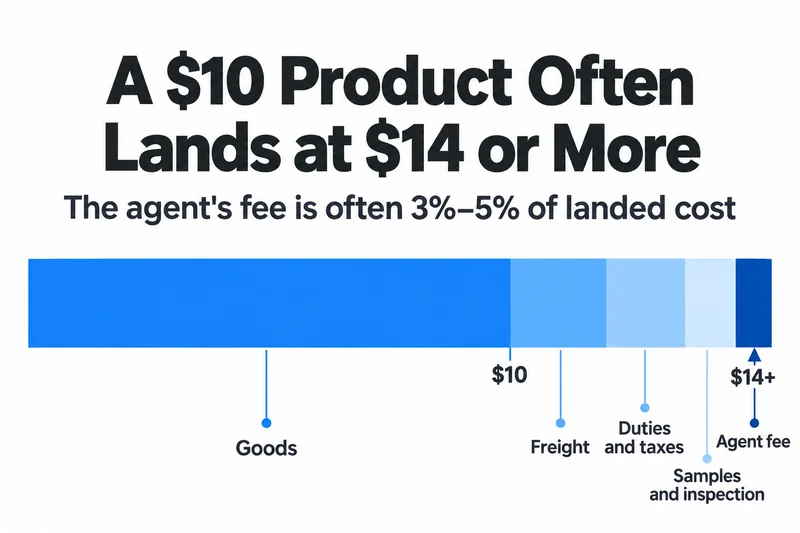
The agent’s fee is usually the smallest part of your landed cost, often 3%–5% of it. Goods, freight and duties are the big numbers: a $10 product often costs $14 or more by the time it reaches your warehouse.
The chart below shows how those costs stack up.
| Cost | Typical amount | Included in the agent’s fee? |
|---|---|---|
| Samples and courier | $50–$300 per product; samples often cost 2–3 times the bulk unit price | No, usually billed at cost |
| Quality inspection | $200–$400 per inspector-day | Varies. Ask, because many buyers assume it’s included |
| Tooling and molds | Depends on the product | No. Ask whether the commission applies |
| Domestic freight and consolidation | Depends on volume and distance | Varies |
| Storage in China | Often free for a few weeks | Varies |
| International freight | Depends on mode and volume | No |
| Import duties and taxes | Depends on the product and country | No |
| Bank and currency fees | A wire fee per payment, plus the exchange-rate spread | No. Ask which rate applies and who pays the fees |
Items billed at cost can carry a markup too. Ask for the original invoice when an agent bills at cost, and compare totals when the quote is all-in.
One Order, Four Quotes: Which Costs Less?
Three honest fee models can land within 2% of each other, while the quote that looks cheapest can cost the most. Take 1,000 units at a true factory price of $8.00, or $8,000 of goods, plus about $570 for samples, one inspection day and domestic freight:
| Quote | Fee model | Total before international freight | Per unit |
|---|---|---|---|
| A | 8% commission, extras billed separately | $8,000 + $640 + $570 = $9,210 | $9.21 |
| B | $800 flat fee, extras billed separately | $8,000 + $800 + $570 = $9,370 | $9.37 |
| C | All-in price of $9.20 per unit, inspection and domestic freight included | $9,200 | $9.20 |
| D | “Only 2%,” but the factory price is quoted at $8.80 | $8,800 + $176 + $570 = $9,546 | $9.55 |
Quote D looks cheapest on paper, yet the padded factory price makes it the most expensive. Compare the cost per unit and what each quote includes, not the percentage, and then check that cost against your selling price.
Is 3% Commission a Lot for a Sourcing Agent?
No. A 3% commission sits at the bottom of the normal range. It’s fair on large repeat orders above $50,000 but low for a $5,000 first order. A 2% rate only makes sense on simple reorders well above $100,000.
The math explains why. A 5%–8% fee on a $10,000 order pays the agent $500–$800 for weeks of supplier calls, samples and production follow-up. When a small first order is quoted at 1%–3%, or with no fee and no explanation, the money usually comes from somewhere else:
- A factory price raised before you see it
- A cheaper factory or cheaper materials than the ones you approved
- A padded US dollar to Chinese yuan exchange rate
- A rebate the factory pays the agent
- Markups on samples, inspection or freight
New agents often quote low to win a first order, then recover the difference in these ways.
How to Compare Sourcing Agent Quotes?
A transparent quote doesn’t have to show the factory’s price; it states how the agent gets paid, lists what the price includes, and stays fixed once you confirm. To compare China sourcing agent fees fairly, put every quote on the same basis first: same specification, quantity, shipping terms and currency. An FOB price and a DDP price can’t be compared directly, as FOB vs DDP explains.
Then ask every agent the same five questions:
- How do you get paid, and do you take anything from factories?
- What does the price include: samples, inspection, domestic freight, consolidation, storage?
- Does the price stay fixed after I confirm the order?
- Who pays if goods fail inspection or ship late?
- What is the payment schedule?
Pay only to the company account named in your agreement, usually a 30% deposit with the balance after inspection, and never 100% up front. Put the fee model, inclusions, and payment terms in writing; the guide to working with a sourcing agent shows what else belongs in the agreement.
Walk away if an agent won’t explain how it gets paid, pushes for full payment or a personal account, or bills costs at cost but can’t show the invoices.
Is a China Sourcing Agent Worth the Fee?
A sourcing agent is worth the fee when the time and risk it saves cost more than the fee itself. That’s usually true for a first order with unknown suppliers, a custom product, several products to consolidate, or any order where one bad batch would cost more than the agent.
An agent is harder to justify for a simple reorder from a factory you already trust. The same goes for a generic product under about $3,000, which you can buy on Alibaba yourself with Trade Assurance. If quality is your only worry, book an inspection on its own.
Final Thoughts
China sourcing agent fees usually run 5%–10% of the order, but the rate matters less than how the agent gets paid and what the quote covers.
- Compare cost per unit, not percentages. A low rate can hide a higher factory price.
- Trust quotes where the agent does what it says, whether that’s a listed commission or an all-in price.
- Get the fee model, inclusions and payment terms in writing before you pay a deposit.
If you’d rather pay one fixed price per unit than track separate fees, that’s how HiSourcing quotes. Send your product list to HiSourcing to get an all-in quote and compare it with what you pay now.
You might like to read:
- 15 Best China Sourcing Agents: Detailed Comparison
- Top 20 Product Sourcing Companies You Need to Know
- Sourcing Agent vs. Trading Company: What’s the Difference?
FAQs about China Sourcing Agent Fees
Does the buyer pay the sourcing agent fee?
Yes. The buyer always pays the sourcing agent fee, either as a listed fee or inside the unit price. If a factory also pays the agent, the agent has a reason to favor that factory, so ask in writing whether the agent takes anything from suppliers.
Will a sourcing agent tell you which factory makes your products?
Usually not, and that’s normal. A sourcing agent’s supplier network is what you pay it for. Ask instead for an approved sample, inspection reports with photos or video, and a written agreement on who fixes defects.
Are US-based sourcing agents more expensive than China-based ones?
Not by default. US-registered agents more often sell flat project fees or packages, while the people visiting factories are usually in China either way. Compare what each quote includes and the cost per unit, not where the agent is registered.
Can you negotiate a sourcing agent’s commission?
Yes, mostly through volume and less work for the agent. Combine several products into one order, send complete specifications, ask for a lower rate on repeat orders, and handle simple reorders yourself.


