
First time to Alibaba? Already narrowed down to the final suppliers but scared to commit? Don’t know how common scams on Alibaba are? Or afraid of supplier will just take the money and never send the goods?
This post from HiSourcing summarizes the latest 6 types of Alibaba scams in 2026, totalling 22 real case studies, to help you identify and get familiar with common scams on Alibaba before losing your money and time. Also, ways to avoid are included.
Does Alibaba Have Scams?
Yes, Alibaba has scams, though it is the world’s biggest B2B marketplace, connecting millions of international buyers with Chinese suppliers and manufacturers.
Apart from that, because of its size, it’s also a marketplace where scammers run sophisticated fraud schemes targeting inexperienced buyers and importers who aren’t familiar with common Alibaba scams.
Also, there’s a good way to learn the frequency of Alibaba scams. Alibaba itself publishes a compilation of suppliers for engaging in fraudulent activities on the official Alibaba Scammer List.

Can You Get Scammed on Alibaba?
Everyone can get scammed on Alibaba if not spot some red flags on time when dealing with suppliers, even if you’re an experienced Alibaba buyer and have worked with several Alibaba suppliers for years.
Alibaba scams are real and growing more and more sophisticated; it is evolving like B2B businesss itself.
Back 5 years ago, common scams on Alibaba were focusing on payment scams like off-platform cheating or ghost suppliers. Recently, new types of scams have been emerging one after another. For example, some of the bad suppliers on Alibaba will steal your product design and manufacture & sell it themselves.
All of the mentioned scams, whether old or new, are listed below. Please read on.
22 Alibaba Scams You Must Avoid
Alibaba Payment Scams
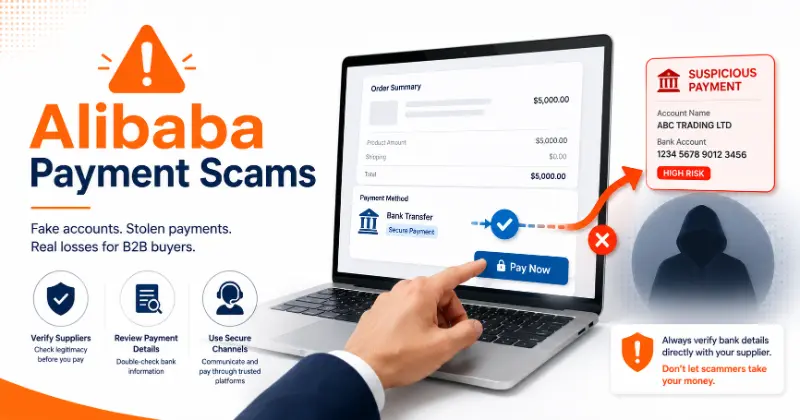
Off-Platform Payment
Recently, I ordered 100 hoodies, and the Alibaba seller told me to pay offline. Because if I take Trade Assurance, they will be charged 2 time extra. I did as they said cuz they convinced me by giving proof. The seller didn’t send me my product. What should I do now?
This is the top and most common Alibaba scam, thousands of buyers still get trapped in it, though it has almost existed since the very day Alibaba was born.
A legit Alibaba supplier will not ask their customers to pay by going off the platform, but do the payment via Trade Assurance. Because the Trade Assurance can somehow protect itself, not only buyers, when a dispute arises.
If the supplier told you to pay through Western Union, MoneyGram, or even cryptocurrency, it’s a scam. These payment methods won’t leave paper trails and are not recognized by Alibaba. That is to say, if anything bad happens after, Alibaba will not help you to protect your rights.
If the supplier asks for payment to a personal account instead of a registered business account, don’t hesitate to walk away and find another one. Chances are, a salesperson is about to leave the company, and he wants to take some money with him.
How to avoid:
- Always pay under Alibaba Trade Assurance, no matter whether big or small orders.
- Confirm the bank account details before payment.
Payment Not Received
I paid $4,100 through Alibaba Trade Assurance for a bulk order of LED strip lights. But the supplier insists that he didn’t receive the transfer. So I sent over the bank confirmation details from my end, and everything matched.
He replied that the payment went to a ‘wrong account’, and I needed to cancel the order and ask for a refund. Meanwhile, he would send me a correct bank account that is not on Alibaba, and I should transfer another payment to let the production begin.
According to our experience, if things like this happen, chances are the seller is not confident about their product’s quality. They are preventing you from future disputes over broken goods.
Without the protection of Alibaba Trade Assurance, in other words, if you arrange the payment directly to the seller’s off-platform account (which has zero connection to Alibaba), you’ll have no dispute mechanism, no coverage, and no leverage.
How to avoid:
- Never pay off-platform.
Hacked Supplier Email
I’d been talking to a supplier for two weeks, negotiating an order for custom packaging. One day, I got an email from them. It contained the final PO details and product specs, as well as a bank account. It’s weird because we’ve talked about the payment before, I prefer to pay under Trade Assurance, and the seller said yes.
Actually, this is not a supplier scam; it’s a third party who’s already on the side. To be short, a hack fraud.
Hackers target supplier email accounts because they’re flooded with inbound inquiries from clients, which is easy to get lost in. They disguise themselves as clients, steal passwords from the seller, and gain access to the mailbox by either phishing links or fake invoice attachments.
Once inside, they watch and don’t act immediately. Reading your conversation history, learn the context, and wait for the right moment. When you are about to place the order, they come up ‘on behalf’ of the supplier, and tell you the original back account is changed, you should transfer the payment to another account.
How to avoid:
- Reach out and speak to the seller via phone call or video chat before payment.
- Double-check the bank account details with the seller.
Alibaba Quality Scams
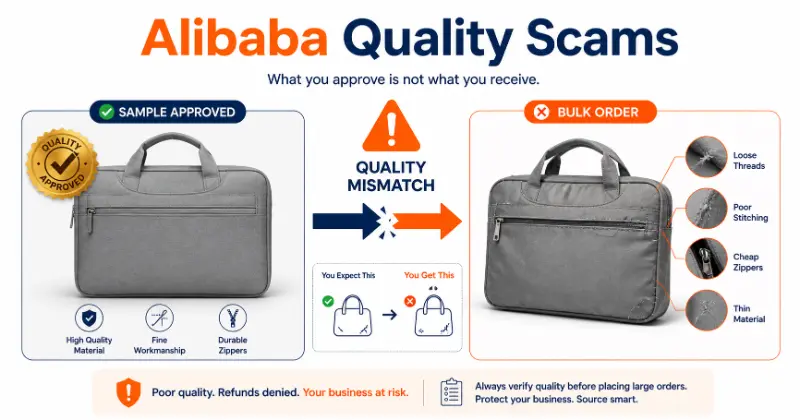
Items Received Not as Described
I bought 3 mowers on Alibaba, which are supposed to have higher engine power, a bigger fuel tank, and be able to work safely on steep slopes.
After receiving the goods, I found the seller had lied about key specifications, even though it was promised in writing and chats, and written in PI. Besides, 2/3 machines got structurally faulty during normal use (bent frames, tracks falling off, completely unusable).
To be honest, this situation is quite common when buying mechanical equipment, electronic components, and other non-standard products on Alibaba. The sin lies in a lack of knowledge of products.
Most equipment suppliers, when training their sales staff, often merely hand them a product manual of their own products. In their eyes, all the parameters and specifications are just cold numbers. The difference between 500W and 650W is just the number 150, let alone more complex parameters like cutting width and height.
Despite the case shown above, in more common products, like handbags, some clients ordered genuine leather, which turned out to be the bag is made of PU leather.
How to avoid:
- Confirm the product spec with the seller, be extremely specific.
- Always do a pre-shipment inspection before goods depart.
- Pay via Alibaba Trade Assurance.
Quality Degradation Over Repeat Orders
I have a supplier on Alibaba, placed some orders before, and it went fine. But this time, I ordered another order from the same supplier, and they sent me the wrong colour, and the goods arrived very late. Total order value was $11000, but the incorrect units make up $3500.
I told the supplier, and we came to an agreement that they would ship me the correct colour by air, and I would pay for the wrong ones after they’re sold.
Most buyers think everything will go smoothly after finding a reliable Alibaba supplier. The first order is stunning, the second is good, and the third is ok. Then, troubles come in. The fourth and fifth order quality is noticeablely dropped.
A reliable supplier is worthless, but counting only on one is troublesome. The fluctuation of raw material prices, order scheduling, changes in the number of customers, and even employee changes are the direct reasons why suppliers cannot maintain the quality within a stable range. Some even outsource production to cheaper (and lower-quality) subcontractors.
How to avoid:
- Check and record the difference from order to order.
- Conduct pre-shipment quality inspection on every order, do not cut it down, as the first three orders went fine.
- Keep seeking better alternative factories to address future risks.
Damaged Shipment
About 4 months ago, I bought 300 units of ceramic mugs for a private label brand I’m launching for around $2,200. The shipment arrived 3 weeks late, and on top of that, the shipment was damaged when it arrived.
The entire pallet was packed with almost zero cushioning between units. No dividers, no foam, nothing. Over half the mugs were chipped or cracked. The ones that weren’t chipped had glaze scratches bad enough that I wouldn’t sell them to anyone.
Nothing’s more frustrating than finding cargo arrived but damaged. The key is who arranged the shipping and how.
If you arranged that, you can turn directly to your logistics company and claim a refund. If it’s the Alibaba seller who arranged it, you should communicate with them and ask for compensation.
Normally, the seller will pay you back first (including goods payment and shipping fee) if you initiate a dispute on Alibaba. But even if you finally get the full refund, it’s a big loss of time.
How to avoid:
- Conduct pre-shipment to make sure the goods are in good condition before shipping.
- Communicate with the seller on the packaging method, such as whether bubble wrap protection is required.
Sample Mismatch
I sourced resistance bands from a supplier in Guangzhou. The sample was thick, with good elasticity and clean printing. So I ordered 5,000 units. When the shipment arrived, the bands were visibly thinner, the printing was blurry, and about 15% snapped during basic stretch testing.
The supplier said it was just ‘normal variation’ in mass production, and offered me a 5% discount on the next order. There was NO next order.
This is the most common Alibaba scam, and the most premeditated. Most suppliers use samples as a hook. They handcraft the sample using better materials, tighter QC, or even buy one from competitors and pass it off as their own. In this case, samples are not a preview of what you’ll get in a bulk order; it’s a sales tool.
Always keep in mind that the sample is the best one among your bulk order, both in looking and quality. Therefore, it is necessary to manage expectations and determine an acceptable range of quality differences.
How to avoid:
- Retain your approved sample as a physical benchmark and reference it explicitly in the purchase contract.
- Specify everything in writing, including material grade, weight, dimensions, tolerances, and color codes.
- Use Trade Assurance and attach the specs; without documented quality standards in the agreement, you have no basis for a claim even with TA coverage.
- Hire a third-party inspection company to inspect goods during production and again before shipment, not after arrival.
Counterfeit and Patent Infringing Products
We sourced a posture corrector from an Alibaba supplier and launched it on Amazon. Sales were strong for the first three weeks. Then our listing got deactivated because of a patent infringement notice filed by a US company.
We went back to the supplier. Turns out the product design had a granted utility patent dating back two years before we even contacted them. They knew but never said a word. We’re out $6,800 in inventory, and the listing is gone.
There are two forms of this kind of scam.
The first one is a supplier selling patent-infringing products. If you buy and resell items with patent infringement issues on Amazon, your listing will be deactivated.
The second form is a supplier selling counterfeit branded products. They may claim they are authorized distributors or OEM manufacturers for international well-known brands. But in fact, they are selling counterfeits and knockoffs.
If you import fake or replica products, even without knowing it, you can face serious legal problems in your own country. Customs authorities in the US, EU, UK, and Australia often seize shipments of fake goods, and the person who imported them (you) can be sued for trademark infringement.
How to avoid:
- Ask for proof of brand authorization or OEM agreements.
- Use Google Patents to check if the wanted product has a registered patent.
- Search for help from a professional patent agent if necessary.
Fake Certifications
Hi guys! Recently, a friend of mine told me I’d better check the certifications of my Alibaba suppliers. So I spent 2+ hours jumping between government databases and company sites trying to verify.
I’ve checked all of my suppliers (about 30) in the past two weeks, and only 8 had fully legit certs! I’ve been working with some of them for years. Feel like an idiot.
When sourcing products like electronics, toys, and packaging materials, certifications like CE, RoHS, and FSC are a must. Without them, you can’t import and resell your goods in a legitimate way.
Dishonest suppliers will claim that they have the cert you need. But the problem is, these docs are forged, photoshopped, expired, or belong to other companies.
Also, even if a factory has its own real certs, in some jurisdictions, you, as the importer/seller, must have your own certificates and testing. Having certifications just proves that the factory is capable of meeting the requirements; it does not necessarily mean that you can use their certificates.
How to avoid:
- Find the issue institute, and cross-reference it on registration numbers, dates, with the docs provided by your supplier.
- Use Accio (an AI-powered B2B sourcing engine, integrated with Alibaba) to quickly verify a supplier’s certifications.
Alibaba Price Scams
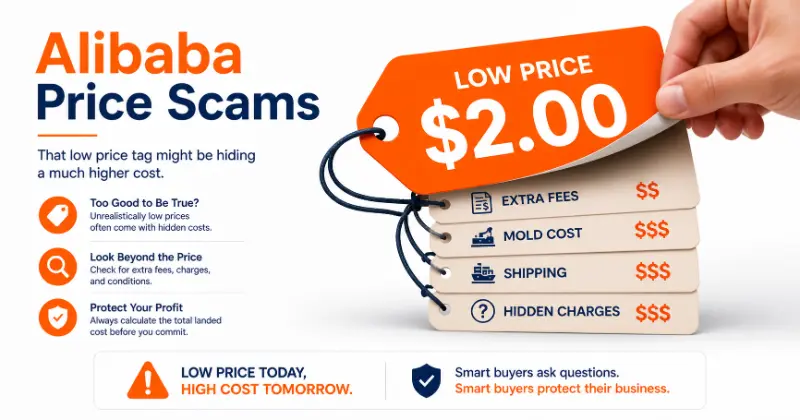
Bait-and-Switch Tactics
I contacted an Alibaba supplier, and we’ve talked for about like 2 weeks. Everything is confirmed, like unit price and delivery time. When I was about to pay the deposit, the supplier changed the price of my order to a 30% higher price.
They explain that there are some mistakes, so the quotes they offered before were no longer valid. Is this a scam or what?
One thing needs to be pointed out first: Alibaba is a B2B marketplace, and the price shown in listings is the bulk order price. You don’t get the precise quote until you tell the seller your quantity, product specs, etc.
However, this is an absolutely textbook Alibaba scam. The supplier lures you in with attractive offers, like too-good-to-be-true pricing quotes, or free shipping on a cheap item. Then hit you with unexpected charges or simply raise the unit price. Sometimes it’s due to the increased raw material costs, revised specifications, or other excuses. Sounds like a bait-and-switch tactic.
How to avoid:
- Confirm all pricing in writing before paying the deposit.
- Lock the quote on the Alibaba Trade Assurance agreement.
- Verify the truth if the seller tells you that raw material prices have increased.
Alibaba Seller Scams
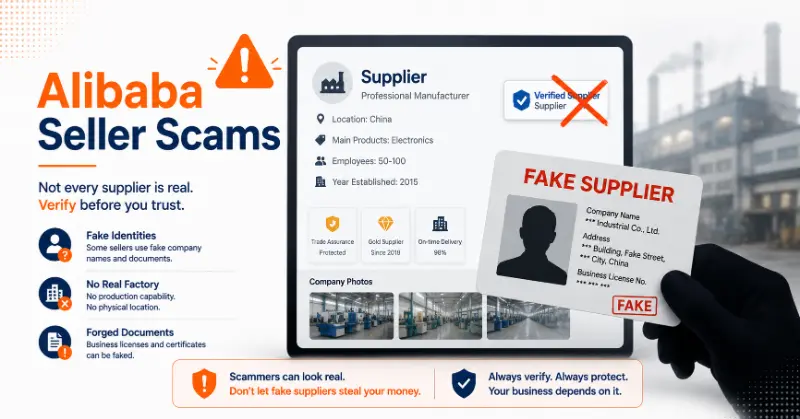
Ghost Supplier
I got scammed on Alibaba! I’ve bought 140k (Canadian) worth of items, laptops, and phones from a supplier there. After the payment, I haven’t received my goods, and the supplier hasn’t responded to me anymore. They just disappeared.
I contacted Alibaba, all they did was shut down their accounts and nothing else, so basically I am out with 140k and no items…
This type of scam is often triggered by low-rated and new suppliers on Alibaba, who run their business on that platform for less than 1 year.
Usually, they will create a professional and convincing storefront, lure clients with extremely low prices and popular items, and respond to inquiries in a suspiciously active way. In fact, they have no products to sell, no inventory, no factory, no more than 2 staff, and most importantly, no intention of fulfilling the order.
The ghost supplier buys a fake business license, pays the annual membership fee of Alibaba, then disappears after receiving the deposit of full payment from the client.
How to avoid:
- Buy from verified suppliers with a good record via Alibaba Trade Assurance.
- Ask the supplier for a business license and register files, then check for the register date (most ghost suppliers are newly registered) and address (see if it’s an office, a factory, or a rented mail box).
- Request a live video tour and ask them to show you around, check to see if there are real products being produced in the production line.
Verified Supplier Poor Quality
I ordered multiple different products from 3 different Chinese sellers verified by Alibaba and with high ratings. But received products were of poor quality, filled with defects, scratches, dents, and a poor finish, not mentioned in their product listings.
The Alibaba “Verified Supplier” badge is a paid membership. It confirms a business license exists and nothing more. It says nothing about product quality, manufacturing capability, or whether the supplier fulfills orders as agreed.
Also, we can tell you a secret: Alibaba’s search ranking is partly driven by ad spend, not buyer satisfaction. A 5-star profile with 1,000 transactions doesn’t mean your order will be the same. Some suppliers even purchase high-rated accounts specifically to exploit that trust.
How to avoid:
- Never judge a supplier by their badge or star rating alone.
- Always arrange a pre-shipment inspection, regardless of the supplier’s verification status.
- Cross-reference the company on China’s official business registries to verify their actual operating history.
Trading Company Posing as a Factory
I thought I was buying directly from the manufacturer. After placing the order, I found out I was dealing with a middleman. The prices were inflated, and I had no control over production.
Many Alibaba listings that look like factories are actually trading companies, intermediaries who source from manufacturers and mark up the price. They show factory photos, respond with technical-sounding answers, and claim to manufacture in-house. In reality, your order is outsourced the moment you pay.
This isn’t always an outright scam. But it means higher prices, less quality control, and no direct relationship with the people actually making your product. For single-product sourcing at volume, you want the factory.
How to avoid:
- Ask specific questions about production equipment, factory size, and lead times for manufacturing runs.
- A supplier offering 200+ unrelated products across multiple categories is almost certainly a trading company.
Alibaba Shipping Scams
Wrong Tracking Number
I ordered a PS5 from Alibaba. The supplier gave me a tracking number (DHL courier), the destination shows it’s SOUTH SAN DIEGO, California, USA, but my address is in South Africa. They explain that my package needs to transit there.
Three days later, the supplier told me my package was held because it was a sensitive product, and I should pay an extra $198 to let USA DHL release it. But they claim I’ll get 98% of the $198.
First of all, for branded products like PS5 or PlayStation, we recommend buying from reputable sellers like Koodoo and Takealot.
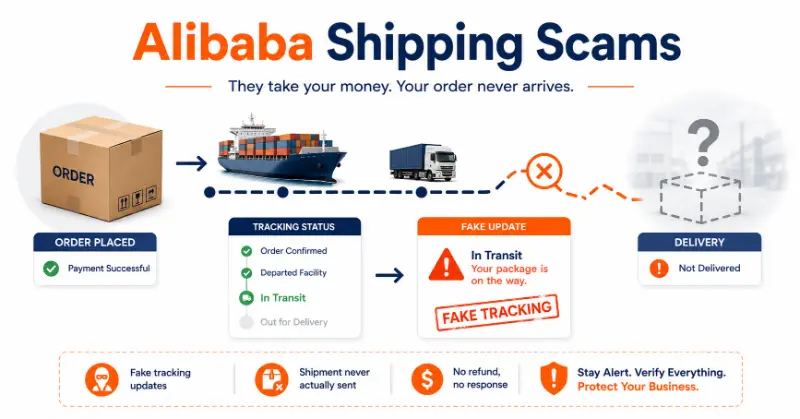
This kind of scam on Alibaba is classic. Typically, it goes like, you pay for the purchase, and the seller gives you a Random tracking number, which has absolutely nothing to do with your order. It goes to another country because it’s a different batch of goods. Then they try to extort more money from you, claiming it’s for this or that.
How to avoid:
- Do not buy branded products on Alibaba, whether an iPhone or a PS5.
- Always ask and confirm before buying to check if the delivery fee covers everything, including customs and tariffs, to avoid any unexpected fees.
Fake Shipping Documents (Empty Container or Garbage Inside)
I paid in full and received a complete documentation package, bill of lading, commercial invoice, and packing list. Everything looked legitimate. The tracking number was valid. When the container opened at the port, it was filled with scrap metal and plastic waste. The supplier had disappeared.
After receiving payment, the supplier sends a convincing documentation package. Sometimes the tracking number is real, but the cargo belongs to someone else’s order entirely. By the time the tracking reads “delivered,” and you investigate, weeks have passed, and the supplier is unreachable.
The scam works because buyers have no way to verify the contents of a container from abroad. Once the money is gone and the ship has sailed, your options are limited.
How to avoid:
- Arrange your own freight forwarder rather than using the supplier’s recommendation.
- Book a third-party pre-shipment inspection at the factory before goods are loaded.
- Verify bill of lading details directly with the shipping line — not through the supplier.
- Never treat scanned copies of shipping documents as proof that your goods are in the container.
Other Scams on Alibaba
Alibaba Scams on WhatsApp
Have you ever talked with sellers through WhatsApp? I’ve used Alibaba for quite a long time. Multiple sellers are asking me to add and contact them on WhatsApp, but I thought it was banned in China?
Apart from that, there are no other red flags. Company profiles are verified, thousands of transaction records, etc.
To be honest, this kind of scam is delicate. WhatsApp is banned in China, but Chinese suppliers can still use it via a VPN for better communication with clients. WhatsApp, like WeChat, is an instant messenger and is better than talking on a webpage for the sake of information exchange.
But always take it as a red flag. If your cargo is delivered and turns out to be broken or does not match the agreed details, Alibaba would not take the WhatsApp chat history as your evidence. Do not talk about product specifications or place an order via it. The agreement on WhatsApp means Nothing on Alibaba.
How to avoid:
- All conversations should happen on Alibaba.
Kickback Scams (Paying Off Your Sourcing Staff)
The supplier doesn’t target you. They target whoever in your company places the orders. They contact your purchasing manager or sourcing agent directly and offer a personal kickback, typically 3–10% of the order value, in exchange for steering business their way.
The result: your team selects this supplier regardless of price or quality. The supplier inflates their pricing to cover the kickback. You end up paying more and getting less, with no idea why.
This scam is particularly hard to detect because the person who should be flagging the problem is the one benefiting from it.
How to avoid:
- Require competitive quotes from at least three suppliers for every order.
- Implement a multi-person approval process for supplier selection.
- Audit your sourcing costs periodically against current market benchmarks.
IP Theft (Stealing Your Product Design)
We shared our product drawings with a supplier for a quote. Six months later, we found our exact design being sold on Alibaba by that same supplier under their own brand, at a lower price than ours.
You share technical drawings, mold specifications, or design files during the quoting stage. Some of the dishonest suppliers use them to manufacture and sell the product themselves, sometimes before you even place an order. In aggressive cases, they file a Chinese utility model patent on your design, which can legally block you from manufacturing your own product in China.
Once your IP is in their hands, you have limited recourse unless agreements are in place upfront.
How to avoid:
- Never share full technical drawings at the quoting stage. Use partial specifications or watermarked versions.
- Sign an NNN agreement (Non-Disclosure, Non-Use, Non-Circumvention) under Chinese law before sharing any proprietary information.
- File your own Chinese patents and trademarks proactively, before going to market.
Fake Customer Service Phishing
I got an email from “Alibaba Support” saying my account was flagged and I needed to verify my identity immediately. The link looked exactly like Alibaba’s login page. I entered my details, and the next morning, my account had been accessed, and my saved payment information was gone.
Fraudsters impersonate Alibaba customer service agents via email, WhatsApp, or phone. They claim there’s an urgent issue with your account, order, or payment — then direct you to a convincing fake page to steal your login credentials.
Once inside your account, they can access your order history, redirect payments, change shipping addresses, or extract saved payment methods. Variations include fake “account verification” emails, phishing links disguised as Trade Assurance confirmations, and suppliers’ email addresses cloned with subtle misspellings.
How to avoid:
- Never click links in unsolicited emails claiming to be from Alibaba.
- Log in to Alibaba by typing the URL directly into your browser.
- Enable two-factor authentication on your Alibaba account.
- Verify any “support” contact through Alibaba’s official help channels only.
Shipment Delays With Rising Freight Costs
My order was delayed three times. Each time, the shipping cost went up. By the end, freight was 70% higher than the original quote. I’m convinced the delays were intentional.
Delivery delays happen. But when they’re consistently accompanied by rising freight charges, it’s often not a coincidence. Some suppliers deliberately stall production after receiving payment, then use peak season or market rate increases as cover to extract more money.
By the time you realize what’s happening, your goods are sitting in a warehouse, and you’re stuck: pay the extra freight or lose your order.
How to avoid:
- Confirm whether your products have actually been manufactured before accepting any delay — don’t rely on photos alone.
- Cover specific lead times, ship dates, and delay penalties in your Trade Assurance order.
- If the supplier requests a revised ship date, require them to update it formally inside the Trade Assurance order system.
Extra Customs Payment Demands
The supplier told me my shipment was held by Chinese customs, and I needed to pay an extra 30% of the order value to release it. Otherwise, I would not receive my goods.
This scam arrives after you’ve already paid in full. The supplier invents an obstacle — a customs hold, a port inspection, a regulatory bond — and demands an additional payment to resolve it. The threat is clear: pay or your goods don’t move.
In reality, no such fees exist in Chinese export customs. These charges are entirely fabricated to extract money from committed buyers.
How to avoid:
- Any demand for additional payment after a confirmed order is a scam. Do not pay.
- Know your trade terms. Under DDP, all export and import duties are the supplier’s responsibility.
- There are no “customs bond” fees in China for exports. If a supplier claims otherwise, it’s a lie.
Inflated Mold Fees and Keeping Your Molds
I paid $4,000 for custom tooling. Two years later, I tried to move production to a different factory. The supplier refused to release my molds and said they owned them. I had to pay all over again at the new factory.
If your product requires custom molds or tooling, some suppliers will quote an inflated fee — then claim the molds belong to them, not you. This creates a lock-in: switching factories means paying for new tooling from scratch, which is exactly what they’re counting on.
Standard injection molds for simple parts typically cost $500–$2,000. Inflated quotes for the same part can run $5,000–$10,000. Buyers unfamiliar with Chinese manufacturing costs have no benchmark to push back against.
How to avoid:
- Negotiate mold ownership in writing before production begins. The contract must explicitly state that you own the molds.
- The agreement should require the supplier to release your molds if you move production elsewhere.
- Get at least two tooling quotes so you have a market reference point before agreeing to any mold fee.
What to Do if Get Scammed on Alibaba?
If, unfortunately, one day, you find ‘I got scammed on Alibaba‘, here are some methods to help you get your money back:
- Save and download evidence: chat history, PI, PO, bank transfer slips, etc.
- File a dispute on Alibaba Trade Assurance.
- Contact your payment provider and raise a chargeback.
- Report the scammer on Alibaba.
The most important thing is not to panic. If you paid via Alibaba Trade Assurance, there’s a high chance of recovering payment.
To Sum Up
As you can see, there are so many Alibaba scams. Any misdecision on any part of your sourcing journey may lead to adverse results. Though this platform offers the link to thousands of Chinese suppliers, it doesn’t tell you which one is trustworthy.
Always keep in mind that there is no such thing as a good or bad platform itself, and it is also a normal phenomenon for suppliers to vary in quality.
If you want to source products from China and are afraid of being scammed on Alibaba, or you are looking for Alibaba Alternatives, an on-site Alibaba sourcing agent like HiSourcing is an alternative and wise choice. Over the past 7 years, we have helped 1500+ clients across the world source products from verified factories in China, lots of them was used to be scammed on Alibaba.
Don’t hesitate to Contact Us, we’re more than happy to help.
Further Reading:
- How to Purchase from Alibaba: A Step-by-Step Guide
- 1688 vs Alibaba, Which is Best?
- Alibaba vs Sourcing Agent: Which is Better?
Frequently Asked Questions
Can you get a refund on Alibaba if you get scammed?
If you pay via Alibaba Trade Assurance, there’s a high chance of getting a refund by raising a dispute on it. Typically, it takes 1–3 working days to process after agreement, but bank processing can add 7–10 working days for credit cards or up to 30 days depending on the method.
How to identify a scammer on Alibaba?
First of all, always be vigilant against suppliers who want you to make off-platform payments. Secondly, if you found the price of your wanted product is too good to be true, there’s a high chance you’re dealing with a scammer.
What is the safest payment method for Alibaba?
The safest payment method for Alibaba is using Alibaba Trade Assurance, plus a credit card or PayPal, which offers you double protection from being scammed.
Can I trust Alibaba with my credit card?
Yes, you can trust Alibaba with the credit card. But you can’t rely on Alibaba suppliers even if you pay via credit card. If something goes wrong, getting a refund is a minor issue, but the wasted time, energy, and customer trust are factors that are hard to make up for.


