
If you are reading this, you are likely staring at your screen in a cold sweat, thinking: I got scammed on Alibaba. You wired the deposit, and now the supplier has completely vanished, the tracking number is fake, or the container just arrived filled with unsellable garbage. Take a deep breath.
As an Alibaba sourcing agent based in China, we’ve seen every trick in the book. Panicking or arguing with the supplier won’t get your money back or lost repaid. What you need right now is a cold, calculated strategy based on the first principles of cross-border trade.
Here is the exact step-by-step recovery playbook you need to diagnose your situation, freeze the damage, and, most importantly, get your money back.
How to Know if You Truly Got Scammed on Alibaba?
Before you launch a nuclear strike on your supplier, you need to properly diagnose the situation. Filing the wrong type of claim will waste your ‘golden window’ for a refund.
Scam vs. Quality Dispute vs. Normal Delay
- A Scam: Pure malicious intent. They took your money and never intended to ship the agreed goods (e.g., ghosting, sending a brick instead of an iPhone).
- Quality Dispute: Execution failure. They tried to make your product but cut corners on materials to increase their margin (e.g., 80% cotton instead of 100%).
- A Normal Delay: Logistics chaos. The goods are sitting at a port waiting for a vessel, or stuck in customs.
5 Red Flags You Are Actually Being Scammed
If you are experiencing any of these, you are likely dealing with a scammer:
- The Ghosting: Complete radio silence on Alibaba TradeManager and email for over 7 days after the deposit is cleared.
- The Bait & Switch: The sample was perfect, but the bulk production looks like it was made in a completely different (and cheaper) factory.
- The Off-Platform Push: Suddenly asking you to pay the balance via Western Union or a personal bank account because their ‘corporate account has tax issues’.
- The Fake Tracking Number: The tracking number shows ‘Pending’ for weeks, or shows delivered to a different state.
- The Freight Extortion: They lured you in with a dirt-cheap FOB price. But right before loading, they suddenly demand thousands of dollars in hidden ‘inland fees’ or fake ‘customs clearance bonds’ to release the bill of lading.
One common confusion: a price being too low does not automatically mean a scam. Most low Alibaba prices are structurally legitimate—see why Alibaba is so cheap for the actual mechanics.
I Got Scammed on Alibaba: What Should I Do?
Time is your enemy. The longer you wait, the easier it is for the scammer to withdraw the funds and close their shell company. Execute these steps within the first 48 hours.
Step 1: Preserve Every Piece of Evidence
Do not tip off the scammer that you are taking action. Scammer accounts get deleted. Screenshots do not. Before anything else, capture and gather:
- Screenshot the entire chat history on Alibaba TradeManager (WhatsApp screenshots hold less weight with Alibaba).
- Original emails including headers (if you guys communicated by it and sent files there)
- Download the Proforma Invoice (PI), Purchase Order (PO), and the Alibaba Trade Assurance contract (in PDF).
- Gather all bank transfer slips or credit card statements (bank details of scammer are needed too).
- Take time-stamped photos of the defective goods side by side with the original approved sample.
- Screenshot of the supplier’s Alibaba storefront URL and company profile page
Step 2: File a Dispute on Alibaba
If you paid via Alibaba Trade Assurance, the scammer supplier received the payment, and you’re unsatisfied with the product quality, initiate a dispute on Alibaba. Here’s how to do it:
- Open Alibaba.com and sign in to your account, then click Orders.

- Navigate to All Orders > View order details > More actions, choose Apply for refund.

- Fill the dispute form carefully, and attach all the evidence you collected (chat history, documents, photos of unqualified products, etc.)

Be aware that once you open a dispute, the supplier might panic and message you privately, promising a full refund if you close the dispute first.
Never close the dispute. Once closed, you often cannot reopen it, and they will block you immediately. Let the platform mediate.
Step 3: Contact Your Payment Provider in Parallel
Do not wait for Alibaba’s verdict. You must attack from two fronts.
- Credit /Debit Card: Call your bank immediately and raise a Chargeback (Dispute). Tell them you encountered a fraud, the more descriptive the better.
- PayPal: Initiate an ‘Item Not Received claim’ (if you didn’t receive the goods from the supplier), or a ‘Significantly Not as Described’ claim (if the goods differ from what you ordered) in the PayPal Resolution Center if you paid by Goods and Services. Do note that PayPal will ask you to return the goods to the seller (if received), and the return shipping cost is covered by you.
- Wire Transfer (T/T): Call your bank and request a Wire Recall or Reversal due to fraud. This has a low success rate if the money has already landed, but it creates an official fraud paper trail and is worth a try.
Step 4: Report the Scammer to Alibaba
Don’t let the scammer make more money from others by scamming; report him to the Alibaba Help Center. Here’s how to do it:
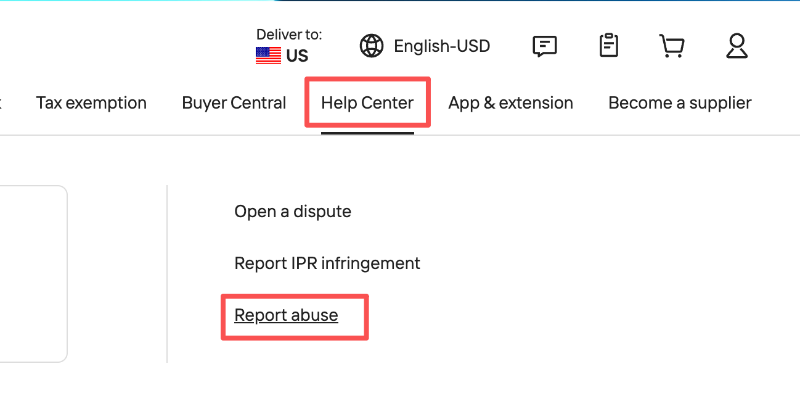
- Sign in to your Alibaba account, navigate to Help Center, then click Report abuse.
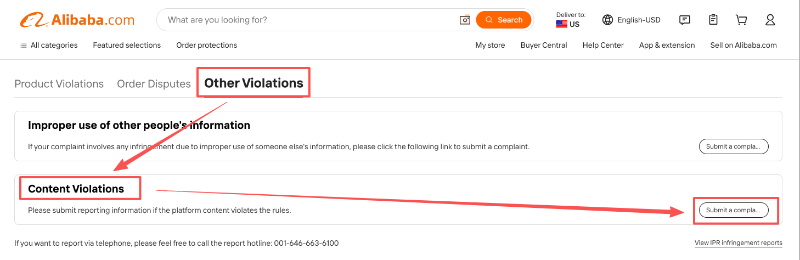
- Navigate to Other Violations > Content Violations > Submit a complaint.
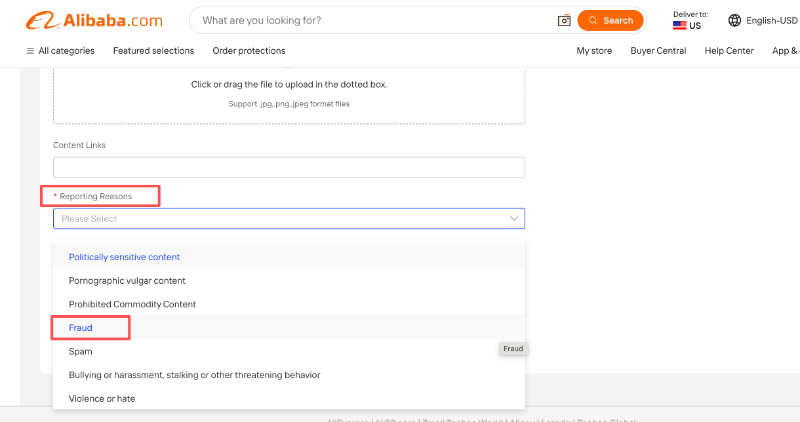
- In the Reporting Reasons, choose Fraud, then fill in the other content in the form and Submit.
After reporting, Alibaba will investigate the supplier carefully by checking the evidence that you provide. Once the scam is confirmed, the fraudulent supplier will be penalized or removed from the platform permanently.
Step 5: Report to Authorities and Create a Public Paper Trail
File a police report in your own country, and submit a fraud complaint to international trade fraud agencies. US buyers can file with the Federal Trade Commission (FTC). It strengthens any future chargeback dispute and flags the supplier in official databases.
Also, you can post a detailed account, supplier name, store link, transaction evidence, communication screenshots, etc., on r/Alibaba Reddit and industry forums. You probably won’t recover your funds this way, but you’ll stop the next buyer from walking into the same trap, and public exposure is one of the few things scam suppliers actually care about.
Step 6: Know When to Stop (The 30-Day Rule)
If 30 to 60 days have passed and your bank has denied the chargeback and Alibaba has ruled against you, you need to face reality. Spending 6 months fighting a faceless entity for $3,000 is a drain on your mental health and business focus. Cut your losses, learn the lesson, and fix your supply chain.
Can I Get My Money Back from Alibaba?
The honest answer: it depends almost entirely on how you paid.
Alibaba’s internal dispute process helps, but the ceiling on your recovery is set by your payment channel the moment you hit send.
| Payment Method | Dispute Window | Odds | Key Action |
|---|---|---|---|
| Credit Card | 60–120 days (per card scheme) | Highest | File a chargeback with your issuer. |
| PayPal | 180 days from payment | High | Open a SNAD case in Resolution Center. |
| Trade Assurance | 30 days after receipt | Moderate | File a claim on your Alibaba order page. Success depends on PO detail. |
| T/T — company account | No formal window; recall within 72 hours | Low | Request a bank recall; file a police report. |
| T/T — personal account | None | Near zero | Document everything; use as chargeback evidence. |
| Western Union / Crypto | None | Near zero | Treat as a total loss. |
Why Trade Assurance Isn’t a Full Guarantee
Many buyers treat Trade Assurance like a magic shield. It isn’t. Alibaba’s mediation team looks at one thing: The Contract.
If your Proforma Invoice simply said “1000x Blue Plushies”, and the factory sends you neon-blue plushies with terrible stitching, Alibaba might rule in favor of the supplier.
Why? Because you got 1000 blue plushies. If you didn’t define the exact Pantone color code, material weight, and defect tolerance in the contract, Trade Assurance cannot protect your assumptions.
How to Not Get Scammed on Alibaba Again?
After getting scammed once by someone on Alibaba, you might have the answer about is Alibaba safe to buy from.
But the reality is more nuanced. For international B2B sourcing, Alibaba remains an incredibly powerful and cost-effective platform. The marketplace itself isn’t the scam. The true threat lies in a fraction of rogue suppliers and bad actors who actively exploit the system.
To succeed, you just need to get familiar with some common Alibaba scams and know how to outsmart them. Here is your definitive playbook for never getting scammed on Alibaba again.
Level 1: Vet the Supplier Beyond the Verified Badge
Scammers hide behind polished storefronts. You need to pierce the veil before sending a single message.
-
Understand the Badges: ‘Gold Supplier’ is just a paid membership. Prioritize ‘Verified Suppliers’, which means a third party has at least audited their existence.
-
Do a China Background Check: Run the company name through aiqicha.com (China’s corporate registry). Check their registration date and business scope. If they claim 10 years of experience but registered last month, walk away.
-
Demand a Live Video Tour: Don’t accept pre-recorded videos. Call them on WeChat or Zoom and ask to see the factory floor. Watch closely for evasion or if the ‘factory’ looks like a residential apartment.
-
Know the Red Zone Niches: Alibaba is for B2B wholesale. If you are trying to buy branded iPhones, single electric bikes, ATVs, or food trucks, you are swimming in a scam-saturated pool. Prices that are ‘too good to be true’ in these categories always are.
Level 2: Secure Your Payment & Communication
Your payment method is your only safety net. If you pay the wrong way, you forfeit all your rights.
-
Credit Card is King: This is the single most important rule. A credit card is the only method that guarantees a chargeback. Pick a card with a long dispute window (e.g., Amex offers 180 days, which covers long production and shipping times).
-
The Off-Platform Trap: Keep all communications and payments inside Alibaba. If a supplier suddenly pushes you to WhatsApp or offers a ‘5% discount for a direct bank transfer’, it is a scam 100% of the time.
-
Leverage Trade Assurance for the Paper Trail: Trade Assurance mediators might be unhelpful, but your internal Alibaba chat logs and official POs become the undeniable evidence base you will use to win your credit card chargeback later.
-
Never Use These: Never wire money (T/T) to a personal account, never send crypto (BTC, USDT), and avoid Western Union. PayPal is an acceptable backup (180-day window), but it often doesn’t cover commercial or highly customized goods.
Level 3: Structure the Deal to Limit Exposure
Never hand over all your leverage on day one. Professional buyers structure their payments to force supplier compliance.
-
Start with a Test Order: Never commit to a bulk order immediately. Limit your initial exposure to a $500–$1,000 sample or test batch.
-
The 30/70 Rule: Never pay 100% upfront. The gold standard is 30% deposit to start production, and the remaining 70% only after the goods are ready and inspected.
-
Hire Third-Party QC: For any bulk order, spend the $200-$300 to hire an independent inspection firm to physically verify the goods at the factory before you release the 70% balance.
Level 4: Partner with a Local Sourcing Expert
You may wonder: Why should I choose a sourcing agent over Alibaba? Here’s the answer:
Even with credit cards and third-party inspections, managing a cross-border dispute is a nightmare. Third-party QC can only tell you the goods are bad after they are made, leaving you stuck negotiating refunds.
The single biggest risk reduction available is having eyes on the ground. Partnering with a China-based sourcing agent like HiSourcing gives you a local team to conduct surprise factory visits, lock in secure Incoterms, and catch defects directly on the assembly line. You stop dealing with platform mediators and start managing a transparent, direct-to-factory supply chain.
If you have any needs, like wondering if there’s a lower price than Alibaba, want genuinely complex, high-customization, or high-value sourcing, feel free to Contact Us.
Frequently Asked Questions
Can I still order from Alibaba to the USA?
Yes. Alibaba is a legitimate platform used by millions of importers. The risk lies in individual supplier selection and payment choices, not the platform itself.
What should I check before buying on Alibaba?
Verify the business license independently, request a live video factory tour, insist on a detailed PI, and pay through Trade Assurance or a credit card.
How long do I have to dispute an Alibaba order?
It depends on which channel you use. Trade Assurance claims must be filed within 30 days after receipt (the Prescribed Period). Credit card chargebacks typically allow 60–120 days from the transaction date, depending on your card scheme. PayPal SNAD disputes give you up to 180 days. File on the earliest-closing channel first.
Can I trust Alibaba with my credit card?
Paying by credit card through Trade Assurance is one of the safest combinations available. You get both platform protection and issuer chargeback rights, which means two independent recovery channels if something goes wrong.
What happens if I pay an Alibaba supplier off-platform?
You forfeit Trade Assurance entirely. Your only remaining option is your payment channel’s own dispute process. And for a T/T wire to a personal account, that’s effectively nothing.
Will Alibaba ban a scammer supplier after I report?
Sometimes, but don’t count on it as your recovery path. Alibaba issues penalty points and can suspend or remove repeat offenders, but the process is slow and opaque from the buyer’s side. Report the supplier anyway. Your complaint feeds into their risk score and protects future buyers, but pursue your refund through your payment channel in parallel.


