
You find a product on Alibaba at 70% below local retail. Your first thought: Is this real, or am I about to lose money?
The answer is both. Alibaba is so cheap for structural reasons that are completely legitimate. The same low price can also hide costs and traps that erase every dollar you saved.
This guide explains exactly why Alibaba is so cheap, when cheap is safe, and when it is not. In most cases, the difference comes down to three things you can check before paying.
Why is Alibaba So Cheap: A Quick Answer
Alibaba is cheap because it connects overseas buyers directly with Chinese factories in a wholesale format. That strips out distributors, retailers, and marketing overhead.
On top of that, six other forces compound: bulk-order pricing, lower domestic production costs, dense industrial clusters, China’s export tax rebate, fierce platform competition, and artificially low hook prices.
Together, they produce prices that can run 50-80% below Western retail.
Further reading:
How to Purchase from Alibaba? A Step-by-Step Guide
Why is Stuff on Alibaba So Cheap?
Factory-direct, not retail
Most Alibaba suppliers are OEM or ODM factories selling directly to overseas buyers.
Every layer a typical product crosses on the way to a Western shelf (distributor, wholesaler, retailer) takes its own margin. Alibaba removes those layers. That is reason number one.
Bulk pricing, real wholesale
Alibaba is built for bulk, not singles. Listings show quantity tiers: 100-499 pcs at one rate, 500-999 lower, 1,000+ lower still.
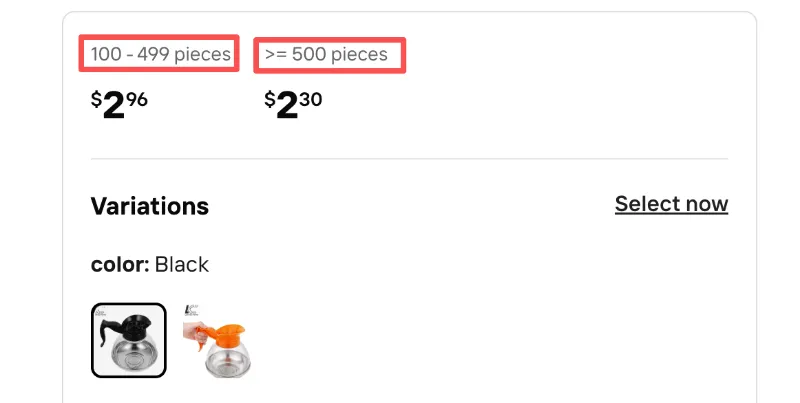
In most cases, the per-unit price at 1,000 units runs 30-50% below the same item at 100 units. Fixed production costs are simply spread across more output.
Lower labor, power, and materials
Manufacturing wages in China remain significantly below US and EU levels. Industrial electricity is structurally cheaper, too.
Actually, the bigger factor is inputs. Cotton, steel, plastics, lithium, ceramics, all produced domestically at scale. That eliminates the import costs Western factories pay before they even start production.
Dense industrial clusters
Chinese manufacturing concentrates regionally:
- Electronics: Shenzhen and Dongguan
- Ceramics: Foshan
- Textiles: Guangzhou
- Toys: Chenghai
- Small commodities: Yiwu
Inside each cluster, components, packaging, molds, and logistics sit within short distances. Shorter supply chains mean cheaper per-unit production.
China’s export tax rebate
China rebates part of the 13% domestic VAT on most exported goods. That lets factories price exports below their domestic cost.
Here is what changed recently. Effective April 1, 2026, China is eliminating the rebate for photovoltaic products and 249 related categories. Battery products drop from 9% to 6% through the end of 2026, then to zero by January 1, 2027.
For buyers in those categories, expect Alibaba prices to rise 6-12% over the next year.
Platform price competition
Thousands of suppliers sell nearly identical products on Alibaba. Buyers can collect ten quotes in an hour.
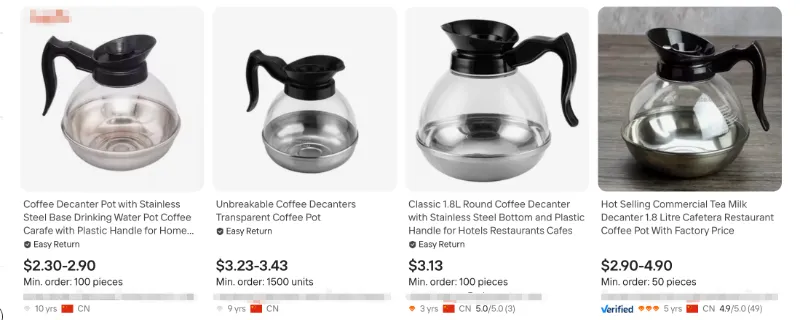
Factories respond by cutting margins. In most cases, newer sellers chasing their first orders go lowest. That creates pricing near the cost floor.
Artificially low hook prices
Not every listed price is the real price. A meaningful share of Alibaba suppliers set the displayed price below what they actually charge, as a lead-generation hook.
Request a real quote, and the number often jumps back toward AliExpress levels. Common pattern from buyer reports: a $1,500 product becomes $2,500 after customization (no real features added), then shipping is quoted at an inflated round number to close the gap.
In my experience, the listing price is the start of a negotiation, not the end.
Why is Technology on Alibaba So Cheap?
Tech is where cheap is most ambiguous. A bluetooth earbud for $3.50 is real. An OEM iPhone 15 Pro for $180 is not.
Components vs. branded goods
Unbranded electronics are genuinely cheap. Cables, chargers, generic earbuds, and no-name tablets, all supported by the densest component supply chain in the world (Shenzhen).
Branded products at heavy discounts are a different story.
3 real states of Alibaba phones

A cheap iPhone or Samsung on Alibaba is almost always one of these:
- OEM-spec unit: same production line, different branding
- Refurbished device: used internals in a new casing
- Clone: a lookalike running modified Android
None of them are genuine new branded phones. Genuine branded phones do not exist on Alibaba at these prices.
When cheap tech is legit
Replace this mental shortcut:
Cheap on Alibaba = fake
With this one:
Unbranded cheap = usually real. Branded cheap = almost always not.
If you already paid for a genuine branded device and received something else, our guide on what to do if you got scammed on Alibaba walks through the refund path by payment method.
Why are Alibaba cars so cheap?
Chinese EVs listed at $5,000-$9,000 are rarely what they appear to be.
Some listings are mini low-speed EVs or quadricycles that cannot pass US or EU crash standards. Others are legitimate Chinese-brand EVs for which the listed number is the FOB factory price, excluding shipping, duties, compliance modifications, and local registration. Add those in, and the landed cost often doubles.
Actually, the bigger risk is support. China’s EV sector has hundreds of new brands, many of which are subsidized by local governments. Smaller ones fold within 1-2 years, leaving buyers with no spare parts.
Is Alibaba Cheaper Than 1688, AliExpress, Temu, Amazon, and eBay?
Short answer: yes for bulk, no for singles. Here is the full picture.
| Platform | Target Buyer | Typical MOQ | Price Level | Best Use |
|---|---|---|---|---|
| 1688 | Chinese domestic wholesalers | 1-100 pcs | Lowest | Rock-bottom China wholesale |
| Alibaba | Global B2B buyers | 100-1,000 pcs | Low | International wholesale |
| AliExpress | Global consumers | 1 pc | Medium | Small-quantity retail |
| Temu | Global consumers | 1 pc | Low-medium | Consumer bargains |
| Amazon | Global consumers | 1 pc | High | Fast-delivery retail |
| eBay | Global consumers | 1 pc | Variable | Used or niche items |
For buyers willing to handle China’s domestic logistics, 1688 offers deeper wholesale pricing than Alibaba. In fact, it is the platform Chinese resellers buy from before marking items up onto Alibaba.
Further reading:
1688 vs Alibaba: Which is Better for China Sourcing?
Alibaba Real or Fake?
When low prices are real
Factory-direct unbranded goods at 60-80% below Western retail are usually genuine. Adequate quality, real products, structural savings.
Red flags for counterfeit
Replace this assumption:
Verified Supplier badge = genuine branded products
With this reality:
Name-brand products at huge discounts = almost always fake, regardless of badge
Factories selling genuine Apple, Nike, or Louis Vuitton goods on Alibaba do not exist. These brands use controlled distribution.
The legal cost of counterfeits
Counterfeit imports are not a gray area. Customs seizure, fines, Amazon or eBay account suspension, and IP-holder lawsuits are the standard outcomes.
For an FBA seller, a single counterfeit detection can destroy an account built over years. The math almost never works in favor of fake goods.
The real risks of buying from Alibaba
In most cases, the real risk is not outright scams.
It is quality drift, spec changes, and delivery delays, all from legitimate suppliers cutting corners. For the full framework, see is Alibaba safe to buy from.
Why is Alibaba So Expensive Sometimes?
Small-order surcharge
Order 50 units instead of 500, and the per-unit price can run several times higher. The listed low price assumes bulk volume.
Shipping breakpoints
For small quantities, courier shipping often costs more than the goods themselves. Sea freight only makes sense at roughly 2-3 CBM and above.
Miss the mode breakpoint and you can double your landed cost.
The manufacturer who isn’t
Here is a widely underappreciated fact: most listed manufacturers on Alibaba are actually trading companies.
Some suppliers even label themselves as a manufacturer and a trading company while producing just one token product to satisfy the rules. The rest is brokered from other factories.
In my experience, these middlemen add 15-30% over true factory prices. The markup is invisible unless you verify the supplier independently.
Tooling, samples, inspection
Three costs first-time buyers forget to budget:
- Tooling fees: custom products need molds
- Sample fees: per-unit cost several times the bulk
- Inspection fees: a few hundred dollars per shipment
None of this shows up in the initial quote.
Why is Alibaba shipping so expensive?
Shipping pricing is non-linear. And some suppliers exploit it.
Apart from honest per-weight freight economics, suppliers sometimes inflate the shipping quote after a low product price has hooked you. A $1,500 product with a later-added $3,000 shipping fee is not unusual.
The safest move is to request a shipping quote from an independent freight forwarder before accepting a supplier’s bundled number.
How to Capture Alibaba’s Low Prices Without the Risk
Four practical moves, in order of impact.
Verify the factory
Check the business license on gsxt.gov.cn. Request a live video factory tour. Confirm export records.
Badges alone are not verification.
Lock specs in your PI
Replace this PI:
“500 pcs bluetooth speakers”
With this one:
“500 pcs bluetooth speakers, Model SP-12, ABS casing, 1200mAh battery, individual white box packaging, CE certified”
Vague PIs are the single most common reason disputes fail.
Pay with recovery rights
Trade Assurance or credit card are the two payment methods with real refund paths. Everything else is effectively uninsured.
When a China-based team wins
Verifying factories, filtering out trading companies, and running pre-shipment inspections from another continent is hard. For most first-time buyers, it is too hard.
A China-based partner walks the factory floor, separates real manufacturers from middlemen charging 15-30% markup, and holds suppliers accountable in the same jurisdiction.
HiSourcing is a China-based Alibaba sourcing team built around this workflow. With the supplier network we’ve built over the past 7 years, we can provide you with even more reasonable quotes while arranging QC, goods consolidation, and shipping. If you want to source products from China, feel free to Contact Us.
Frequently Asked Questions
Why is Alibaba so cheap in the USA?
US retail carries high distribution, marketing, and labor markups. A $2 factory good in China often retails for $15-20 in a US store.
Why is Alibaba shipping sometimes more than the product?
For small orders, shipping is priced by weight and distance, not product value. Some suppliers also inflate shipping after quoting a low product price. Get an independent freight quote to sanity-check.
Is Alibaba cheaper than AliExpress for bulk?
Yes. AliExpress is retail-priced per unit. Alibaba factory pricing at 500+ units is typically 40-60% below AliExpress.
How much do hidden fees add to an Alibaba price?
Tooling, samples, inspection, shipping, duties, and bank fees can add 30-50% to the listed unit price for first-time buyers.
Are Alibaba prices negotiable below the listed range?
Often yes, at volumes above the listed maximum tier. Quotes below 500 pcs rarely move. Quotes above 5,000 pcs almost always do.
Why is the same supplier cheaper on Alibaba than AliExpress?
AliExpress is retail with single-unit MOQ and consumer-protection costs built in. Alibaba is wholesale with bulk MOQ. Same supplier, different pricing model.
Final Thoughts
Alibaba is cheap for real reasons. Factory-direct access, bulk pricing, lower input costs, export rebates, and platform competition. Most of those savings are structural.
The risk is not that cheap is fake. It is that cheap often comes attached to hook pricing, hidden middlemen, and shipping tricks that erase the savings.
Buyers who verify the factory, lock their specs, and use a recovery-capable payment method capture the upside without the downside.


