
Recently, some of our clients reached out to us and asked what the difference is between FOB and CIF.
FOB and CIF are two common Incoterms in ocean freight, and the FOB vs CIF decision sets who pays for the main shipping, who arranges insurance, and who carries the risk while the goods are at sea.
FOB vs CIF: Key Takeaways
- CIF roughly equals FOB plus insurance and freight.
- Both pass risk to the buyer once goods are on board.
- FOB: the buyer books freight; CIF: the seller does.
- FOB usually means a lower price and more control.
- CIF insurance is only basic cover, so consider topping up.
This guide from HiSourcing explains what FOB and CIF mean, the advantages and drawbacks of each, a full comparison, and a simple way to decide which term fits your business.
FOB vs. other trade terms:
What is FOB?
FOB (Free On Board) means the seller delivers your goods onto the ship at the origin port, and from that moment the cargo is your responsibility.
The seller packs the goods, trucks them to the port, clears them for export, and loads them on board the vessel you have nominated. Once the goods are on board, the freight, the insurance, and the risk all sit with you, the buyer.
FOB is always written with a named port, such as FOB Shanghai or FOB Ningbo. That port is the exact spot where responsibility changes hands. The term is built for sea and inland waterway shipping only.
Advantages of FOB
- Lower purchase price, since the seller’s costs stop at loading.
- Full control of the main shipping and your choice of carrier.
- Freedom to negotiate your own freight rates.
- A clear, early handover point that is easy to document.
- You decide how much insurance to buy, and with whom.
- Easier cost comparison, because freight is quoted separately.
- Better visibility over transit times and routing.
Disadvantages of FOB
- You manage the logistics, which takes time and know-how.
- Insurance is your job; skip it and a sea loss is uncovered.
- You carry the risk for the entire sea journey.
- More upfront coordination: booking, customs, unloading.
- Harder for first-time importers without a freight partner.
- Pre-shipment damage can be difficult to prove.
New to importing from China and want to start a business? A sourcing agent can quote your goods at FOB or EXW and handle the whole sourcing process for you, from finding reliable suppliers and ensuring smooth production to arranging delivery. Get A Free Quote ›
What is CIF?
CIF (Cost, Insurance and Freight) means the seller pays for the main shipping and buys insurance to the destination port, but you still carry the risk once the goods are on board.
Under CIF, the seller does everything an FOB seller does, then adds two things:
- Book and pay the ocean freight to your destination port.
- Buy a marine insurance policy for the cargo.
CIF is also quoted with a named port, this time the destination, such as CIF Rotterdam or CIF Los Angeles. Like FOB, it is for sea and inland waterway transport only.
Advantages of CIF
- Less work for you: the seller arranges freight and insurance.
- One bundled price covers goods, shipping, and basic cover.
- Helpful for newer importers without a freight forwarder.
- Insurance is included, so the cargo is never uncovered at sea.
- A predictable cost all the way to the destination port.
- The seller handles export documents and the insurance certificate.
Disadvantages of CIF
- Higher quoted price, often with a markup on freight and insurance.
- Little control over the carrier, route, or transit time.
- The required insurance is only minimum cover, not all-risks.
- You still carry the risk during the sea voyage.
- Harder to compare freight costs, as they are bundled in.
- Claims can be slower when someone else bought the policy.
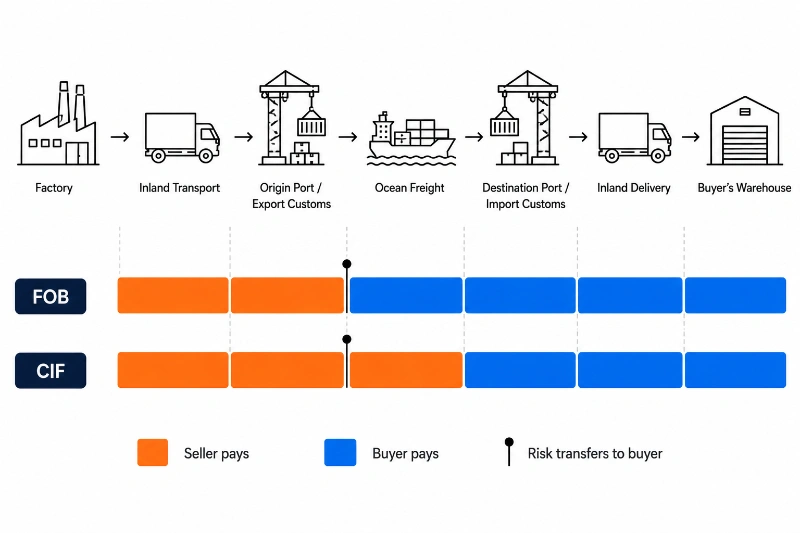
FOB vs CIF: Complete Comparison
The core FOB vs CIF difference is simple: under FOB the buyer pays for and controls the main shipping, while under CIF the seller does. Almost everything else follows from that one split.
| Factor | FOB (Free On Board) | CIF (Cost, Insurance and Freight) |
|---|---|---|
| Transport mode | Sea and inland waterway | Sea and inland waterway |
| Loads goods on vessel | Seller | Seller |
| Export clearance | Seller | Seller |
| Main ocean freight | Buyer pays | Seller pays |
| Insurance | Buyer (optional) | Seller (mandatory, minimum cover) |
| Risk transfer point | On board at origin port | On board at origin port |
| Import clearance and duties | Buyer | Buyer |
| Unloading at destination | Buyer | Buyer |
| Carrier and route control | Buyer | Seller |
| Typical price | Lower | Higher (bundled) |
| Best suited to | Buyers who want control and lower cost | Buyers who want a hands-off shipment |
Responsibility Allocation
Both terms split the journey at the origin port, but CIF moves more of the shipping tasks onto the seller.
Seller’s Responsibility
Under both FOB and CIF, the seller will:
- Pack and label the goods for export.
- Load the goods on board the vessel.
- Deliver them to the origin port.
- Complete export customs clearance.
Under CIF, the seller also books and pays the ocean freight to the destination port, and buys marine insurance and hands you the certificate.
Buyer’s Responsibility
Under both FOB and CIF, the buyer will:
- Handle import customs clearance and pay duties and taxes.
- Pay for unloading at the destination port.
- Arrange final delivery to the door or warehouse.
Under FOB, the buyer also books and pays the ocean freight and arranges cargo insurance, which is strongly recommended.
Risk Transfer Point
Here is the part most people get wrong: under both FOB and CIF, risk passes to the buyer at the same moment, when the goods are loaded on board the ship at the origin port.
It is easy to assume that because the CIF seller pays for shipping and insurance, they also carry the risk to the destination. They do not.
Under the current Incoterms 2020 rules, the CIF seller’s cost responsibility runs to the destination port, but their risk responsibility ends on board at origin, exactly like FOB.
So why buy CIF insurance at all? Because you carry the risk at sea, the seller’s insurance is bought for your benefit. If the cargo is lost or damaged during the voyage, you claim against that seller-arranged policy. Under FOB, if you never bought insurance, the same loss comes straight out of your pocket.
One small note on wording: Incoterms 2010 replaced the old “ship’s rail” phrase with “on board the vessel,” and that is still the rule today. If you read an older contract that mentions the ship’s rail, treat it as on board.
Insurance and Freight Cost
The price gap between FOB and CIF is exactly the freight plus insurance the seller adds, which is why CIF roughly equals FOB plus insurance and freight.
A quick way to think about the two prices:
- FOB price = cost of goods + export packing + inland transport to the port + origin port charges + export clearance + loading on board.
- CIF price = FOB price + ocean freight to the destination port + marine insurance.
One detail many buyers miss: the insurance a CIF seller must provide is only the basic level coverage, known as Institute Cargo Clauses (C). That covers a limited list of major events, not all risks, such as rough handling. If your goods are fragile or high value, ask for fuller cover or arrange a top-up policy yourself.
A lower FOB price does not automatically mean FOB is cheaper overall. You still pay freight and insurance under FOB; they are simply unbundled. The real question is whether you can book those cheaper than the supplier can.
Control and Flexibility
FOB gives the buyer control of the shipping; CIF gives that control to the seller.
With FOB, you choose the carrier, lock in your own freight rates, and decide the route and insurance level. With an experienced freight forwarder, that usually means lower cost and fewer surprises.
With CIF, the seller picks the carrier and the insurance terms. That is convenient, but you have less say over transit time, service quality, and how a claim is handled.
Customs and Documentation
Customs duties work the same way under both terms: the seller clears the goods for export, and the buyer clears them for import.
The seller provides the commercial invoice, packing list, and bill of lading. Under CIF, the seller adds the insurance certificate to that paperwork.
Whichever term you use, you are responsible for import duties, taxes, and clearance in the destination country.
FOB vs CIF: Which Should You Use?
There is no single best Incoterm. FOB usually wins for buyers who want control and a lower cost; CIF suits buyers who want a simple, hands-off shipment.
Choose FOB if:
- You ship regularly or already have a freight forwarder.
- You want the lowest landed cost and full control.
- You are comfortable arranging insurance and customs.
Choose CIF if:
- You are new to importing and want it kept simple.
- You do not have a freight partner yet.
- You value convenience over squeezing out every cost.
| Your priority | Better choice |
|---|---|
| Lowest cost | FOB |
| Maximum control | FOB |
| Least hassle | CIF |
| No freight forwarder yet | CIF |
| Sensitive or high-value cargo | FOB with your own full insurance |
If you still have no idea which shipping terms for your order, feel free to reach out to us. Our experienced sourcing agent will help you decide according to your specific situation. Contact Your Personal Agent ›
Conclusion
FOB and CIF describe the same sea journey, split at the same point, with one difference: who arranges and pays for the freight and insurance.
FOB hands you control and a lower price, in exchange for doing the logistics. CIF hands the seller the work, in exchange for a higher, bundled price and less control. Risk, in both cases, becomes yours the moment the goods are on board at the origin, so insurance is never really optional in practice.
For most growing importers with a reliable shipping partner, FOB is the more cost-effective long-term choice. If you are just starting out, CIF is a reasonable, low-effort way to get your first orders moving.
Want FOB factory prices from China without the hassle? We source, inspect, and ship with no service fees, so you keep control of the shipping terms and the savings. Get a sourcing quote ›
Recommended Posts for you:
- CPT Incoterm: What Is It?
- FOB Shipping Point and FOB Destination
- How Long Does Shipping from China Take?
- How to Source Products from China?
- 15 Best China Sourcing Agents: Full Comparison
FAQs about FOB vs CIF
Is CIF or FOB higher?
CIF is higher than FOB as a quoted price, because it bundles the ocean freight and insurance into the seller’s number. FOB looks cheaper only because those costs are billed to you separately.
What is best, CIF or FOB?
Neither is best for everyone. FOB is better for experienced importers who want control and a lower cost, while CIF is better for beginners who want the seller to handle shipping and insurance.
How to calculate CIF and FOB?
FOB equals the cost of the goods plus export packing, inland transport to the port, origin charges, export clearance, and loading. CIF equals that FOB figure plus the ocean freight to the destination port and marine insurance.
Who pays for insurance under CIF?
The seller pays for insurance under CIF and must provide at least minimum cover to the destination port. Because you carry the risk at sea, that policy is bought for your protection, and you claim against it if the cargo is damaged.
Can FOB or CIF be used for container shipping?
You can, and many traders do, but the ICC recommends FCA instead of FOB and CIP instead of CIF for containers. Those terms transfer risk when the carrier takes the container, which fits how container shipping actually works.


