
Short Answer:
FOB means the seller delivers your goods onto the ship at the origin port, after which the ocean freight, insurance, import clearance, and duties are yours.
DAP means the seller delivers goods to your named address, but you still clear customs and pay the import duties.
FOB vs DAP is one of the most confused choices in international trade, and picking the wrong one quietly shifts thousands of dollars of cost and risk onto the wrong party. Both of them are Incoterms 2020 rules, both have the seller arrange part of the journey, and that overlap is exactly where buyers get caught.
This guide compares these two shipping terms comprehensively. You will see who handles shipping, where the risk passes, what each term really costs once the hidden local charges are added, and a simple way to choose.
FOB vs. More Shipping Terms:
What is FOB (Free on Board)?
FOB (Free on Board) means the seller is responsible for your goods until they are loaded on board the vessel at the named port of origin, including export clearance. From that point on, the ocean freight, insurance, import clearance, duties, and final delivery all belong to the buyer.
FOB is built for sea and inland waterway shipping only, and it is always written with a named origin port, such as FOB Ningbo or FOB Shanghai if you’re sourcing products from Chinese suppliers.
What is DAP (Delivered at Place)?
DAP (Delivered at Place) means the seller delivers your goods to a named destination of your choice, ready for unloading, and bears all costs and risks of getting them there. That covers export clearance and the main carriage, by sea, air, or road.
The buyer is responsible only for unloading the goods and, importantly, for import clearance and duties at the destination.
FOB vs DAP: What’s the Difference?
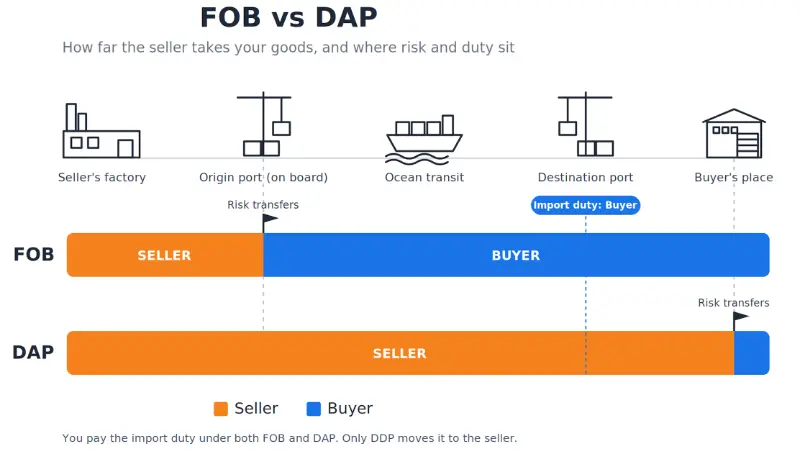
The core difference is how much of the journey the seller handles: under FOB, the seller stops at the origin port, while under DAP, the seller carries the goods all the way to your destination. Almost everything else follows from that one point. Here is the side-by-side FOB vs DAP comparison:
| Dimension | FOB | DAP |
|---|---|---|
| Shipping method | Sea and inland waterway only | Any transport mode |
| Seller’s responsibility | To loading on board + export clearance | To the named place, ready for unloading + export clearance + main carriage |
| Buyer’s responsibility | Main freight, insurance, import clearance, duties, unloading, and last-mile delivery | Unloading, import clearance, duties, and import VAT |
| Risk transfer point | When goods are loaded on board | When goods reach the named place, ready for unloading |
| Who pays the main freight | Buyer | Seller |
| Import duty/customs | Buyer | Buyer (note: not the seller) |
| Control over shipping | Buyer controls the main carriage | Seller controls delivery to the door |
Shipping method
FOB works only for sea and inland waterway shipping, while DAP works for any mode, including air and road. This is why DAP is the more flexible label when your goods move by more than one method, and why containerized ocean cargo is the one case where FCA is the cleaner choice over FOB.
Responsibilities
Picture the journey as a relay, and the two terms hand over the baton at different points. The stages are the same for both: production, export clearance, main carriage, import clearance, unloading, and last-mile delivery.
Under FOB the seller runs the first leg only, up to loading on board, then passes the baton to you. Under DAP the seller keeps running through export clearance and the entire main carriage, and only hands over once the goods reach your named place. Import clearance and duties stay with you under both.
Risk transfer point
Under FOB, risk passes when the goods are loaded on board at the origin port; under DAP, it passes when they reach your named place, ready for unloading.
FOB has one quiet danger here. You carry the risk from the moment of loading, across the whole ocean leg, yet many first-time buyers forget to arrange marine cargo insurance for exactly that stretch. A single damaged container then becomes a direct loss. Under DAP the seller carries that risk for you, which is part of what you pay for in the higher price.
Cost breakdown
FOB usually shows a lower headline price because it covers less of the journey, but the totals can land close once you add the legs you pay yourself.
Under FOB, you pay the ocean freight, insurance, destination charges, customs, duties, and delivery on top of the goods.
Under DAP, the seller folds the freight and delivery into one number, and you add only unloading, customs, and duties.
A simplified example, for a 40ft container from Ningbo to Los Angeles (illustrative, with rates as of mid-June 2026):
- FOB Ningbo price: say $18,000 for the goods, with origin local charges already folded in.
- Add ocean freight: around $5,100 per 40ft container on the Shanghai and Ningbo to US West Coast lane, per the Drewry World Container Index for the week of 18 June 2026. This is a spot rate; it is elevated by peak season, and it moves week to week, so always check the live figure.
- Add marine insurance, destination handling, customs clearance, and delivery: a few hundred dollars plus your broker fee.
- An equivalent DAP quote to your LA warehouse would bundle that freight and delivery into roughly the same total, since the seller is paying the same legs you would.
The catch is that under DAP, you still pay the import duty on top, exactly as you would under FOB. For Chinese goods entering the US in 2026 that duty is rarely trivial: imports carry a stack of a base rate plus Section 301 tariffs plus a temporary Section 122 surcharge, which for many consumer goods has landed in the rough range of twenty to forty percent of the customs value.
The exact figure is specific to your product’s code and has kept changing through the year, so confirm it on the USITC HTS and with your customs broker. Duties also vary by destination country, so the principle, not the percentage, is what travels.
Where FOB really earns its keep is the local charges that buyers forget to count. A clean FOB quote should already cover them, but they are the costs that turn a cheap headline price into a surprise:
- Terminal handling charge (THC) at the origin port
- Booking and documentation fees
- Telex release fee
- Certificate of origin and other document charges
- Inland trucking from the factory, for example Yiwu to Ningbo port
Controllability
FOB hands you control of the main carriage, while DAP hands that control to the seller. With FOB you choose your own freight forwarder, route, and sailing schedule, and you see every cost as a separate line, which is ideal once you have a forwarder you trust. With DAP you trade that control for convenience: the seller arranges everything to your door, but you lose the leverage to shop the freight and the flexibility to time the shipment.
FOB vs DAP: Pros and Cons
FOB
✅ Transparent, controllable costs; you can shop the freight and the headline price is lower.
❌ You need your own clearance and logistics ability, risk passes to you at loading, and the coordination is on you.
DAP
✅ Convenient; the seller manages delivery all the way to your door, which suits buyers without a forwarder.
❌ Higher unit price, no control over the carrier, and import clearance and duties are still yours, which is easy to misjudge.
FOB vs DAP: How to Choose?
Match the term to your logistics ability, not to whichever quote looks cheapest. Three simple cases cover most decisions.
- You have a reliable forwarder or can clear customs yourself: choose FOB. You get the lowest goods price and full control of the freight.
- You want the goods delivered to your door and you can handle import clearance: choose DAP. The seller runs the shipment, while you keep control of the customs entry.
- Your order is small, you have no clearance ability, or you want a delivered price with nothing left to pay: you most likely want DDP, where the seller also handles import customs and duties.
For an e-commerce seller sending stock into a fulfillment center, FOB plus your own forwarder usually gives the best mix of cost and control, as long as you are set up as the importer.
Further Reading:
How Long Does Shipping from China Take?
FOB vs DAP: FAQs
Is DAP the same as DDP?
No. Under DAP you clear customs and pay the import duties, while under DDP the seller does both. That single point, who is the importer of record, is the whole difference.
Is FOB or DAP cheaper?
It depends on whether you can manage your own freight. FOB has a lower headline price but you pay the ocean freight and import costs yourself, while DAP bundles delivery into one higher price and still leaves the duties to you.
Can I use FOB for container shipping?
You can, and most people do, but the ICC technically recommends FCA for containers because they are handed over before loading. FOB still works in practice for most shipments.
Who pays customs duty under DAP?
The buyer. DAP makes you the importer of record, so you clear customs and pay any duties or import taxes at the destination.
When does risk transfer under FOB?
When the goods are loaded on board the vessel at the origin port. From that moment the goods are at the buyer’s risk.
Does the seller pay freight under DAP?
Yes. Under DAP the seller pays the main freight and delivers to your named place, and you only handle unloading and import clearance.
Is FOB the same as “FOB destination”?
No. “FOB destination” is a US domestic term under the Uniform Commercial Code, not an Incoterm, and it keeps the seller responsible all the way to the buyer.
Conclusion
FOB gives you the lower goods price and full control of the shipment, but you carry the risk from loading and you have to run the logistics. DAP gives you a delivered price and a seller who manages the journey, but the unit price is higher and import clearance and duties are still yours.
Decide based on whether you can handle the freight and the customs entry, write the named place and “Incoterms 2020” into the contract, and you have removed the guesswork. If you are sourcing from China and want the right term plus a clear quote from the ground in Yiwu, we are glad to help.
Ready to import from China the straightforward way? HiSourcing finds and vets suppliers, sets the right shipping term, and runs your order from factory to port, with no service fees. Start with HiSourcing ›
Other Incoterms You Might be Interested in:


