
When you import from China, one of the first things a supplier asks is whether you want your price quoted FOB or EXW. It sounds like a small detail. It isn’t. Your choice between FOB vs EXW decides who arranges export clearance, who pays each leg of the journey, and the exact moment your risk begins.
Here’s the short answer for your quick decision: FOB is the more balanced, lower-effort choice for most importers, while EXW gives you maximum control and cost visibility if you have a reliable freight partner in China.
This post from HiSourcing breaks down what each term means, where they differ, where they’re actually the same, their pros and cons, and how to choose the right one for your business.
FOB vs EXW: Key Takeaways
| Factor | FOB (Free On Board) | EXW (Ex Works) |
|---|---|---|
| Export customs clearance | Seller handles it | You (the buyer) handle it |
| Where your risk begins | When goods are loaded on board at the origin port | At the seller’s factory door |
| Inland transport to the port | Paid by the seller | Paid by you |
| Main ocean freight | Paid by you | Paid by you |
| Quoted unit price | Higher (origin costs included) | Lower (origin costs excluded) |
| Cost visibility and control | Lower (supplier sets origin charges) | Higher (you see every cost) |
| Transport modes | Sea and inland waterway only | Any mode |
| Best suited to | Most importers, especially newer ones | Buyers with a strong China logistics partner |
What Are EXW and FOB?
Before comparing FOB vs EXW, here’s a plain definition of each. Both are official Incoterms 2020 rules published by the ICC, and both specify exactly which costs and risks belong to the seller and which to the buyer.
EXW (Ex Works)
Under EXW (Ex Works), the seller’s only job is to have the goods packed and ready at their own premises, usually the factory or warehouse. From that point on, everything is the buyer’s responsibility:
- loading the goods
- Inland transport
- Export customs clearance
- Ocean freight
- Insurance
- Import duties
- Final delivery
In short, EXW puts the least obligation on the seller and the most on you (buyer), which is why it works best only when you have a freight forwarder or agent you fully trust to manage the origin side.
FOB (Free On Board)
Under FOB (Free On Board), the seller handles everything up to and including loading the goods on board the vessel at the named port of shipment. That covers inland transport to the port and export customs clearance.
The moment the goods are loaded on board, responsibility and risk pass to you, and you then pay for the ocean freight, insurance, import clearance, and delivery. FOB splits the work in a way that feels balanced to most buyers, which is why it’s the most common term when sourcing products from China.
FOB vs EXW: What’s the Difference?
Now that the basics are clear, let’s look at where FOB and EXW actually part ways.
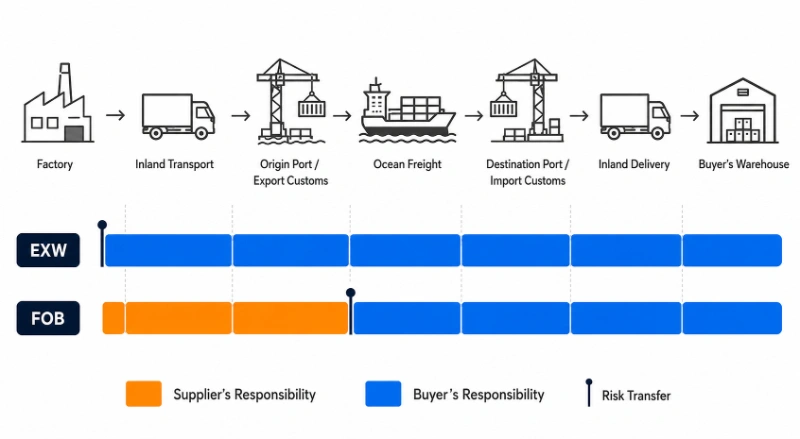
Responsibility Split
Under FOB, the seller manages the origin side, including inland transport and export clearance, and you take over once the goods are on board.
Under EXW, you are responsible for the entire chain from the factory door to your destination warehouse, including loading and export formalities.
Risk Transfer
Under FOB, risk passes to you the moment the goods are loaded on board the vessel at the port of loading.
Under EXW, risk passes to you as soon as the goods are made available at the seller’s premises, before they have even left the factory.
Export Clearance
Under FOB, the seller clears the goods for export in China.
Under EXW, export clearance is the buyer’s responsibility, so it falls on you.
Freight Control
Under FOB, the supplier arranges the origin leg, so you don’t pick the trucker or the origin terminal.
Under EXW, you arrange and control every step from the factory pickup onward.
Product Unit Price
Under FOB, the quoted unit price is higher because it already includes inland transport and export costs at the origin.
Under EXW, the quoted unit price is lower because it strips out all logistics, which can make a supplier look cheaper than they really are once you add those costs back.
Cost Transparency
Under FOB, origin charges and terminal handling charges (THC) are bundled and arranged by the supplier, so you don’t always see how each one is calculated.
Under EXW, you pay every origin charge directly, so every line item is fully visible to you.
Quote Comparability
Under FOB, prices include variable origin charges that differ by supplier and by port, so quotes are harder to line up side by side.
Under EXW, prices reflect the goods alone, giving you the cleanest basis for comparing one supplier against another.
Inland Cost
Under FOB, the supplier covers the cost of moving the goods from the factory to the port of loading.
Under EXW, you (or your forwarder) pay for that inland transport, also called pre-carriage.
Cargo Insurance
Under FOB, the seller has no obligation to insure the goods, so you should arrange cargo insurance for the main voyage.
Under EXW, the seller also has no insurance obligation. But, since your risk starts earlier (right from the factory door), insuring the goods from pickup is the safer move.
Documentation
Under FOB, the seller handles the export documents, and the carrier you book issues the Bill of Lading.
Under EXW, you are responsible for arranging export documentation yourself, which is difficult for a foreign buyer who usually cannot file Chinese export paperwork directly.
Required Expertise
Under FOB, you can import successfully even without local expertise, because the supplier handles the complex origin steps.
Under EXW, you need a capable freight forwarder or sourcing agent in China to manage pickup and export, which makes it better suited to experienced importers.
Transport Mode
Under FOB, the term is built for sea and inland waterway shipping only, so it fits ocean freight out of China.
Under EXW, the term works for any mode, including air, sea, railway, and courier.
Related Posts:
- FCA vs FOB Incoterms: What’s the Difference?
- FOB vs DDP: Ultimate Comparison for New Importers
- FOB vs DAP: How to Choose?
- FOB vs CIF: Differences, Costs & Risks
- CPT Incoterms Explained: Meaning, Costs & When to Use It?
- How Long Does Shipping from China Take?
FOB vs EXW: What’s the Similarity?
FOB and EXW are usually presented as opposites, but they share more than you might expect. Knowing what stays the same helps you understand these two incoterms more.
Incoterms Framework
FOB and EXW are both part of Incoterms 2020, the standardized trade rules published by the ICC. That means both are internationally recognized and read the same way by suppliers, forwarders, and customs authorities worldwide.
Import Responsibility
With either term, import customs clearance, import duties and taxes, and final delivery in your country are entirely your responsibility. Neither FOB nor EXW asks the seller to deal with anything at the destination port or beyond, so your customs broker handles that leg regardless.
Freight Booking
Under both terms, you can book and pay for the main carriage and choose your own freight forwarder or carrier. This gives you direct control over your ocean freight rates, no matter which term you pick.
Insurance Obligation
Unlike CIF, neither FOB nor EXW obligates the seller to buy cargo insurance. Because you carry the risk during the main voyage under both, arranging your own insurance is always a smart move.
Title Transfer
This surprises many buyers: Incoterms define costs and risk, not legal ownership. Under both FOB and EXW, when the title transfer happens is set by your sales contract, not by the Incoterm itself.
FOB vs EXW: Pros and Cons
Each term comes with clear trade-offs. Here’s a quick rundown so you can weigh them side by side.
FOB Pros and Cons
Pros:
- The supplier handles the hardest origin steps: inland transport to the port and export customs clearance.
- A balanced split of work and cost that most suppliers and forwarders know well.
- You still control and pay the main ocean freight, so you can shop around for better rates.
- Beginner-friendly, with no need to manage export formalities inside China.
Cons:
- Origin charges are arranged by the supplier, so they can carry a quiet markup you don’t notice.
- Less control over the origin leg, since you don’t choose the trucker or the origin terminal.
- Built for sea freight only, so it doesn’t suit air or courier shipments.
- The bundled unit price is higher and harder to compare across suppliers.
EXW Pros and Cons
Pros:
- Maximum control and full visibility over every cost in the chain.
- The cleanest unit price for comparing suppliers like-for-like.
- Works with any transport mode, from sea to air.
- Lets you consolidate goods from several factories your own way, which helps when buying from several suppliers.
Cons:
- You are responsible for everything from the factory door, including loading and export clearance.
- Export clearance in China falls on you, and most foreign buyers cannot file it directly without local help.
- It’s the riskiest term, because risk passes to you before the goods even leave the factory.
- Not beginner-friendly, and mistakes at origin can get expensive fast.
FOB vs EXW: How to Choose?
The right term depends on your experience, your shipping setup, and how much control you want. Use the pointers below to find your fit, whether you’re stocking a warehouse or sending goods to Amazon FBA.
When to Choose FOB?
FOB is usually the safer default. Choose FOB if:
- You’re shipping by sea, which covers most cargo coming out of China.
- You want the supplier to handle origin logistics and export clearance.
- You’re newer to importing or don’t yet have a trusted forwarder in China.
- You want to control and compare your own ocean freight rates.
For most importers, especially those still building their supply chain, FOB removes the riskiest and most technical part of the origin process.
When to Choose EXW?
EXW rewards control, but only if you can handle the origin side. Choose EXW if:
- You have a reliable freight forwarder or sourcing agent in China to manage pickup and export.
- You want full visibility into every cost and the cleanest unit prices.
- You’re consolidating orders from multiple suppliers and want to manage that yourself.
- You’re shipping by a mode that doesn’t fit FOB, such as air.
We’re HiSourcing, a leading sourcing firm in China. Over the past 9 years, we’ve helped 1000+ importers, wholesalers, Amazon FBA sellers, and start-ups around the world bring products out of China without the usual headaches.
As your sourcing partner on the ground, we handle the whole process: finding reliable suppliers, sourcing products at the best price, checking samples, overseeing production, running quality inspections, consolidating your orders, and arranging shipping.
We support all delivery terms, from EXW to DDP, and help you pick the one that fits your order best. Tell us about your ideas, and our dedicated sourcing expert will give you a precise quote.
Frequently Asked Questions
Are EXW and FOB the same?
No. With EXW you handle everything from the factory door, including export clearance. With FOB the seller covers inland transport, export clearance, and loading on board before you take over.
Is FOB cheaper than EXW?
Not exactly. The FOB price looks higher because it includes origin costs, but the total landed cost is usually about the same. EXW only works out cheaper if you can handle the origin side efficiently.
When should EXW not be used?
Avoid EXW when you don’t have a reliable agent or forwarder in China, since you’d be on the hook for export clearance and origin logistics that most foreign buyers can’t handle directly. In that case, FOB is the safer choice.
What’s the difference between FOB, CIF, and EXW?
EXW means the seller just has the goods ready at the factory. FOB adds loading on board and export clearance. CIF goes one step further: the seller also pays ocean freight and insurance to the destination port, though risk still passes at loading.


