
Stanley cups are made in China and Brazil. Design, testing, and corporate operations happen at the brand’s Seattle, Washington headquarters. This American company has not run mass production in the United States since 2002, when Pacific Market International (PMI) acquired the Stanley brand and shifted manufacturing to Chinese factories.
This guide from HiSourcing covers where Stanley cups are made, why China dominates the supply chain, how the manufacturing process works, and how to tell an authentic Stanley product from a counterfeit. As a China sourcing agent based in Yiwu, we work closely with stainless steel drinkware factories across the manufacturing clusters where Stanley cups are produced.
Stanley Cups Manufacturing at a Glance
| Field | Detail |
|---|---|
| Primary manufacturing location | China |
| Secondary manufacturing location | Brazil (Manaus and Rio de Janeiro) |
| Design and testing | Seattle, Washington, USA |
| Parent company | Pacific Market International (PMI) |
| Ultimate parent | The HAVI Group LP |
| Current brand name | Stanley 1913 |
| Brand founded | 1913, Great Barrington, Massachusetts |
| Main China production hubs | Yongkang (Zhejiang Province) and Dongguan (Guangdong Province) |
| Year manufacturing moved to China | 2002 |
Where Are Stanley Cups Made?
Stanley cups are primarily made in China, with a smaller share produced in Brazil. The brand’s Seattle headquarters handles design, testing, and quality oversight, but no Stanley products are mass-produced in the United States today.
Here is the country breakdown:
| Country | Role | Notes |
|---|---|---|
| China | Primary manufacturing | Vast majority of stainless steel tumblers, water bottles, and thermos flasks |
| Brazil | Secondary manufacturing | Two facilities, mainly serving regional markets |
| USA | Design, testing, brand operations | No mass production since 2002 |
Most consumers searching for “where are Stanley cups made” expect a Made in USA answer, but the supply chain reality is that the brand operates as an American company with global manufacturing. It’s kind of like a low-cost country sourcing strategy.
Brief History of Stanley Cup Manufacturing
Stanley’s manufacturing locations have shifted three times in 110 years. Production started in Massachusetts, moved to Tennessee in 1965, and finally relocated to China in 2002.
From Massachusetts to Global: A 110-Year Timeline
The Stanley brand traces back to a single invention. On September 2, 1913, William Stanley Jr. received US Patent 1071817A for the first all-steel vacuum flask. This patent laid the foundation for the entire Stanley product line.
| Year | Event |
|---|---|
| 1913 | William Stanley Jr. patents the all-steel vacuum flask |
| 1915 | Stanley Insulating Company founded in Great Barrington, Massachusetts |
| 1921 | Acquired by Landers, Frary & Clark of New Britain, Connecticut |
| 1965 | Acquired by Aladdin Industries of Nashville, Tennessee |
| 1988 | Aladdin outsources plastic molding to Brazil |
| 2002 | Pacific Market International (PMI) acquires Stanley, manufacturing moves to China |
| 2016 | Stanley Quencher tumbler launched |
| 2020 | Terence Reilly joins as president, social media strategy launched |
| 2019 to 2023 | Annual revenue grows from $70 million to $750 million (per CNBC) |
The shift to China in 2002 marked the most significant change. Before that point, Stanley products were assembled in the United States or Brazil. PMI moved core production to Chinese factories shortly after the acquisition.
Who Owns Stanley Cups Today?
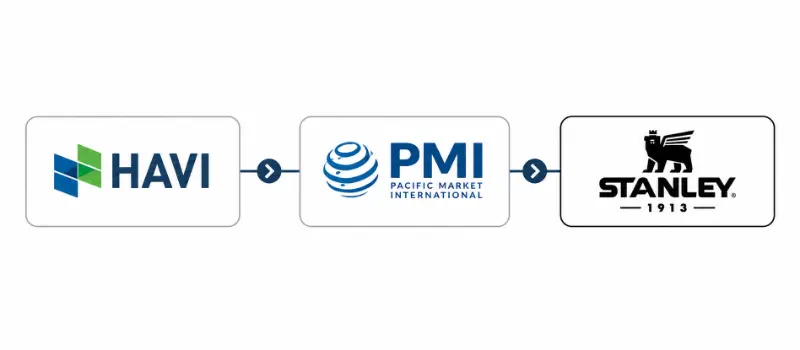
Stanley cups are owned by Pacific Market International (PMI), today operating as PMI WW Brands, LLC. a Seattle-based company that operates as a subsidiary of The HAVI Group LP. PMI manages the Stanley brand, oversees product design, and contracts with manufacturers in China and Brazil for production.
The ownership chain is straightforward: the Stanley brand belongs to PMI, and PMI belongs to HAVI.
The brand uses Stanley 1913 as its official name across all marketing channels. This naming reflects both the founding year and the brand’s broader identity strategy.
Are Stanley Cups Made in China?
Yes, Stanley cups are primarily made in China. Production began shifting to China in 2002 after PMI acquired the brand, and China has remained Stanley’s main manufacturing base ever since. The bulk of Stanley’s stainless steel tumblers, water bottles, and thermos flasks comes from Chinese factories.
Further Reading:
Two production clusters handle most of Stanley’s Chinese output: Yongkang in Zhejiang Province and Dongguan in Guangdong Province. Both regions specialize in stainless steel drinkware and have decades of OEM experience.
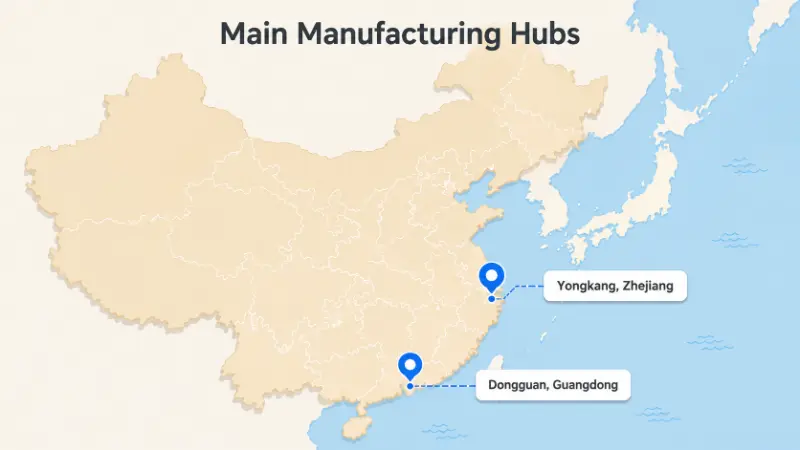
Yongkang, Zhejiang: China’s Vacuum Flask Hub
Yongkang, a city in eastern Zhejiang Province, is China’s largest production cluster for vacuum-insulated drinkware. The city earned the nickname “Hardware Capital of China” because it concentrated stainless steel and metalworking factories.
Yongkang’s geography supports its manufacturing role. The city sits about 55 kilometers from Yiwu, the world’s largest small commodities trading hub. It is also close to Ningbo Port, one of the busiest container ports in the world, which simplifies export logistics. Hangzhou, the provincial capital, lies within easy reach.
The Yongkang cluster offers a closed-loop supply chain for vacuum flasks. Raw materials, molds, surface treatment, lids, straws, and packaging are all available within a short driving distance. This integration is one reason brands like Stanley, Yeti, and Hydro Flask all source from the same region.
Dongguan, Guangdong: The Secondary Production Cluster
Dongguan, located in Guangdong Province, is China’s secondary production cluster for Stanley cups. The Pearl River Delta region has long served as a manufacturing base for export-oriented consumer goods, and Dongguan’s stainless steel factories supply much of southern China’s drinkware output.
Dongguan factories tend to focus on higher-volume runs and complex product customization. Many also handle finishing steps like powder coating, laser engraving, and packaging. For Stanley, the Dongguan cluster supplements the larger Yongkang base and provides flexibility for specific product lines.
Why Does Stanley Manufacture in China?
Stanley manufactures in China because the country offers a complete vacuum flask supply chain, mature OEM and ODM capabilities, and broad international certification compliance. No other country currently matches China in all three areas at the scale Stanley requires.
This is not just a cost decision. Chinese vacuum flask factories have spent two decades refining the specific processes needed to produce double-wall, vacuum-insulated stainless steel drinkware at consistent quality.
A Complete Vacuum Flask Supply Chain
China’s drinkware industrial clusters, especially Yongkang and Dongguan, contain every layer of the supply chain in one region. A factory in Yongkang can source 304 stainless steel coils, deep drawing molds, powder coatings, silicone seals, plastic lids, and retail-ready packaging from suppliers within a single industrial park.
This local sourcing structure reduces lead times. A new product design can move from prototype to mass production in weeks rather than months. For a brand like Stanley that releases seasonal colors and limited editions, this responsiveness is a major advantage.
Mature OEM/ODM Capabilities
OEM (Original Equipment Manufacturer) means a factory produces goods to a brand’s exact specifications. ODM (Original Design Manufacturer) means the factory designs and manufactures products that the brand then sells under its own label. Chinese vacuum flask factories handle both models at scale.
Core technologies in this category include deep drawing forming, laser welding, vacuum sealing, electrolytic surface treatment, and powder coating. Many top Chinese factories have automated these processes, which improves consistency across large production runs. Years of experience producing for international brands have refined these capabilities to a level that buyers from Europe, North America, and Asia rely on.
International Certifications (FDA, LFGB, BSCI)
Chinese drinkware factories that supply Stanley and similar brands typically hold a stack of international certifications. The most relevant ones are:
- FDA (US Food and Drug Administration): Confirms that materials in contact with food and beverages meet US safety standards
- LFGB (Lebensmittel- und Futtermittelgesetzbuch): Germany’s food contact materials safety standard, broadly accepted across the European Union
- BSCI (Business Social Compliance Initiative): An ethical manufacturing audit covering working conditions, wages, and hours
- ISO 9001: International standard for quality management systems
Stanley’s official statements describe their China and Brazil suppliers as meeting “high quality and ethical standards.” In practice, this means suppliers undergo regular audits against these certifications. For brand buyers sourcing from China today, asking for current FDA and LFGB test reports is a standard step before placing orders.
Are Stanley Cups Made in the USA?
No, Stanley cups are not currently manufactured in the United States. The American brand handles all design, testing, marketing, and corporate operations at its Seattle headquarters, but mass production has been based overseas since 2002.
Seattle: Where Stanley Cups Are Designed
According to Stanley’s official statements, all Stanley products are “designed and tested in our Seattle, Washington headquarters.” This is where product engineers, designers, and quality teams work on new tumblers, water bottles, and limited-edition releases.
The Seattle office handles:
- Product design and engineering
- Material specifications and prototyping
- Quality control standards
- Supplier audits and oversight
- Marketing, sales, and brand management
This is the standard split for many globally distributed consumer brands. Design happens in one country, manufacturing happens in another, and quality oversight bridges the two.
Further reading:
- Where are Coach bags made?
- Where are Skechers shoes made?
- 15 Best Chinese Replica Websites: Clothes/Shoes/Bags/Watches/Electronics
Why There’s No US Mass Production Today
The shift to overseas production in 2002 was driven by cost, supply chain efficiency, and access to specialized manufacturing capabilities. US stainless steel drinkware factories at the time could not match the scale or unit economics that PMI needed to grow the brand.
This pattern is common across the drinkware category. Yeti, Hydro Flask, Thermos, and most other major brands also manufacture in Asia despite being American or European companies. The infrastructure for high-volume vacuum flask production simply concentrated in China during this period, and it has stayed there.
Where Are Specific Stanley Products Made?
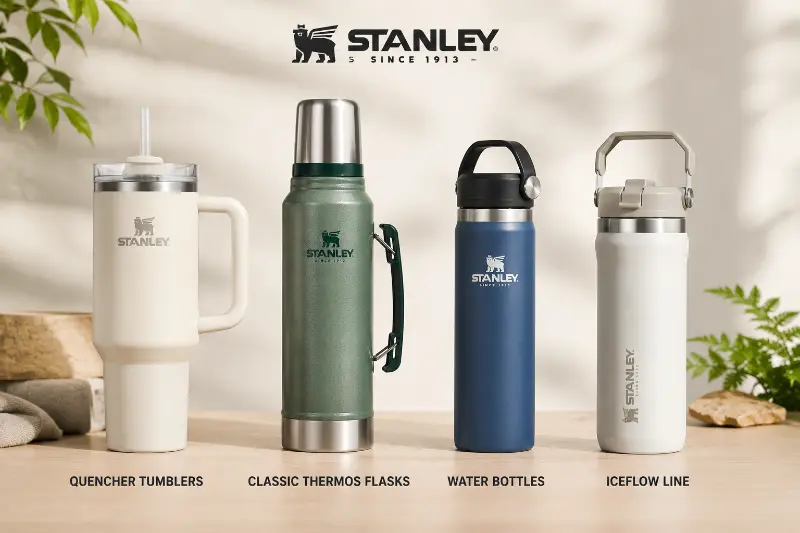
Most Stanley products, including Quencher tumblers, classic thermos flasks, water bottles, and the IceFlow line, are made in China. A smaller selection comes from Stanley’s Brazilian facilities, mainly for regional distribution.
The country of origin is usually printed on the base of the cup or on the packaging. Here is the breakdown by major product line.
Stanley Quencher Tumblers
The Stanley Quencher, the 40-oz tumbler that drove the brand’s viral growth on social media from 2020 onward, is made in China. The Quencher line is produced in sizes of 14, 20, 30, and 40 US fluid ounces, with all sizes manufactured at Chinese contract factories. This is the brand’s best-selling product and accounts for a large share of total production volume.
Stanley Classic Thermos
Stanley’s heritage product line, the green Classic vacuum bottles and thermos flasks that the brand has produced for over a century, is also made in China today. Earlier generations of these products were manufactured in the US and Brazil, but current production is concentrated in Chinese factories alongside the rest of the catalog.
Stanley Water Bottles and IceFlow
Stanley’s water bottles, including the IceFlow series of flip straw and lid-top hydration bottles, are manufactured in China. Both lines share the same supply chain as the Quencher and use similar materials and construction methods.
Stanley Cups Made in Brazil
Stanley operates two manufacturing facilities in Brazil, located in Manaus and Rio de Janeiro. The Brazilian operations focus on basic insulated bottles and serve primarily the South American market. Production volume is smaller than the Chinese facilities, and the Brazilian factories do not handle the brand’s full product range.
The dual-country setup gives Stanley supply chain redundancy. If Chinese production faced disruption, Brazilian facilities could cover part of the demand for select product categories.
How Are Stanley Cups Manufactured?
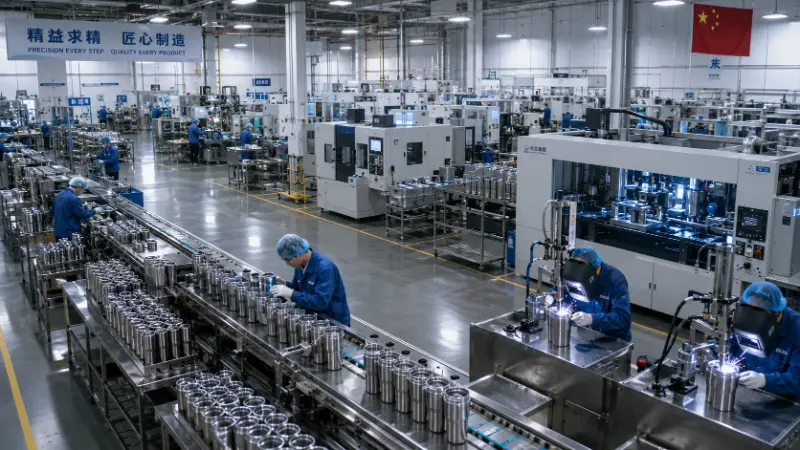
Stanley cups are made through a multi-step process that combines stainless steel forming, vacuum sealing, surface finishing, and quality testing. The full sequence runs from raw material selection to final packaging.
This process is standard across most Chinese vacuum flask factories that produce for Stanley, Yeti, and similar brands. Each step matters for the finished product’s insulation performance and durability.
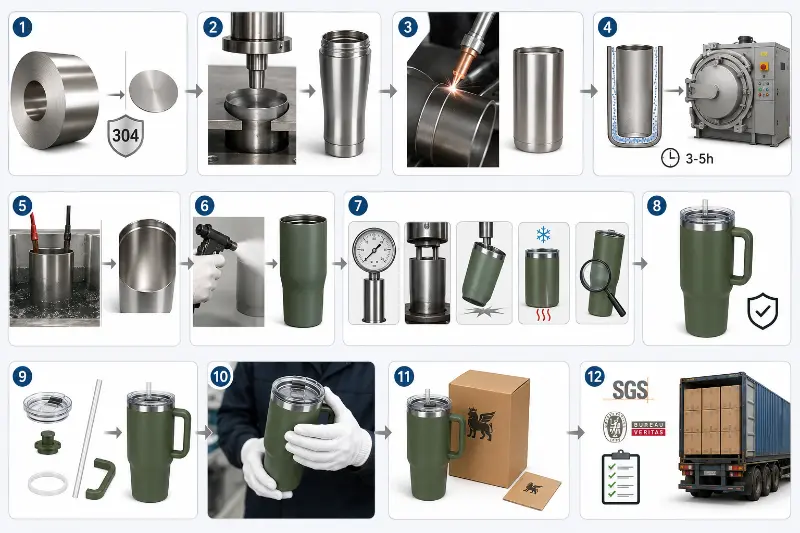
Raw Material Selection (304 Stainless Steel)
Stanley cups start with food-grade 304 stainless steel, also written as 18/8 stainless steel. The number refers to the alloy composition: about 18 percent chromium and 8 percent nickel. This grade is the standard for premium drinkware because it resists corrosion, does not react with beverages, and tolerates repeated temperature changes.
Factories source steel coils from certified mills, then cut them into the size and shape needed for inner and outer cup walls. Lower grades like 201 stainless steel are cheaper but more reactive, and they are not used in authentic Stanley products.
Forming, Welding, and Vacuum Sealing
The inner and outer cup walls are formed using either pipe cutting or deep drawing. Deep drawing pulls a flat steel disc into a cup shape using a hydraulic press and a matched mold. This step shapes the neck, threads, and base.
After forming, the inner and outer walls are joined by welding. Many top factories use laser welding for the seam, which produces a cleaner, stronger joint than traditional welding. The cups then move to vacuum machines, where the air is removed from the space between the two walls. This vacuum layer is what gives the cup its insulation performance.
A typical vacuum process runs for three to five hours per batch. Pressure and temperature testing follow immediately to confirm the vacuum holds.
Surface Treatment and Quality Testing
The cups then receive surface treatment. The inner wall typically undergoes electrolysis, which creates a smooth, corrosion-resistant finish. The outer wall is polished and then powder-coated to add color, grip, and scratch resistance.
Top factories perform quality testing at multiple stages:
- Helium leak testing to confirm vacuum integrity
- Pressure testing, sometimes at 1200 kPa, to test for structural defects
- Drop testing to confirm impact resistance
- Temperature retention testing to verify insulation performance
- Visual inspection for surface defects
These tests filter out cups that do not meet specifications before they move to assembly.
Assembly and Final QC
The final stage adds lids, straws, handles, and silicone seals. Each unit goes through a last visual and functional inspection, then gets packaged for shipping. Packaging usually includes a printed carton with brand markings, instruction inserts, and any retailer-required labeling.
For brands like Stanley, final QC also involves third-party inspection. Independent firms such as SGS and Bureau Veritas conduct random audits on outbound shipments to verify compliance with the brand’s quality standards.
At HiSourcing, we have our own quality control team. Before shipping, we conduct a thorough 1-by-1 inspection to make sure everything meets the Quality Control Checklist.
How to Spot a Fake Stanley Cup?
Counterfeit Stanley cups have flooded online marketplaces since the Quencher went viral on social media. The good news: spotting a fake takes seconds once you know the details.
These checks apply equally to authentic Chinese-made and Brazilian-made Stanley products. The country of origin is not the issue. Unauthorized counterfeit factories are.
Check the Handle and Screws
- Screws: Authentic Stanley handles use hex head screws that require an Allen wrench. Phillips (cross-head) screws are a clear sign of a fake.
- Position: The real handle sits close to the top of the cup. Counterfeit handles are typically positioned about 1 cm lower.
- Length: An authentic 40 oz Quencher handle measures approximately 12.8 cm. Fakes are usually around 11.7 cm.
- Texture: Real handles feel smooth and soft. Counterfeit handles often have a visible plastic seam and feel hard.
- Grip inserts: Authentic soft grip inserts sit flush with the handle. Fake inserts often protrude slightly.
Inspect the Logo, Bottom, and Materials
- Logo placement: Authentic Stanley logos are precisely centered and aligned. Off-center, crooked, or undersized logos indicate a counterfeit.
- Logo printing quality: Real logos are sharp, clean, and fade-resistant. Smudged, blurry, or easily scratched logos are red flags.
- Bottom markings: Authentic cups have clearly etched manufacturer markings including the country of origin (Made in China or Made in Brazil) and product details. Missing or blurry stamping signals a fake.
- Lid material: Genuine Quencher lids use white BPA-free Tritan plastic. Counterfeit lids often have a slight blue hue.
- Top rim width: The silver rim around the cup mouth is approximately 8 mm wide on authentic cups. Fakes tend to have a wider rim, around 10 mm.
- Color match: Cross-check the color against stanley1913.com. Colorways not listed on the official site do not exist as genuine products.
Test the Build Quality
- Weight: Authentic Stanley tumblers feel solid and well-balanced. Lightweight or hollow-feeling cups indicate cheap, thin steel.
- Welding seams: Real cups have smooth, seamless construction. Visible rough seams or uneven joins are signs of a fake.
- Insulation performance: Genuine Stanley cups keep drinks hot for at least 7 hours and cold for over 11 hours. Significantly worse retention points to a counterfeit.
Buy from Authorized Retailers Only
- Verified channels: Buy only from stanley1913.com, Target, Dick’s Sporting Goods, REI, Amazon’s official Stanley store, or other listed authorized dealers.
- High-risk channels: Avoid TikTok Shop, unknown Amazon third-party sellers, random Instagram stores, and unfamiliar marketplaces.
- Price red flag: Brand-new 30 oz and 40 oz Quenchers retail within a defined range. Deep discounts on new products are usually counterfeit signals.
- Verify if unsure: Contact Stanley customer service with photos. They confirm authenticity directly.
Stanley vs Yeti: Where Are They Made?
Both Stanley and Yeti manufacture their stainless steel drinkware primarily in China. The two brands share a similar overseas production strategy and use overlapping supplier networks, but they differ in pricing, design language, and target customers.
Here is a side-by-side comparison:
| Feature | Stanley (Quencher) | Yeti (Rambler) |
|---|---|---|
| Primary manufacturing | China | China and the Philippines |
| Secondary manufacturing | Brazil | Limited US operations |
| Design and HQ | Seattle, Washington | Austin, Texas |
| Material | 304 stainless steel | 18/8 stainless steel (304 equivalent) |
| Founded | 1913 | 2006 |
| Retail price range (40 oz) | $45 to $55 | $40 to $50 |
| Brand positioning | Lifestyle and viral social media | Outdoor and rugged |
Both brands rely on the same Chinese manufacturing infrastructure that handles vacuum-insulated drinkware. Choosing between them is mostly a question of design preference, price point, and brand identity rather than country of origin.
Looking for Stanley-Quality Tumblers from China?
If you are an importer, wholesaler, or private-label brand looking to source Stanley-quality stainless-steel drinkware directly from China, HiSourcing can help.
As a China sourcing agent based in Yiwu, we work with the same manufacturing clusters in Yongkang and Dongguan that produce for top global drinkware brands, and we have developed our own Stanley Cup manufacturers network.
We help international buyers find verified factories, manage quality control, and handle the full procurement process from sample to shipment. If you have any needs, feel free to Contact US and Get a Quote.
Frequently Asked Questions
Are real Stanley cups made in China?
Yes, authentic Stanley cups are made in China. Pacific Market International (PMI), Stanley’s parent company, moved production to Chinese factories in 2002. Products manufactured at PMI’s authorized Chinese contract factories are genuine Stanley products. The country of origin is printed on the base of every cup and on the packaging.
Is Stanley still an American company?
Yes, Stanley is still an American company. The brand is owned by Pacific Market International (PMI), a Seattle-based subsidiary of The HAVI Group LP. All design, testing, marketing, and corporate operations remain at Stanley’s Seattle, Washington headquarters, even though manufacturing happens in China and Brazil.
What country is Stanley made in?
Stanley cups are made in China and Brazil. China handles the majority of production, including all Quencher tumblers, water bottles, and thermos flasks. Brazil produces a smaller share of basic insulated bottles for regional distribution.
Who invented the Stanley cup?
William Stanley Jr. invented the Stanley vacuum flask in 1913. He received US Patent 1071817A on September 2, 1913, for the first all-steel insulated vacuum bottle. He founded the Stanley Insulating Company in Great Barrington, Massachusetts, in 1915.
What are Stanley cups made of?
Stanley cups are made of 304 stainless steel, also called 18/8 stainless steel, for both inner and outer walls. The lids and straws are typically BPA-free plastic, and silicone seals provide leak resistance. The exterior usually features a durable powder coat finish.
Why are Stanley mugs so expensive?
Stanley mugs are priced based on premium materials, brand investment, distribution costs, and lifetime warranty coverage. The Quencher tumbler uses food-grade 304 stainless steel and double-wall vacuum insulation, which cost more to produce than basic drinkware. Stanley also invests heavily in influencer partnerships and limited-edition releases, which support the brand’s premium positioning.


