
When you agree to FOB shipping point vs FOB destination, you are settling one thing that matters more than any other detail in the contract: the exact moment the goods stop being the seller’s problem and become yours.
Under FOB shipping point, that moment is when the goods are handed to the carrier at the origin.
Under FOB destination, it doesn’t arrive until the shipment reaches your door.
Key Takeaways
- FOB shipping point means ownership and risk pass to the buyer once the goods are handed to the carrier at the named origin.
- FOB destination means the seller keeps ownership and risk until the goods arrive at the buyer’s named location.
- Under FOB shipping point, the buyer usually pays freight; Under FOB destination, the seller usually pays.
- Import duties and taxes normally stay with the buyer under both terms.
- “Freight prepaid” and “freight collect” decide who pays the carrier, which is separate from who owns the goods.
- In international contracts, DAP is the Incoterms rule that works the same way as FOB destination.
In this post from HiSourcing, you’ll find plain definitions, real shipment examples, a FOB shipping point vs FOB destination comparison table, and a full cost breakdown for each term, so you know exactly what you’re signing on your next purchase order.
What is FOB Shipping Point?
FOB shipping point (also called FOB origin) means the buyer takes ownership of the goods, along with the risk of loss or damage, the moment the seller hands them to the carrier at the named origin point.
From that moment on, the buyer pays the freight and deals with anything that goes wrong in transit.
The seller’s job ends once the goods are handed to the carrier at the origin point. From that second, the goods belong to the buyer. The buyer usually pays the freight, arranges the shipping, and files any claim if something is lost or damaged on the way.
Because the risk passes so early, buyers on these terms almost always arrange their own cargo insurance.
FOB shipping point example
Say you order 500 lamps from a supplier under FOB shipping point. The supplier delivers them to the carrier at the origin port, and at that moment, the lamps become yours.
If a container is dropped and half the lamps shatter in transit, the loss is on you, not the supplier. You would file the claim against your own cargo insurance, not ask the supplier for a refund.
Sourcing from China? HiSourcing helps importers pin down the right shipping term and get a clear, itemized FOB price quote from vetted suppliers, with no service fees. Talk to our team ›
What is FOB Destination?
FOB destination means the seller keeps ownership of the goods and the risk, until they are delivered to the buyer’s named location, usually the receiving dock. The seller usually pays the freight and stays responsible for the goods the entire way there.
A common question is whether the transfer happens the moment goods arrive, or only after the buyer inspects and accepts them.
Under the U.S. Uniform Commercial Code (UCC § 2-319), the seller must transport the goods at its own expense and risk to the named place and tender delivery there. Risk passes once the goods arrive and are made available for you to take delivery.
Your right to inspect doesn’t postpone that transfer, but it doesn’t weaken your protection either. Any damage that happened in transit occurred while the seller still carried the risk, so the seller is responsible for it regardless.
FOB destination example
Take the same order of 500 lamps, this time under FOB destination. The supplier owns the lamps until they reach your warehouse.
If that same container is dropped in transit, the supplier has to replace the broken lamps or refund you. The risk during the journey was never yours to carry.
FOB Shipping Point vs FOB Destination: Key Differences
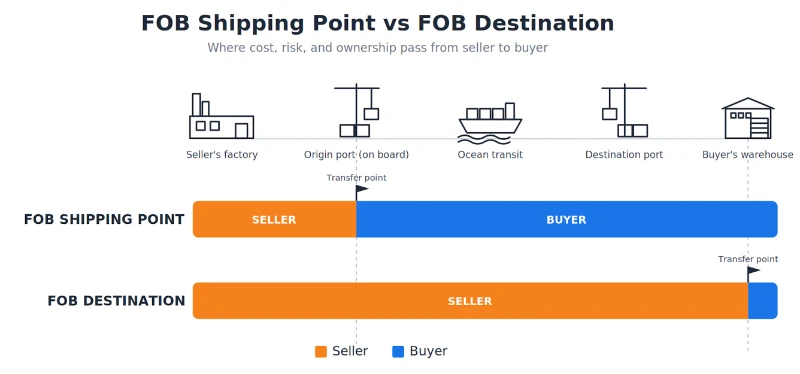
The two terms split every major responsibility at opposite ends of the trip. Here is the FOB shipping point vs FOB destination side-by-side comparison:
| Factor | FOB Shipping Point | FOB Destination |
|---|---|---|
| Also called | FOB origin, FOB point | FOB destination point |
| Ownership transfers | When goods are handed to the carrier at the origin | When goods arrive at the buyer’s named location |
| Risk during transit | Buyer | Seller |
| Who usually pays freight | Buyer | Seller |
| Cargo insurance | Arranged and paid by the buyer | Arranged and paid by the seller |
| Who arranges shipping | Buyer picks the forwarder and carrier | Seller controls the shipping arrangements |
| Who files damage claims | Buyer | Seller |
| Import duties & taxes | Buyer | Buyer, unless agreed otherwise |
| Best for | Importers who manage their own freight | High-value goods and delivered-price deals |
Who Pays FOB Shipping Point vs FOB Destination Cost?
Under FOB shipping point, the buyer pays for the main journey, and under FOB destination, the seller does. Either way, import duties and taxes normally stay with the buyer. Here is the standard split.
Cost under FOB shipping point
- Seller pays for: export packaging + inland transport to the port or carrier at origin + export customs clearance + loading and origin charges.
- Buyer pays for: main freight (ocean or air) + cargo insurance + destination port charges + import customs clearance, duties, and taxes + final delivery to their own warehouse.
Cost under FOB destination
- Seller pays for: export packaging + inland transport at origin + export customs clearance + main freight + cargo insurance + delivery to the buyer’s named location.
- Buyer pays for: import duties and taxes (unless the contract states otherwise) + unloading at their own dock.
One more label to watch is who pays the carrier. “Freight prepaid” means the seller pays the carrier; “freight collect” means the buyer pays the carrier. That is a separate question from who owns the goods. You can have FOB shipping point with freight prepaid, where the buyer owns the goods from the origin while the seller pre-pays the carrier and bills it back.
Importing from China? HiSourcing finds and vets suppliers, sourcing products at factory price, locks in the right shipping term, and manages your order from factory to port. Start with HiSourcing ›
Freight Prepaid vs Freight Collect: Reading the Full FOB Term
On invoices and bills of lading, FOB terms often carry a second phrase: freight prepaid or freight collect. The first half of the term controls ownership and risk. The second half only controls who pays the carrier.
- FOB shipping point, freight collect: the buyer owns the goods in transit and pays the carrier. This is the default pairing.
- FOB shipping point, freight prepaid: the buyer still carries the transit risk, but the seller pays the freight bill. If the term adds “and charged back,” the seller invoices that freight cost to the buyer afterward.
- FOB destination, freight prepaid: the seller carries the risk and pays the freight. This is the default pairing.
- FOB destination, freight collect: the seller carries the risk all the way to delivery, but the buyer pays the carrier on arrival.
So a term like “FOB destination, freight collect” is not a contradiction. It simply separates who is liable for the goods from who gets billed for the truck or vessel.
FOB Destination vs DAP: The Term Importers Actually Use
Here is the part that quick definitions tend to skip. “FOB destination” is a US domestic shipping term, and it does not exist in the Incoterms rules that govern international trade.
So when you import from a supplier overseas, like sourcing products from China, you will rarely see a clean “FOB destination” in a proper contract. The term that does the same job is DAP.
DAP (Delivered at Place) means the seller delivers the goods to your named destination and carries the risk the whole way there, while you handle import customs clearance and the duties. It gives you seller-arranged delivery with your own control over the customs entry.
DDP (Delivered Duty Paid) goes one step further: the seller also pays the import duties and taxes. The easiest way to picture DDP is FOB destination plus duties.
This matters on a real purchase order. If you write “FOB destination” to an overseas supplier, the two sides can read it completely differently. The supplier may read “FOB” the Incoterms way, as loaded at the origin port with you arranging the main freight, while you expected delivery to your door.
The result is that no one books the ocean freight or arranges customs. For anything crossing a border, use DAP or DDP for delivered terms, or FOB followed by the port for an origin handoff, and always add the named place and “Incoterms 2020.”
| FOB Destination (US) | DAP (Incoterms) | DDP (Incoterms) | |
|---|---|---|---|
| Where it applies | US domestic | International | International |
| Seller delivers to | Buyer’s location | Buyer’s named place | Buyer’s named place |
| Seller pays freight | Yes | Yes | Yes |
| Who clears import and pays duties | Not applicable (domestic) | Buyer | Seller |
| Risk transfers | At the buyer’s location | At the named place | At the named place |
More international trade terms under ICC Incoterms 2020:
Which Should You Use, FOB Shipping Point or FOB Destination?
Most experienced importers choose FOB shipping point, or Incoterms FOB on international deals, because it usually delivers a lower landed cost and full control over the freight.
Choose FOB shipping point when you have a freight forwarder you trust, you want to compare carrier rates yourself, and you’re ready to buy cargo insurance. The unit price is lower because the seller isn’t pricing transit risk into the quote.
Choose FOB destination (or DAP) when the goods are fragile or high value, you’re new to importing, or you simply want one delivered price with no logistics homework. Expect to pay a premium for the convenience, since the seller builds freight, insurance, and risk into the price.
If your supplier is quoting other terms instead, some of our blogs picked and explained some commonly used ones:
Not sure which term fits your next order? HiSourcing arranges FOB shipments from vetted China suppliers and explains every cost up front. Get a quote ›
When you import from overseas, most experienced buyers ship FOB at the origin port. It gives full visibility into every cost, lets you choose your own freight forwarder, and leaves a natural checkpoint at the port for a pre-shipment inspection before the goods ever leave the country.
Common FOB Mistakes to Avoid
A few simple habits prevent almost every FOB dispute:
- Do not assume FOB means free shipping. It sets who is responsible, not a discount on the price.
- Keep two questions apart: who owns the goods, and who pays the carrier. Ownership and freight prepaid or collect are different things.
- Confirm cargo insurance for your leg of the trip. A gap here turns a transit accident into a direct loss.
- Skip “FOB destination” on international orders. Use DAP or DDP so both sides read the contract the same way.
- Always write the named place and the rule set, for example, “FOB Ningbo, Incoterms 2020,” so there is nothing left to interpret.
Conclusion
FOB shipping point vs FOB destination comes down to one decision: where responsibility for the goods changes hands. Under FOB shipping point, it passes to you at the seller’s location, so the transit risk and most of the cost are yours. Under FOB destination stays with the seller until the goods reach you.
Once you know where that handoff sits, the freight, the insurance, and the paperwork all follow from it. And when your shipment crosses a border, reach for the Incoterm that matches what you actually want, whether that is FOB at the port, DAP, or DDP.
FAQs about FOB Shipping Point vs FOB Destination
Is FOB shipping point the same as FOB destination?
No. They are opposites: FOB shipping point passes ownership and risk to the buyer at the seller’s location, while FOB destination keeps them with the seller until the goods reach the buyer.
Is FOB origin or destination better?
Neither is better for everyone. FOB origin, also called shipping point, suits buyers who want control and a lower price, while FOB destination suits buyers who want convenience and less transit risk.
Is DAP the same as FOB destination?
They are close but not identical. DAP is the Incoterms term for international shipments where the seller delivers to your location and you clear customs, while FOB destination is a US domestic term that says nothing about import duties.
Is Amazon FOB shipping point or destination?
It depends on the deal. As a third-party FBA seller you are the importer, so you usually buy from your supplier on FOB origin terms and arrange the freight to the Amazon warehouse yourself.
Is FOB only for sea freight?
Under the Incoterms rules, FOB applies only to sea and inland waterway transport, and FCA is the correct term for air or road. The US domestic FOB shipping point and FOB destination labels are used more broadly across transport modes.
Is freight collect the same as FOB shipping point?
No. Freight collect only says the buyer pays the carrier, while FOB shipping point says the buyer owns the goods and carries the risk from the seller’s location. A shipment can be FOB shipping point with either freight collect or freight prepaid.


