
A shipping mark is identifying information printed or labeled on the outside of a cargo carton or crate. It tells handlers, customs officers, and warehouse staff who the goods belong to, where they are going, how much they weigh, and how to handle them.
Think of it as the ID card for your shipment. Without it, your boxes are just anonymous cargo in a container with 30 other importers’ orders. And in that situation, things go wrong — wrong delivery, delayed customs clearance, missing cartons that nobody can trace.
After reading this guide, you’ll learn what goes on a shipping mark, how to format one, what Chinese factories typically get wrong, and what Amazon FBA specifically requires. Let’s dive in.
What Is a Shipping Mark?
A shipping mark, sometimes called a cargo mark, box mark, or shipping mark and number, is the trade identification information applied to the outer packaging of goods shipped internationally.
It appears on cartons, crates, pallets, and shipping documents. The bill of lading(B/L), for example, has a dedicated ‘Marks and Numbers’ field that must match the marks on your physical cartons exactly. These same marks also appear on the shipping manifest, the carrier’s master list of all cargo on the vessel, which customs authorities use to verify your shipment at the destination port.
One thing that confuses many first-time importers:
A shipping mark is not the same as a shipping label.
A shipping label is the barcode sticker generated by FedEx, UPS, or your courier for route tracking. A shipping mark is the trade information you provide to your supplier.
When your Chinese factory asks, ‘Do you have a shipping mark for us?’ in your product spec sheet, they want your consignee details and PO number, not a courier sticker.
What Goes on a Shipping Mark?
There is no single globally mandated format, but five categories of information are standard across international freight.
1. Consignee Information
This is the most important part. The consignee is the person or company receiving the goods. You need:
- Full company name (in English, or the language of the destination country)
- Destination port or city
- Optionally: PO number, order reference
Example:
GOTHENBURG, SWEDEN
PO NO.: NH-2026-084
If this is wrong, whether it is wrong spelling or wrong port, your goods cannot be released to you. Customs and port operators work from the marks on the carton. They do not call around to find out who a shipment belongs to.
2. Carton Number
Suppose you are importing 500 cartons of glass perfume bottles. Your supplier should number each box from 1 to 500, formatted as:
CTN NO.: 15/500 — meaning carton 15 out of 500 total.
This matters most on LCL shipments, where your cargo shares a container with other buyers’ goods. When the container is unpacked at the destination, handlers sort by carton marks. Without numbering, you have no way to confirm all 500 cartons have arrived. A missing box goes unnoticed until you count at the warehouse.
3. Dimensions and Weight
Mark each carton with:
- Dimensions: L × W × H (in centimeters or inches)
- Gross weight (G.W.): total weight including packaging
- Net weight (N.W.): product weight only, without packaging
Example:
G.W.: 6.5 KG / 14.3 LBS
N.W.: 5.2 KG / 11.5 LBS
Carriers use this to calculate CBM (cubic meters) and the total weight of your goods, then plan container loading. At customs, the declared weight on your documents is cross-checked against the marks on the carton. Discrepancies slow things down.
For the carton dimensions, it should also be included in the quality control checklist. The QC inspector will check to make sure cartons are not oversized.
4. Country of Origin
US law (specifically 19 U.S.C. § 1304, enforced by US Customs and Border Protection) requires that imported goods and their outer packaging must state the country of origin in English.
For goods from China, that means: ‘Made in China’ or ‘Made in PRC‘.
Here is the catch that trips up a lot of buyers:
‘China’ alone is not sufficient. A carton marked just ‘China’ but no ‘Made in’ can be flagged as non-compliant.
CBP has the authority under 19 U.S.C. § 1304(j) to require re-exportation or re-marking of goods that do not meet this requirement. Of course, at the importer’s expense.
5. Handling and Hazard Symbols
Handling symbols are pictograms that tell warehouse and transport staff how to treat your package without needing a common language. Common ones include:
- This side up (directional arrows)
- Fragile / Handle with care (wine glass)
- Keep dry (umbrella over horizontal lines)
- Do not stack (two hands pushing down with an X)

These are standardized under ISO 780 and recognized globally.
If your shipment contains lithium batteries, including power banks, laptops, or anything with a built-in rechargeable battery, additional mandatory markings apply. Under IATA Dangerous Goods Regulations (air freight) and the IMDG Code (sea freight), you need the UN number label: UN 3480 for lithium-ion batteries shipped alone, or UN 3481 for lithium-ion batteries packed with or inside equipment.
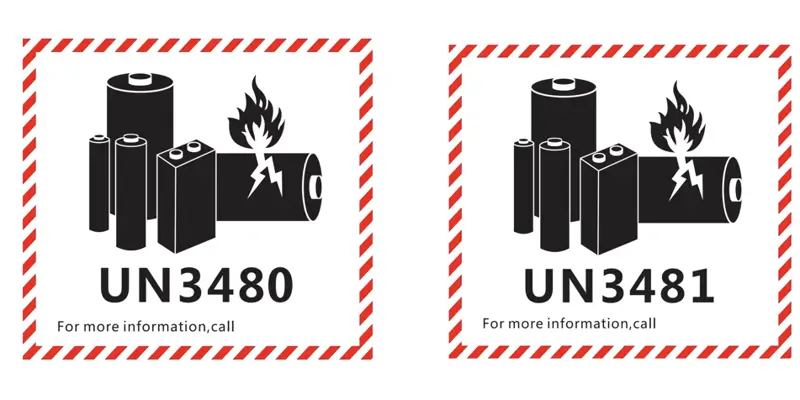
Carriers refuse shipments without these marks. This applies to the product inside the carton, not just standalone battery shipments.
Shipping Mark Template
Here is a ready-to-use template. Copy it, fill in your details, and send it to your supplier before production starts. No special software needed.
Main Mark (Front / Long Side)
This goes on the largest face of the carton.
[DESTINATION PORT], [COUNTRY]
ITEM: [PRODUCT NAME]
PO NO.: [YOUR PO NUMBER]
CTN NO.: ___/[TOTAL CARTONS]
MADE IN CHINA
Filled example:
GOTHENBURG, SWEDEN
ITEM: BAMBOO CUTTING BOARD SET
PO NO.: NH-2026-084
CTN NO.: ___/180
MADE IN CHINA

Side Mark (Short Side)
This goes on the shorter face. It repeats the carton number and adds the product and measurement details.
ART. NO.: [ARTICLE NUMBER]
QTY: [QUANTITY] PCS/CTN
CTN NO.: ___/[TOTAL CARTONS]
G.W.: [GROSS WEIGHT] KG / LBS
N.W.: [NET WEIGHT] KG / LBS
MEAS: [L] × [W] × [H] CM
Filled example:
ART. NO.: BK-3302
QTY: 12 PCS/CTN
CTN NO.: ___/180
G.W.: 6.5 KG / 14.3 LBS
N.W.: 5.2 KG / 11.5 LBS
MEAS: 52 × 38 × 29 CM

Three Rules for the Marks Themselves
1. Use black ink.
Most export cartons are brown. Black gives the clearest contrast and is the universal default.
2. Use waterproof materials.
Sea freight means humidity, condensation inside containers, and handling in all weather. Standard ink on paper labels blurs. Use direct printing on the carton or waterproof synthetic labels — polypropylene stock is common. Handwriting with a marker is technically permitted, but it is not how commercial shipments are done.
3. Keep text readable from a distance.
The minimum practical character height for main mark information is 10mm. If a handler needs to squint, the mark is too small.
Where Do Shipping Marks Go?
On Cartons

Main mark on the long face. Side mark on the short face. For LCL shipments, mark all four long faces. When handlers are pulling your cartons out of a shared container, they need to identify your boxes from whatever angle they happen to be facing.
On Pallets

When cartons are palletized, add a pallet label on the outside, positioned 15–30cm from the ground, at forklift operator eye level. The pallet label mirrors the main carton mark and adds the total number of cartons stacked on that pallet.
On the Bill of Lading

The bill of lading has a field called ‘Marks and Numbers’. This is the document-level record of your shipping marks, and it must match your physical cartons character for character.
When you instruct your freight forwarder to prepare the bill of lading, send them your shipping mark text exactly as it appears on the carton. Do not summarize or abbreviate. If the customs officer at the destination port pulls your bill of lading and the marks do not match the carton in front of them, they flag the shipment for examination. That means cost and delay, sometimes both.
Importing from China: What to Know About Shipping Marks
What Your Factory Will Do by Default
If you do not send your supplier a shipping mark, they will make one up based on their internal defaults.
The typical result is a carton marked with:
- The factory name or an internal code instead of your company name
- ‘China’ instead of ‘Made in China’.
- No PO number, or the factory’s own reference number
- Inconsistent or missing carton numbering
For shipments to the US, that second point alone — ‘China’ vs ‘Made in China’ — is a compliance problem under 19 U.S.C. § 1304. CBP has the authority to require the goods to be re-marked or re-exported at the importer’s expense.
What to Include in Your Purchase Order
Add a ‘Shipping Mark’ section to your purchase order with the following:
- Consignee name: full name, exactly as it should appear on the carton
- Destination: port name and country
- PO number: in the format you use internally
- Carton numbering: e.g., ‘CTN NO.: X/[TOTAL]’
- Origin: “Made in China” — write this out explicitly
- Handling symbols: list any that apply (fragile, keep dry, etc.)
A plain text document works fine. You do not need a designed form. The goal is a written record that the supplier has received the correct instructions.
Shipping Marks on Alibaba Orders
Alibaba’s Trade Assurance order form has a ‘Shipping Mark’ field. This is where you input your carton marking information.
The practical issue is that a text field submission on Alibaba is easy for a supplier to overlook. Fill in the field, then follow up with a direct message to the supplier through the Alibaba platform or on WeChat, attaching your shipping mark as a separate text or document. Get a reply that confirms they have seen it. That confirmation is what matters.
Further Reading:
Amazon FBA: Shipping Mark Requirements
Amazon FBA has specific requirements on top of standard international shipping marks. Getting these wrong costs money (Amazon charges prep fees for non-compliant cartons), and in some cases, it refuses the shipment at the fulfillment center.
FBA Shipping Label
Every carton going to an Amazon fulfillment center needs an FBA shipping label, which you generate through Seller Central when creating a shipment. Per Amazon’s official FBA packaging requirements:
- Place the label at least 1.25 inches from any edge
- Do not place it on a corner, opening, or seam
- Do not cover it with tape or any material
- Remove all old shipping labels from reused cartons
- If the goods are made in China, ‘Made in China‘ must appear either on the FBA label or directly printed on the carton
For heavy cartons, additional labels are required:
- ‘Team Lift‘ — for any single carton over 50 lbs
- ‘Mechanical Lift‘ — for any single carton over 100 lbs
Amazon recommends putting 2 to 4 FBA labels on each carton. If one label gets damaged or obscured in transit, you need a backup that can still be scanned.
FNSKU Label
Every individual unit inside the carton needs an FNSKU (Fulfillment Network Stock Keeping Unit) barcode on its outer packaging. This is separate from the shipping mark on the carton. The shipping mark identifies the box, and the FNSKU identifies the product inside.
Amazon’s specifications for FNSKU labels:
- Size: between 1 × 2 inches and 2 × 3 inches
- Print resolution: minimum 300 DPI
- Ink: black on white label stock
- Must be scannable and fade-resistant
Who applies the FNSKU is up to you. Most buyers ask their Chinese supplier to do it because it is usually free, and the supplier just needs the barcode file and clear instructions. For small initial orders, some sellers handle them themselves. There are also third-party prep service companies in both China and the US that can handle it for a fee.
Is a Shipping Mark Required?
Legally
There is no single international law requiring a specific shipping mark format on all cargo. But two legal requirements do apply in specific situations:
Country of origin: US law (19 U.S.C. § 1304) requires all imported goods and their outer packaging to display the country of origin in English. The EU has a parallel requirement under Regulation (EU) No 952/2013. These are enforced at customs — non-compliant goods can be held, re-marked, or re-exported at the importer’s cost.
Dangerous goods: IATA Dangerous Goods Regulations (air) and the IMDG Code (sea) require specific mandatory markings for hazardous materials. Carriers enforce this at acceptance — if the marks are missing, the shipment does not get on the plane or ship.
Practically
Outside those specific cases, shipping marks are not legally required. But consider what happens without them.
Suppose your 250 cartons arrive at Long Beach in a shared container with 15 other buyers’ orders. There are no marks on your boxes — no consignee name, no carton numbers. The port handler unpacks the container and tries to sort the cargo. Your boxes look like everyone else’s. Three of them end up with the wrong importer. Two more sit in a warehouse for a week while the freight forwarder figures out who they belong to.
That is the practical case for shipping marks. The cost of creating one is measured in minutes. The cost of not having one can be measured in weeks and hundreds of dollars.
Do They Need to Be Waterproof?
No regulation says so. But sea freight, especially transoceanic routes, exposes cartons to sustained humidity, container condensation, and outdoor handling at ports in tropical climates. Standard ink on paper labels blurs under those conditions reliably enough that waterproof materials are simply the accepted standard.
Direct printing on the carton is the best option. Synthetic label stock (polypropylene) is the common alternative. If your shipment is small and you are using handwritten marks, at minimum use a permanent waterproof marker — the kind rated for outdoor use.
Frequently Asked Questions
What is a shipping mark from China?
It is the identifying information printed on the outside of export cartons — consignee name, destination, weight, dimensions, and country of origin. For the US, “Made in China” must appear on all outer cartons under 19 U.S.C. § 1304. Always send your supplier a completed shipping mark before production starts rather than relying on their default format.
How do I get a shipping mark?
You create it yourself — it is not issued by any government or carrier. Use the template in this guide, fill in your details, and send it to your supplier in writing before production begins.
Can I handwrite my own shipping mark?
Technically yes, but it is not recommended for sea freight. Humidity and physical handling during transit cause handwritten ink to blur. Use direct printing on the carton or pre-printed waterproof labels.
What is a shipping mark on a bill of lading?
The bill of lading has a field called “Marks and Numbers” that must match the marks on your physical cartons exactly. Give your freight forwarder the exact text to copy in — do not paraphrase or abbreviate. A mismatch triggers a customs examination at the destination port.
What is a shipping mark on Alibaba?
It is a field in the Trade Assurance order form where you input your carton marking information. Fill it in using the template in this guide, then follow up with the supplier directly to confirm they have seen it. The form field alone is not a reliable confirmation.
Do lithium batteries require a special shipping mark?
Yes. Lithium batteries are Class 9 dangerous goods and require UN number labels — UN 3480 for lithium-ion batteries alone, UN 3481 for batteries packed with or inside equipment. This applies to any product containing a rechargeable battery, not just standalone battery shipments. Carriers refuse shipments without these marks.
What are shipping mark symbols?
They are standardized pictograms on the carton that tell handlers how to treat the package — fragile, this side up, keep dry, and so on. They are standardized under ISO 780 and recognized globally without language. Dangerous goods symbols follow separate IATA and IMDG classifications and are legally required, not optional.
One Last Thing
The format of a shipping mark is not the hard part. The hard part is making sure your supplier actually uses the mark you specified, formatted correctly, before your cartons get sealed and loaded onto a truck.
Send the mark in writing, get confirmation, and check it against the draft bill of lading before the shipment departs.
If you are sourcing products from China and want someone to manage these details on the ground (supplier communication, packaging requirements, pre-shipment document checks), HiSourcing is here to help. Contact us if you need any support.


