
The right supplier is not the company with the longest product catalog. It is the source that fits your buying model and can show that it can reproduce the running sock you intend to sell.
This China running socks supplier guide from HiSourcing helps you choose where to search, define a quote-ready product, and compare suppliers on evidence you can check before a bulk order.
Quick Answer: Settle These Five Decisions First
| Decision | What to settle before you choose a supplier |
|---|---|
| Sourcing route | Stock product or custom construction; direct factory, marketplace, trader, or sourcing partner. |
| Running-sock brief | Shoe fit, sock volume, cushion map, ventilation, toe construction, size range, yarn blend, branding, and packaging. |
| Capability proof | The legal entity and production site, recent comparable work, construction details, and evidence tied to your brief. |
| Comparable offer | The same specification revision, variant mix, packaging, quantity, test scope, and named trade term. |
| Bulk reference | An approved physical sample linked to the purchase order and a product-specific inspection checklist. |
Choose the China Sourcing Route That Fits Your Running Sock
The best place to search depends first on whether you want a ready-made sock with your branding or a custom performance construction. That distinction changes the type of supplier you need, the development work involved, and the questions worth asking.
Stock branding and custom development are different purchases
A stock or white-label program uses an existing sock construction. You may change the logo, label, colors, or packaging, but the underlying product remains largely fixed. This route suits market tests and buyers who value speed over exclusivity.
A custom program changes the sock itself: perhaps its cushion zones, mesh layout, toe construction, yarn system, size grading, or cuff. It requires a supplier with relevant knitting and development capability, plus more disciplined sampling. If a standard product already meets your needs, do not pay for custom development merely to make the project feel more proprietary.
Four sourcing routes and when each works
| Route | Best fit | What you gain | Main risk | First proof to request |
|---|---|---|---|---|
| Direct performance sock factory | Custom construction and repeat orders | Direct product and production discussion | The sales company may not own or control production | Chinese legal entity, production address, relevant current work, and a live process view |
| Marketplace or directory | Fast discovery and broad comparison | Many leads and visible product options | A listing badge does not prove product capability | Apply the same identity, facility, and sample checks used off-platform |
| Stock wholesaler, trader, or market | Ready-made products and smaller market tests | Speed, assortment, and sometimes a lower MOQ | Limited construction control and an undisclosed production source | Exact stock sample, continuity, available quantities, and label terms |
| China sourcing partner | Buyers who need local search, sample coordination, verification, inspection, or consolidation | China-side execution and one control point | Fee, conflict, and transparency vary by provider | Fee basis, factory disclosure, sample/QC process, and ownership of records |
Alibaba, Made-in-China, factory websites, referrals, and trade events can all produce leads. Yiwu and other China wholesale markets are more useful when you want existing products than when you need a technical custom sock. Discovery channel does not change the evidence standard.
Further Reading:
- How to Source Products from China?
- How to Purchase from Alibaba?
- How to Buy from Yiwu Market?
- What is a Sourcing Agent? What does it do?
- Alibaba vs. Sourcing Agent: What’s the Difference?
Define the Running Sock Before You Build a Shortlist
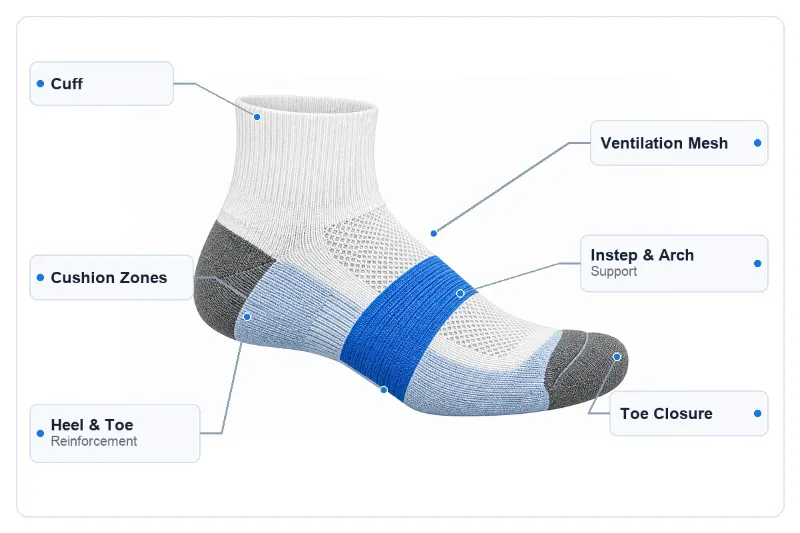
A supplier cannot quote or prove capability against “premium running socks.” Start with the runner and the shoe: road or trail, hot or cold conditions, typical duration, shoe volume, and the fit problem the sock should solve.
A practical rule is to settle sock volume and cushion placement before debating a favorite fiber. A thicker sock can change the fit of a close shoe; cushion under the heel is not the same as cushion around the toes; a breathable instep does a different job from a reinforced sole. Toe-seam bulk and seam ends also deserve attention because a material label will not reveal them.
No fiber is automatically “best.” Synthetic fibers, wool blends, and other yarn systems make different trade-offs among moisture behavior, warmth, feel, durability, care, and cost. Specify the result you need and the claim you intend to make, then ask suppliers to explain how their construction supports it.
Use a quote-ready product brief
| Field | Your decision | Supplier must confirm |
|---|---|---|
| Height and sizes | No-show, ankle, quarter, or crew; target foot sizes | Size chart, grading approach, and cuff position |
| Sock volume and cushion map | Thin, medium, or high volume; exact cushion zones | Proposed knit construction and a comparable sample |
| Ventilation | Where mesh or a more open structure is needed | Achievable zone layout and expected stability |
| Toe and heel | Toe-closure feel and reinforcement locations | Closure method and reinforcement construction |
| Fit and hold | Cuff and instep/arch behavior without unsupported medical claims | Elastic structure and size-specific construction |
| Fiber and yarn | Fiber percentages or a measurable performance requirement | Actual blend, yarn type, and substitution rules |
| Color and branding | Color reference, logo technique, size, and position | Artwork limits and approval method |
| Labels and packaging | Destination, label copy, pack format, and carton needs | Materials, dimensions, barcode, origin, and care placement |
Put these fields in one revision-controlled product specification sheet. Send the same file to every candidate. Photos and retail reference samples can clarify the intended feel, but they do not replace written construction, size, branding, and acceptance details.
Ask for Evidence of Running-Sock Capability
A company license proves that an entity exists. It does not prove that the company owns the knitting line shown in its photos or can reproduce your sock.
Request the supplier’s full Chinese legal name and Unified Social Credit Code, then check the official National Enterprise Credit Information Publicity System (GSXT). Compare the registry result with the company on the quotation, contract, invoice, and beneficiary account.
Next, connect that entity to the production site. Ask where knitting, toe linking, dyeing, boarding or finishing, labeling, and packing occur, and which operations are subcontracted. A live walk-through and current production records are useful supporting evidence. Neither one is a guarantee, so evaluate them alongside the physical sample and written process details.
Connect each requirement to proof and a sample check
| Running-sock requirement | Evidence before paying for custom samples | What to inspect or test on the sample |
|---|---|---|
| Sock volume and cushion placement | Comparable style plus a construction description | Fit in target shoes, zone position, and pair consistency |
| Ventilation zones | Zone map or recent comparable production | Placement, openness, and distortion after washing |
| Toe construction | Close-up of current work and stated closure method | Seam bulk and ends, wear-trial comfort, and opening or hole risk |
| Size grading | Size chart and grading method | Foot fit, cuff position, stretch, and recovery |
| Fiber or yarn claim | Composition declaration and a scoped report if the claim requires it | Spec and label match; lab verification when the claim risk justifies it |
| Moisture claim | Defined claim and proposed method, not “quick dry” sales copy | Buyer-selected wear or lab assessment; AATCC TM195 where its fabric scope fits |
| Wash stability | Construction record and agreed wash procedure | Dimensional and appearance change using a repeatable procedure when appropriate |
| Harmful-substance certification | Certificate number and scope covering the relevant product or material | Issuer lookup and scope match; do not treat it as durability or performance proof |
Use standards within their scope. AATCC TM195 measures and classifies liquid moisture-management properties of textile fabrics; it does not supply your brand’s pass level or guarantee in-shoe comfort. ISO 6330:2021 provides domestic washing and drying procedures for textile testing; it does not define an acceptable shrinkage limit.
The same boundary applies to certification. OEKO-TEX STANDARD 100 concerns textiles tested for harmful substances. A valid, in-scope certificate can support that question, but it does not prove fit, moisture performance, durability, social compliance, or factory ownership.
Compare Quotes and Samples on the Same Scope
A low quote is meaningless if it prices a different yarn, quantity mix, package, or trade term. Give every candidate the same specification revision and ask each one to return the same commercial fields.
Normalize the quote
- Product basis: specification revision, artwork, sample status, and any allowed substitutions.
- Quantity basis: units by style, color, and size, plus whether the MOQ applies per style, color, size, yarn, or total order.
- Price basis: unit price at quantities you might actually buy, currency, validity period, and inclusions.
- Development: stock sample, custom sample, size set, logo setup, revisions, and refundable or non-refundable charges.
- Order extras: labels, packaging, testing, inspection, tooling, and any artwork or setup charges.
- Timing: what starts the lead time—deposit, final artwork, material arrival, or sample approval—and what “complete” means.
- Trade term: the Incoterms rule and named place or port, plus costs explicitly excluded.
If one design launches in three colors and two size groups, you may have six variants. Ask whether the supplier’s minimum applies once, per color, per size group, or to every variant. This is why what MOQ means and what drives it matter more than a headline number.
Request prices at two quantities you could realistically order: the first commercial run and a plausible reorder. Add a third scale quantity only if it could affect your decision. More volume may spread setup cost, but it does not buy better yarn, tighter tolerances, or stronger inspection unless those items are written into the offer.
The International Chamber of Commerce’s Incoterms 2020 checklist helps buyers choose a rule that matches the transport and responsibility split. Always include the named place or port. “FOB price” by itself is not landed cost, and “EXW” without a pickup location is not a complete comparison.
Let the sample eliminate suppliers
Do not pick a winner from listings or quotations alone. Compare samples against the same brief and, where practical, review them without the supplier’s branding influencing the score. Check size and fit, sock volume, cushion and mesh placement, toe closure, heel and toe shape, stretch and recovery, pair matching, branding, wash result, and packaging.
A good-looking sample without a revision number is only a showroom piece. Record what was approved, what changed, and which sample becomes the bulk-production reference.
Carry the Approved Sample Into the First Bulk Order
The first bulk order should reproduce an approved revision, not a verbal promise to “match the sample.” Mark and retain the physical sample, reference its specification revision on the purchase order, and convert its important details into a product-specific quality control checklist.
For running socks, define defects such as a wrong finished size or sock volume, shifted cushion or mesh zones, a bulky or open toe seam, holes or dropped stitches, poor elastic recovery, yarn or color mismatch, weak pair matching, and incorrect logo, labels, or packaging. Classify those defects for your product and market rather than copying a generic garment list.
ISO 2859-1:2026 defines an acceptance-sampling system indexed by AQL for lot-by-lot inspection. It does not choose your inspection level, AQL, or critical, major, and minor defects. Those decisions belong in the buyer’s approved quality plan.
Compliance is also market-specific. For the United States, the Federal Trade Commission’s textile-label guidance says most textile products require fiber content, country of origin, and the identity of the manufacturer or another responsible business. The guidance also gives most socks a specific origin-mark placement rule. Treat this as a US example and verify the rules for every destination market before production.
Decide Whether to Buy Direct or Use a China Sourcing Partner
A sourcing partner is useful only when the China-side work it removes is worth its cost and added relationship layer. Buy direct when you already have a proven factory, a clear brief, reliable communication, sample and inspection resources, and no need to consolidate suppliers. In that situation, an intermediary may add little.
A partner can add value when you need local supplier search, legal-entity and production-site checks, quote normalization, sample consolidation, production follow-up, inspection, or combined shipments. Ask any provider how it is paid, whether it receives supplier compensation, whether you will see the factory, who owns samples and records, and how the relationship can be handed over.
Frequently Asked Questions
How do I find a direct running-sock supplier in China?
Use factory websites, B2B marketplaces, directories, trade referrals, or a China-based sourcing partner to build a shortlist. Then ask each candidate for its Chinese legal entity, production address, relevant current work, and a live view of the processes used for your sock. “Direct” should describe a verified production relationship, not a label on a listing.
How much does it cost to make a pair of socks in China?
There is no reliable universal price. Yarn, knit structure, cushion zones, colors, size mix, logo, packaging, testing, order quantity, and trade term all change the quote. Give suppliers the same specification and ask them to separate unit price, development, setup, packaging, testing, inspection, and shipping-related costs.
What MOQ should I expect for custom running socks?
Expect the minimum to depend on the factory’s setup and its suppliers’ yarn, dyeing, logo, and packaging constraints. Ask whether MOQ applies to the entire order or separately to each design, color, size group, or yarn. A lower minimum may come with a higher unit price or fewer customization choices, so compare total commitment rather than one number.
What material is best for running socks?
No single material is best for every running sock. Select the yarn blend and knit construction for climate, shoe fit, moisture behavior, warmth, feel, durability, care, and cost. Then evaluate the finished sock in its intended use. Fiber names alone do not reveal cushion placement, ventilation, seam feel, or overall fit.
How can I tell whether a supplier is a factory or a trader?
Match the Chinese legal entity to the quote, contract, invoice, bank beneficiary, and official company record, then connect that entity to the production site. Ask which operations are in-house, which are subcontracted, and who controls materials and QC. A trader can still be useful; the problem is an undisclosed or poorly controlled supply chain.
Final Thoughts
A useful China running socks supplier guide should make your shortlist smaller, not your checklist longer. Choose the source route that fits the order, define the sock in concrete terms, and ask for proof tied to those terms before spending heavily on development.
We’re HiSourcing, a leading sourcing company in China. If you need China-side help with that work, send us your brief, realistic quantities, destination, and current supplier status so we can scope the support honestly. Click here to get a free quote.


