
A China sourcing agent is a person or company in China that finds suppliers, negotiates prices, follows production, checks quality and arranges shipping for you. Agents usually get paid through a margin in the unit price, a 5%–10% commission on order value, or a flat project fee. To find a reliable one, check its license, ask how it gets paid, compare landed costs and start with a trial order.
You’re in good company. In 2025, about 97% of identified US importers were small and medium-sized businesses, and China was their top source country, with 110,074 of them buying there.
In this guide from HiSourcing, you will see the ultimate breakdown of a China sourcing agent, including:
- What is a China sourcing agent?
- What does a China sourcing agent actually do?
- Types of sourcing agents in China
- How much does a Chinese sourcing agent charge?
- How to find a reliable sourcing agent in China?
- How to vet a sourcing agent?
- How to work with a China sourcing agent?
What Is a China Sourcing Agent?
A China sourcing agent is a person or company based in China that represents overseas buyers in their dealings with Chinese suppliers. The agent finds and vets suppliers, negotiates prices, follows production, inspects goods and arranges shipping. A sourcing agent works for the buyer, not for the factory.
You’ll also see buying agent, purchasing agent and procurement agent, often used for the same role. Some guides split finding suppliers from reordering with chosen ones, but industry guides use the terms loosely and no single definition exists, so your contract decides what an agent does.
Sourcing Agent vs Trading Company, Freight Forwarder and Shopping Agent
Sourcing agents, trading companies, freight forwarders and shopping agents differ in who they work for, how they earn and what they handle.
| Works for | Makes money from | Quality checks | Shipping | Best for | |
|---|---|---|---|---|---|
| Sourcing agent | You | A unit-price margin, a commission or a flat fee | Yes | Yes, including consolidation | Finding and managing several suppliers |
| Trading company | Itself, reselling to you | A markup of usually 15%–30% over the factory price, sometimes up to 40% | Only on its own goods | Its own orders | One ready-made product |
| Freight forwarder | You, for transport only | Freight and handling charges | No | Yes | Goods you’ve already bought |
| Shopping agent | Individual shoppers | Fees on each purchase | No | Small parcels | Personal use and tiny quantities |
Choose a sourcing agent if you need suppliers found, compared, checked, and consolidated. A trading company suits one ready-made product, and a freight forwarder suits goods you’ve already bought. A China shopping agent is for personal buys, such as getting Taobao orders shipped to the US.
Agents and trading companies can both build profit into the unit price, so the real difference is whose side they’re on. A trading company sells you its own range, while an agent searches across suppliers for your spec. That’s why buyers ask for a real agent “rather than just a trading company/reseller.” For more, see sourcing agent vs trading company.
What a Sourcing Agent in China Does for You
A China sourcing agent is your team on the ground, and the job can cover everything from finding a product to getting it on a ship.
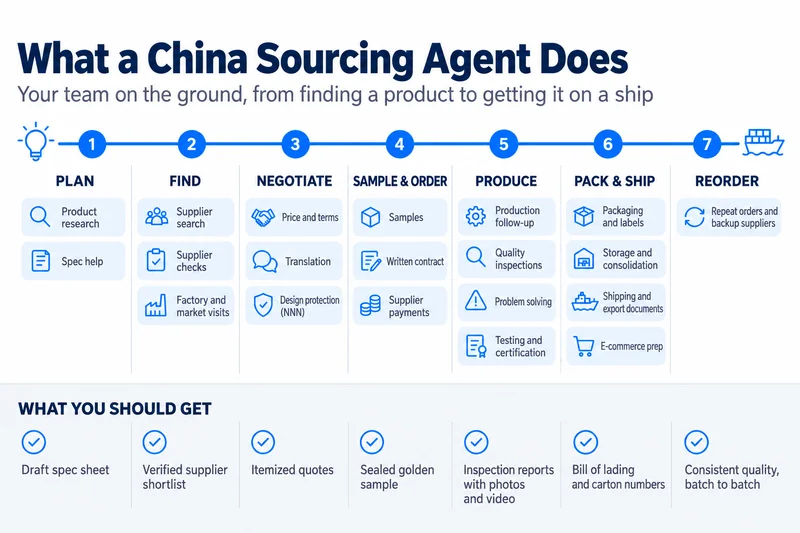
Research products and markets
Agents can tell you which items China makes well, which manufacturing hubs specialize in them, and what realistic prices, MOQs and lead times look like before you commit.
Turn your idea into a quotable spec
If your drawings, materials list or prototype aren’t production-ready, the agent helps fill the gaps so every supplier quotes the same product.
Find and shortlist suppliers
Using local contacts, Chinese platforms like 1688, Alibaba, wholesale markets, and trade fairs, the agent surfaces factories that rarely advertise in English and compares several for each product.
Verify that suppliers are real
The agent checks business licenses and certificates, visits or video-tours factories and assesses equipment and capacity, so you don’t end up with a shell company or a trader posing as a manufacturer.
Negotiate price and terms
Beyond the unit price, the agent negotiates MOQ, tooling costs, lead times, and payment terms in Chinese, using local price benchmarks.
Bridge the language and culture gap
The agent translates your requirements precisely, explains what suppliers really mean, and heads off the misunderstandings that lead to wrong orders.
Manage samples
The agent orders samples, consolidates them from several suppliers into one parcel, checks them against your spec, and sends photos, videos, or the samples themselves for your approval.
Put the order in writing
The agent drafts or reviews the purchase contract so specs, quality standards, deadlines, and penalties for defects or delays are clear before you pay a deposit.
Follow production
The agent stays in touch with the factory, sends progress updates, and flags material shortages or schedule slips before they hit your ship date.
Inspect quality at every stage
From factory audits and raw-material checks to during-production, pre-shipment, and container-loading inspections, the agent catches defects while they can still be fixed.
Resolve problems with the factory
When goods fail inspection or arrive wrong, the agent negotiates rework, replacement or compensation and re-inspects before anything ships.
Coordinate testing and certification
For products that need lab tests or certificates for your market, the agent arranges testing and collects the paperwork, although legal compliance remains the importer’s responsibility.
Customize packaging and labels
The agent arranges branded boxes, private-label printing, barcodes, inserts, and warning or origin labels so goods arrive ready to sell.
Pay suppliers on your behalf
The agent can pay factories in Chinese yuan, cover several suppliers with one transfer from you, and hold the balance until goods pass inspection.
Store and consolidate goods
The agent receives orders from different factories at its warehouse and combines them into one shipment, cutting freight and handling costs.
Arrange shipping and export paperwork
The agent books freight, handles trucking and container loading, and prepares export documents such as the commercial invoice, packing list, and bill of lading.
Prepare goods for e-commerce
Many agents handle Amazon FBA prep, kitting and bundling and product photography, and some ship single orders straight to your customers.
Protect your designs
The agent signs a non-disclosure agreement with you and can put NNN (non-disclosure, non-use, non-circumvention) agreements in place with factories before you share drawings or samples.
Guide you in person
If you visit China, the agent can take you to factories, wholesale markets, and trade fairs and interpret during meetings.
Manage reorders and scale up
Once a product sells, the agent handles repeat orders, keeps quality consistent from batch to batch, and lines up backup suppliers.
What a Sourcing Agent Can’t Do for You
An agent can run your order in China, but your legal duties at US customs, product certification and sales risk stay with you.
Customs duties stay with the importer. The importer of record must declare goods with reasonable care, and handing the work to an agent, forwarder, customs broker or DDP deal doesn’t automatically shift that duty. If a broker you paid doesn’t pay the duties, the importer still owes them.
So when a first-time FBA seller asks an agent to “Arrange door-to-door shipping to the USA (including customs clearance),” the agent can arrange it. The legal duty still stays with whoever files as importer of record. Read more on how US customs works for China imports and the hidden risks of DDP from China.
Certification stays with you. Electronics approved through the FCC’s Supplier’s Declaration of Conformity need a responsible party located in the United States, so an agent’s or factory’s test report can’t fill that role.
Inspection checks a sample. A zero-critical-defects setting fails the lot if one critical defect turns up in the sample; it doesn’t make the whole order defect-free.
Sales risk is yours. An agent can tell you what’s easy to make and what it costs, but whether your product sells is on you.
Some agents skip the work entirely. One seller found that the agent paid for quality checks “didn’t actually do any QC,” and the result was blunt: “Defect rate was up to 50%.” So ask for an inspection report with every order.
Types of Sourcing Agents: Freelancers, Agencies and Sourcing Companies
Sourcing agents come in five main types, and what separates them is who does the work for you and who answers for problems.
| Type | Best for | Usually charges | Who answers for problems |
|---|---|---|---|
| Freelancer on Upwork, Fiverr or LinkedIn | One-off tasks such as supplier lists | By the hour or by milestone | Only that person, with no warehouse or QC team |
| Small agency | Small and midsize buyers, mixed products | A unit-price margin or a commission | The company |
| Full-service China sourcing company | Custom products and development | Monthly, project or commission | The company, often with higher minimums |
| US company with a China office | Buyers who want a US contract partner | Commission or fixed packages | A US company |
| Platform tools such as Alibaba’s AI tool, Accio | Standard products | Built into the platform | You, since an AI tool can’t visit a factory or open a carton |
An independent sourcing agent is fine for a quick task. But the more complex your order and the costlier a mistake, the more you need a company with its own warehouse and inspection staff.
Freelance Agents on Upwork and Fiverr: Worth the Risk?
Freelancers are worth it for a well-defined, one-off task, but not for holding your money or running an entire order.
On Upwork, sourcing freelancers in China typically charges $12–$35 an hour, many at $15–$25.
Fiverr listings often run $25–$50 an hour, and agencies billing hourly charge about $30–$80.
As of October 2026, Upwork pays out only for work you approve, and fixed-price milestones suit jobs like supplier shortlists or sample checks. Fiverr holds your payment and completes an order automatically if you don’t respond within three days of delivery. Neither platform protects money you send outside it, such as a payment to a factory.
Define the deliverable first, such as how many suppliers and a license, quote, and MOQ for each, so you avoid “just getting a random Google Docs document.” A narrow brief is the right size, like “You connect us with 2–3 direct manufacturers in a WeChat group.”
China-Based vs US-Based Sourcing Agents
A US-based agent gives you a US contract partner and easy communication; a China-based agent sits closer to the factories, and of course, factory prices.
But being US-based doesn’t automatically mean higher fees. Several US-registered agents with teams in China publish about 5% of order value or fixed packages of roughly $500–$3,000. China-based agents mostly publish commissions of 3%–10%.
So rather than hunting for an American sourcing agent in China, ask any agent how many US shipments it has handled. Then check its China entity’s registration.
Where Sourcing Agents in China Are Based: Yiwu, Guangzhou and Shenzhen
An agent’s city decides which markets and factories it knows best.
| City | What’s concentrated there | Good for |
|---|---|---|
| Yiwu | Yiwu International Trade City, the world’s largest small-commodities wholesale market, with nearly 80,000 booths and over 2.1 million types of goods | Small commodities and mixed small orders |
| Guangzhou | Zhongda for fabric and trims, 31 large and midsize garment wholesale markets in Shahe plus Baima, cosmetics in Baiyun, and leather goods in Shiling | Apparel, fabric, beauty and bags |
| Shenzhen | Huaqiangbei electronics market, with 35 specialized markets selling over 1 million types of components, which local officials call the world’s largest electronic components hub | Electronics |
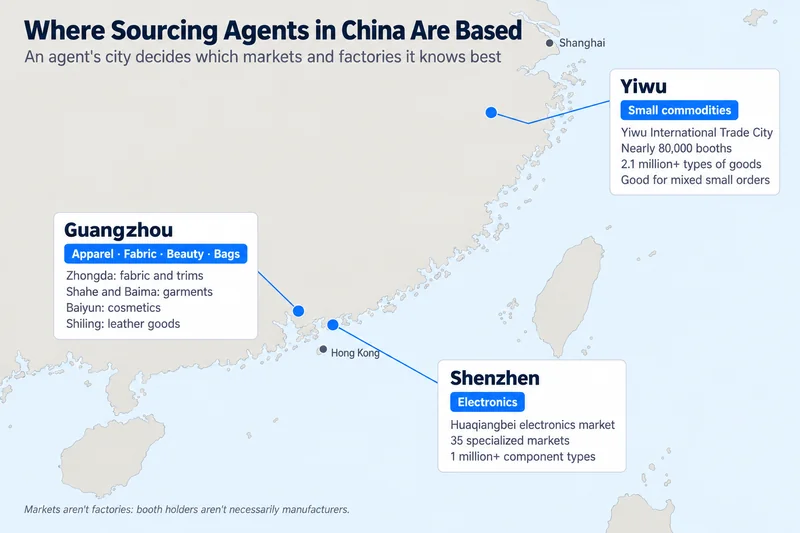
Markets aren’t factories. Booth holders aren’t necessarily manufacturers, and even Huaqiangbei is a trading hub, with mass production spread across China’s Pearl River Delta.
So a sourcing agent in Guangzhou, China, a Shenzhen sourcing agent, and a Yiwu sourcing agent each know different suppliers and specialize in different categories of products.
You Might Also Want to Read:
- How to Buy from Yiwu Market: Ultimate Guide
- Guangzhou Electronics Market: A Buyer’s Guide
- Top 10 China Wholesale Markets: Clothes, Bags, Electronics & More
Specialist Agents for Dropshipping, Amazon FBA and Specific Products
If your product needs certification, special materials, or single-unit shipping, use a specialist; for mixed standard goods, a generalist is enough.
A first electronics order with molds and FCC paperwork, carbon-fiber materials or small-batch food points to a specialist. Sourcing for “a restaurant build-out in the USA,” from furniture to tableware, suits a generalist who can consolidate many categories.
Furniture, fabric, jewelry, and toys have specialists too, as do Amazon FBA sourcing agents, sourcing agents for electronics, and any apparel sourcing agent.
Dropshippers face one more change if you want a dropshipping agent. As of October 2026, the $800 de minimis exemption remains suspended: for China and Hong Kong since May 2, 2025, and for all countries since August 29, 2025. With a formal repeal due July 1, 2027, commercial parcels from China to US consumers no longer enter duty-free for being under $800.
How Much Do Chinese Sourcing Agents Charge?
Most Chinese sourcing agents charge a commission of 5%–10% of order value, and the rate falls as orders grow. Others charge a flat fee, usually $200–$1,000 for a supplier search or $1,500–$3,500 for a full product project, or build their margin into the unit price.
To be clear, a China sourcing agent fee is the agent’s service fee, separate from what you pay for goods and freight.
| How the agent charges | Typical rate | Best for |
|---|---|---|
| Margin in the unit price | No separate service fee | Suppliers found from scratch |
| Commission on order value | 8%–10% on $2,000, 7%–8% on $5,000, 5%–7% on $10,000, 4%–6% on $20,000, 3%–5% on $50,000, 3%–4% above $100,000 | Factory price and fee shown separately |
| Execution only | 3%–5% of goods value, usually at least about $100 per order | Existing suppliers; follow-up, inspection, shipping |
| Flat or project fee | $200–$1,000 per supplier search; $1,500–$3,500 per full product project | One-off tasks, many styles in small quantities |
| Monthly retainer | $500–$3,000 a month, more for a dedicated team | Ongoing, high-volume sourcing |
The same order looks different under each fee model. Take a $10,000 factory order (an assumption), quoted FOB from the same port:
| Commission | Flat fee | Margin in the unit price | |
|---|---|---|---|
| Goods | $10,000 factory price | $10,000 factory price | One unit price; the margin isn’t shown |
| Agent’s fee | 5%–7%, or $500–$700 (calculated) | $1,500–$3,500 per project | Inside the unit price |
| US duty | Generally on the factory price only | Ask your customs broker | Generally on the full unit price, margin included |
A project fee is usually paid once, while a commission repeats with every order, so compare a year of orders if you’ll reorder.
Duty differs too. CBP generally doesn’t add a bona fide buying commission to dutiable value, but an intermediary’s markup on goods it resells to you is part of the price you pay and is dutiable. Whether a commission counts as bona fide depends on the real relationship, and the importer must prove it. The duty gap is roughly the duty rate times the agent’s margin (calculated).
So don’t compare one agent’s $500 fee with another’s zero service fee; compare landed cost, everything you pay until the goods arrive.
What the Fee Covers and What Costs Extra
A service fee usually doesn’t cover inspections, sample shipping, storage after a free period, freight, or factory visits, so ask your agent about each in detail.
| Extra cost | Typical price |
|---|---|
| Third-party inspection | $250–$350 per person-day, from about $150; travel, re-inspection, and lab tests extra |
| Sample handling | $5–$30 per sample or $30–$100 per consolidated shipment, plus courier |
| Storage | Often free for about 30 days, then about $0.30–$1 per cubic meter per day; HiSourcing gives up to 30 days free warehousing |
| Domestic freight and payment fees | Charged per factory, which adds up on a few cartons from each |
| Factory visits | Travel billed separately |
Compare quotes on the same price basis. For a full container, an FOB quote usually runs 2%–5% above EXW, covering inland transport, export clearance, and port charges of about $500–$1,000 for a 20-foot container. On a small order, the share is much higher: $700 of export costs on $5,000 of goods is 14%.
Do You Need a Sourcing Agent?
Whether you need a sourcing agent depends on how many suppliers you use, whether the product is custom, and how big the order is. If you’re buying a standard product from one supplier for about $2,000 or less and paying through Alibaba’s Trade Assurance, you can do it yourself.
Above that, or with several suppliers, custom work or high quality risk, an agent usually pays off.
| Buying direct | Using an agent | |
|---|---|---|
| Cost | No agent fee; you may be able to pay 1688 sellers directly, depending on region and verification, but you deal with them in Chinese | A fee or margin; buying 1688 goods through an agent usually lands 20%–30% below Alibaba, but not under about 200–300 units |
| Quality | You arrange inspections | The agent inspects, with reports, photos and videos |
| Communication | Each factory, across time zones | One Chinese-speaking contact |
| Logistics | Each supplier ships separately | Goods consolidated into one shipment |
| Risk | Sits with the supplier | Sits with the agent |
Buying direct puts your risk on suppliers; using an agent puts it on the agent, so vet whichever you rely on. On 1688, an agent’s value is Chinese communication, receiving, inspection, consolidation, and one payment for many suppliers, not paying for you.
With suppliers already in place, you can buy just inspection and shipping. One seller noted an agent “does come with a cost and managing an additional person,” while another prized “the valuable time saved.”
When a Sourcing Agent Is Worth It
An agent is worth it for multi-supplier orders, custom products, first orders with tooling or certification, first-time importers and buyers who can’t be in China.
The supplier math adds up fast: comparing 10 suppliers for each of 10 products means 100 conversations. A first electronics order raises the stakes, as one founder wrote: “given the tooling costs and FCC certification requirements involved I keep thinking that’s the wrong call.” In money terms, an agent usually pays off above about $2,000.
When You Can Skip the Agent
You can skip the agent for a standard product from one supplier, an order of about $2,000 or less, and payment through Alibaba Trade Assurance. As of October 2026, Trade Assurance covers orders placed and paid on Alibaba.com that don’t ship, don’t arrive, or don’t match the order.
Claims are due within 30 days of delivery (60 for Enterprise buyers); the cover is free, but off-platform payments aren’t covered, and a claim doesn’t guarantee a full refund.
Doing it yourself suits buyers like this one: “Since I’m starting with a small fund, I wanna do as much work as possible by myself to save money.” You can search, order samples, and pay on the platform yourself, then hire an inspector at $250–$350 per person-day or pay $200–$1,000 for a one-off supplier search. See buying direct from manufacturers and how to purchase from Alibaba step by step.
Will a Sourcing Agent Take a Small Order?
Yes. Some agents take small orders for a minimum fee of about $100 per order, while others only accept orders above $2,500–$10,000. An agent’s minimum order, its minimum fee, and a factory’s MOQ are three different things.
Expect higher unit prices on small runs: ordering below MOQ usually costs 10%–30% more per unit, and runs of 100–200 pieces can cost double. Consolidation is where sourcing agents for small businesses earn their keep, since factories lose interest in tiny orders: “communication got poor at times and slow when they knew it was low MOQ.”
How to Find a Sourcing Agent in China
Getting a Chinese agent usually starts with a referral from a buyer who has worked with the agent, the most reliable route; Upwork, Fiverr, and LinkedIn simply have the most freelance agents. Wherever you find one, verify it using the steps in the next section.
| Channel | Who you’ll find | Reliability | Watch for |
|---|---|---|---|
| Referrals from other buyers | Small agencies and individuals | High | Best from buyers with similar products and order sizes |
| Google search | Agency websites | Medium | Every site says it’s the best |
| Individuals and companies | Medium | Check work history and mutual contacts | |
| Reddit and other forums | Everyone | Low to medium | Pitches and bots mixed with real advice |
| Trade fairs | Mostly factories and trading companies | Medium | Face-to-face meetings, but few agents |
| Upwork and Fiverr | Freelancers | Medium | Protection covers fees paid on the platform only |
The places with the most agents aren’t the most reliable ones. The Canton Fair runs every spring and autumn in Guangzhou in three phases by product category. On forums, expect what one buyer got: “Have got a few contact details and dms but they are mostly bots.” Another searched widely and found that “most of them got bad reviews from their customers.”
To screen candidates, trust only recommendations where a buyer confirms working with the agent, ignore unsolicited messages, and put every candidate through the same questions below. Also confirm you’re talking to an agent, not a trading company’s salesperson.
How to Vet an Agent Before You Hire
Hiring a China sourcing agent takes six steps, and the middle three are checks:
- Define the job. Write down the product, order size, and services you need. For a small business, order size decides who will take you: some agents only accept orders above $2,500–$10,000, while others take small ones for about $100 per order like HiSourcing.
- Build a shortlist from the channels above.
- Ask every candidate the same questions.
- Check the license and references.
- Place a trial order of $1,000–$5,000.
- Sign an agreement covering fees, inspection standards and payment milestones.
Watch for red flags at every step.
Questions to Ask a Sourcing Agent Before Hiring
Ask how the agent makes money, what the quote includes, who inspects, and who pays when something goes wrong.
- Money: Do you earn through a unit-price margin, a commission, or a flat fee? What does the quote include, and what costs extra? Do you take commissions from suppliers? Who do I pay?
- Quality: Who inspects, and will I get a report with photos and video for every order? When you visit a factory, do you go yourself, or hand it to someone else? Who pays for problems found after shipping, and what happens if a supplier runs late?
- Experience: Which categories do you handle? How many US shipments have you managed? Can you name two or three current clients like me as references? Can you do a video call first?
How to Check That an Agent Is Legit
The most reliable check is the agent’s business registration on China’s National Enterprise Credit Information Publicity System (gsxt.gov.cn), which is free to search.
- Get the identifiers. Ask for the agent’s full Chinese company name and its 18-character unified social credit code, then search by name, code, or registration number. Real-name login has been in effect since November 26, 2021, and no official rule says whether foreigners can complete it, so ask for a screenshot or have someone in China search.
- Read the basics: company type, legal representative, registered capital, founding date, address, business scope, and status. A revoked license isn’t the same as a deregistered one.
- Read the business scope as a clue. Inspection firms note that production or manufacturing usually points to real production, while only sales or import and export suggests a trading company, but one company can register both.
- Check the insured headcount. Annual reports since 2016 must publish the number of insured employees, so compare it with the team size the agent claims. The figure is self-reported at year-end for each insurance type, so don’t add types together.
- Look for records on the abnormal operations list, administrative penalties, and the serious violations list. No record doesn’t mean no past violations.
Also try an unannounced video tour of the office and warehouse, video calls with two or three of its factories, and a reference call about inspection reports. For China sourcing agent reviews, trust detailed accounts and repeated patterns over one-line praise.
Start With a Small Trial Order
Start with a trial order of $1,000–$5,000; for stock items, one carton per style is enough. Don’t test with your most important product. Judge response speed, itemized quoting, inspection reports with photos and video, problem handling, and on-time delivery. Negotiate long-term terms only after the trial goes well.
Red Flags That Mean Walk Away
Walk away if an agent won’t explain how it charges, wants money sent to a personal account, or refuses to sign anything in writing. Other red flags:
- A quote far below everyone else’s
- Pressure to pay immediately
- A large “registration fee” before any work
- Only one factory offered, with no comparison
- Reassurance instead of inspection data
- No traceable bill of lading or carton numbers after shipping. One buyer wrote: “I’ve already paid the money for the products and the shipping cost and he said it got shipped yesterday”
- A personal email account for business
- A trading company’s salesperson posing as an independent agent
Keeping the factory’s name private isn’t a red flag by itself; what matters is what your agreement says (see the FAQ).
What to Put in Your Sourcing Agent Agreement
A good sourcing agent agreement turns every promise into numbers and actions: fees, kickbacks, confidentiality, inspection standards, liability, and exit.
| Clause | How to make it work |
|---|---|
| Fees and payment | Name the model and rate, and tie payments to inspection. With a commission, a written buying agency agreement plus separate invoices and payments is evidence the commission isn’t dutiable, though not decisive on its own |
| Supplier commissions | The agent must disclose any supplier commission, rebate or interest and take none without your written consent |
| Confidentiality (NNN) | China business lawyers advise an NNN agreement covering non-disclosure, non-use and non-circumvention, signed before you share drawings, specs or samples |
| Inspection standard | AQL levels, commonly 0 critical, 2.5 major, 4.0 minor, are agreed terms, not law; sample size follows lot size, so at the usual Level II a 3,201–10,000-unit lot means 200 samples, 5% of 4,000 units or 2% of 10,000 |
| Reports, defects and delays | A report with photos, video, and sample size for every order; the right to inspect at the agent’s warehouse; who pays for rework, freight, post-shipment problems, and late delivery |
| Labels and IP | Mark goods *China* or *Made in China*; CBP doesn’t accept PRC, and unmarked goods must be re-marked, re-exported or destroyed, or face a 10% marking duty. CBP can seize counterfeit goods, regardless of what the agent promises |
| Language and exit | In a bilingual contract, state which version prevails, since Chinese doesn’t win automatically; set notice periods and the handover of samples, molds, and stock |
Sign the NNN before you share anything important. A contract with a Chinese agent doesn’t move your duties as importer of record or the US-based FCC role onto the agent, and it can’t stop customs enforcement.
How to Work with a Sourcing Agent, Step by Step
Working with an agent takes eight steps, from spec sheet to delivery review. A first order takes roughly one to four months from quote to finished goods, depending on samples and tooling.
- Write your requirements and a spec sheet.
- Compare quotes.
- Approve samples and keep a sealed golden sample.
- Pay the deposit and place the order.
- Follow production.
- Inspect before the balance is due.
- Pay the balance and ship; check shipping times from China by method.
- Review the delivery against the inspection report and your landed cost.
| Stage | Typical time |
|---|---|
| First quotes | A few days, often 2–5 |
| Verified supplier shortlist | 1–2 weeks |
| Samples | 1–2 weeks for existing items, 2–3 for material or color changes, 4–6 for new designs, 5–8 with tooling; each revision adds time |
| Mass production | 15–45 days after sample approval and deposit, often 25–35, excluding inspection and shipping; plan a 20%–30% buffer |
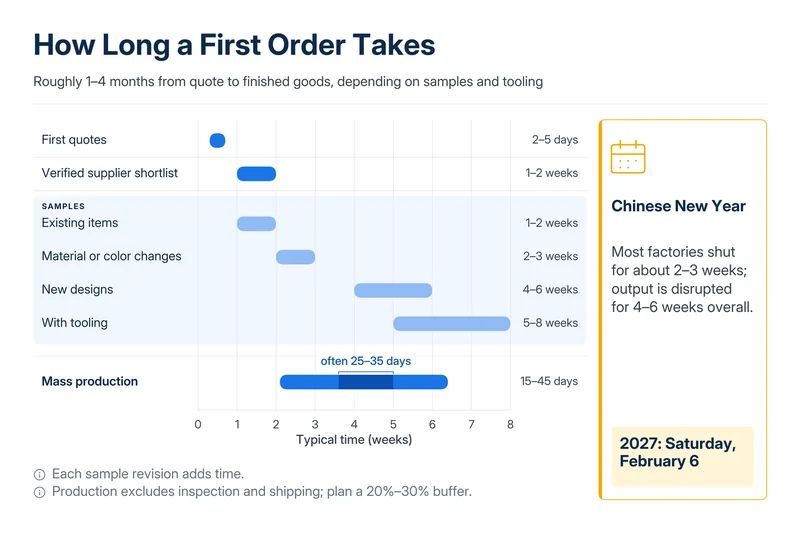
Chinese New Year shuts most factories for about 2–3 weeks and disrupts output for 4–6 weeks overall. In 2027, the Lunar New Year falls on Saturday, February 6.
Freight forwarders note that long-standing, high-volume customers tend to get scheduled first around the holiday, while new and small buyers may wait. If you need to “Continue sourcing/shipping during CNY period,” ask each factory for its shutdown and restart dates and your place in the queue.
How Payments Work When You Use an Agent
You can pay either way safely, as long as you pay company accounts, get itemized invoices, and tie the balance to inspection.
- Pay the factory and the agent separately.
- Pay the agent, who pays suppliers in Chinese yuan.
The usual split is a 30% deposit and a 70% balance before shipment, ideally after inspection passes; samples, small orders or special materials may need 50% or full payment.
Paying against a copy of the bill of lading happens after loading, which isn’t the same as paying before shipment, so write balance-after-inspection into the contract. After shipping, ask for the bill of lading and carton numbers.
When to Switch Sourcing Agents
Switch when replies slow down, small orders get ignored, inspection reports stop, or quotes stop making sense. Before switching, run a trial order with the new agent, plan the handover of stock, samples, and molds, and follow your contract’s termination terms. Done right, a switch can lead to building a long-term relationship with your agent. For more on avoiding common mistakes and building that relationship, see how to work with a sourcing agent.
Who Is the Best Sourcing Agent in China?
No single agent is best for everyone; the best one fits your product, your order size, and where you sell. Many “best agent” lists are written by agents that rank themselves first, so treat any list as a shortlist and vet it with the steps above. Start with this side-by-side comparison of China sourcing agents.
| Your situation | What to look for |
|---|---|
| One supplier, standard product, about $2,000 or less, Trade Assurance available | Buy direct and hire an inspector if needed |
| Suppliers already chosen | Execution-only service |
| Just need supplier names or quotes | A freelancer or a one-off flat fee |
| Many categories in one container (retail, wholesale, restaurants) | A generalist agent with a warehouse for consolidation |
| First electronics order with tooling and certification | A specialist in your category; certification duties stay with you |
| Amazon FBA or dropshipping | An agent that handles FBA prep, labeling or branded direct shipping |
| Tiny order | An agent that takes small orders for about a $100 minimum, not one that requires $2,500–$10,000 |
The best China sourcing agent is the one that fits your situation and passes your checks.
FAQ
How to become a sourcing agent?
You need fluent Chinese and English, deep knowledge of one or two product categories and quality inspection, and a network of suppliers. Working at a trading company, factory or sourcing firm first is a practical way to build that base. Agents earn through a margin in the unit price, a commission of usually 5%–10% of order value or flat fees.
Do you still negotiate prices when you work with a sourcing agent?
Yes. The agent negotiates with factories, but you can still negotiate with the agent. With a commission agent, do what one buyer does: “what I do is ask for the factory price and agent fee separately.” With a margin-in-price agent, compare itemized quotes by landed cost and negotiate the total.
Is it normal for a sourcing agent not to share factory details?
Yes. Many agents keep factory identities private, and as one buyer put it, “It depends on what agreement you have with the Sourcing agent.” If yours doesn’t, get proof the factory is real and capable, such as an audit or video tour and per-order inspection reports, and set out in the contract who answers for quality.
Can a sourcing agent help before your specs are final?
Yes. When one buyer asked an agent “do you need final specs first?”, the honest answer was not necessarily: an agent can help with sampling and supplier search while your design develops. Each revision adds time, though, with new-design samples taking 4–6 weeks and tooled samples 5–8. Start with a draft spec sheet and let the agent help fill the gaps.
Final Thoughts
The right China sourcing agent isn’t the cheapest one; it’s the one whose pay you understand, whose quote you can compare by landed cost, and whose promises are in writing.
- Ask how the agent gets paid, then compare landed cost, not fees.
- Check the license before you pay, and start with a $1,000–$5,000 trial order.
- Put inspection standards, payment milestones, and a no-kickback clause in writing.
If you’d rather not find suppliers, inspect goods, and consolidate shipments yourself, HiSourcing can handle them. Send your product brief for a free, itemized quote and compare its landed cost with the quotes you already have.


