
If you’re sourcing a product from China to sell under your own brand, you’ve hit the same fork everyone hits: private label vs white label. Both let you put your logo on a factory’s product. But they split hard on three things that decide your margins: control, cost, and speed, and that split changes how you actually buy from China.
We’ve helped first-time importers, Amazon sellers, and wholesale buyers go both routes. This guide from HiSourcing breaks down the real difference between private label and white label, what each costs, how they play on Amazon, and how to pick.
Key Takeaways
- White label = a ready-made, generic product you rebrand. Fast, low MOQ, low cost, but no exclusivity (competitors can sell the identical item).
- Private label = a product built to your spec and sold only under your brand. More control, higher MOQ, and upfront cost, but defensible.
- On Amazon, you effectively need a private label to enroll in Brand Registry and protect your listing; white-label listings are easy to undercut.
- Most brands start with white label to test demand, then graduate winners to private label.
What Is White Label?
A white-label product is a generic item a factory already makes, which you buy and rebrand as your own. You don’t touch the design or formula. The only things you control are the logo, label, and packaging.
Because the product is non-exclusive, the same factory can sell the identical item to dozens of other brands. Think unbranded phone chargers, kraft mailers, microfiber cloths, or a plain glass candle jar. You’ve seen the same water bottle under five names, that’s white label.
Some profitable products to import from China start with white label products.
What Is Private Label?
A private-label product is made to your specification and sold exclusively under your brand. You define the materials, dimensions, formula, features, and custom packaging; the factory builds your version and can’t sell it to anyone else.
This is closer to contract manufacturing: you own the spec, and often the mold or tooling. A grocery chain’s exclusive snack line, a DTC brand’s custom-scented candle, Costco’s Kirkland Signature: all private label. The factory makes it; the brand owns it. And some international brands, like Costco, have their own private label manufacturers in China.
How do you tell white label and private label apart fast? Ask one question:
Can a competitor buy the exact same product?
If yes, it’s white label. If the factory is contractually building it only for you, it’s private label. Everything else, like cost, speed, and MOQ, flows from that one fact.

Private Label vs White Label: Key Differences
Here’s the side-by-side comparison of private label vs white label:
| Dimension | White Label | Private Label |
| Customization | Logo, label, packaging only | Materials, design, formula, features |
| Exclusivity | None, competitors sell the same item | Exclusive to your brand |
| MOQ | Low (often 100–500 units) | Higher (often 500–3,000+ units) |
| Lead time | ~1–3 weeks (stock goods) | ~30–60+ days (sampling + production) |
| Upfront cost | Low, no R&D or tooling | Higher, samples, tooling, testing |
| IP / mold ownership | Factory owns the design | You own spec; negotiate mold ownership |
| Quality control | Limited to factory’s standard | You set the QC checklist and certifications |
| Amazon Brand Registry | Hard, generic product, no real brand control | Yes, your brand, eligible for protection |
| Hijack / price-war risk | High, identical product, race to bottom | Low, unique listing |
What Does Private Label vs White Label Actually Cost?
The honest answer: white label costs less upfront, private label costs more upfront but defends your margin over time. The gap shows up in four line items, not just the unit price.
The ranges below are illustrative typicals we use to set expectations, not a quote. Your real numbers depend on the product, material, and volume.
| Cost line | White Label (illustrative) | Private Label (illustrative) |
| Samples | ~$20–80 (existing product) | ~$50–300+ across iterations |
| Tooling / molds | None | ~$0 (label only) to $2,000–15,000 (custom mold) |
| MOQ capital tied up | Lower, small first order | Higher, bigger commitment |
| Pre-shipment inspection | ~$100–300 / man-day | ~$100–300 / man-day (more critical) |
In our experience, the mistake isn’t choosing the “expensive” option; it’s underestimating the tooling and MOQ commitment on private label, then getting stuck with stock you can’t move.
And private label is far from a niche bet. U.S. store-brand sales hit a record $282.8 billion in 2025 (up 3.3%, all outlets), taking 21.3% of dollar share and 23.5% of unit share, both all-time highs (PLMA, 2025). Across ten major sectors, private label is ~26% of unit volume and 61% of consumers say it offers above-average value (Numerator, 2025).
Private Label vs White Label on Amazon FBA
For serious Amazon sellers, this choice is mostly made for you: private label is the route that unlocks Brand Registry. To enroll, Amazon wants a registered trademark on your brand, which a generic white-label product rarely supports in a defensible way.
That matters because Brand Registry is what gives you A+ Content, Sponsored Brands, and tools to fight hijackers.
A white-label listing is exposed: anyone sourcing the identical product can list against you (or on your ASIN) and drag it into a price war. Private-label brand protection exists precisely because generic listings get attacked.
How to Choose: White Label or Private Label?
Choose white label if speed and low risk matter most. You’re testing a market, have a thin budget, or sell in a category where the product is a commodity, and your edge is branding and marketing.
Choose private label if you’re building a brand you intend to keep. You need differentiation, pricing power, exclusivity, or Amazon Brand Registry, and you can fund the tooling and MOQ.
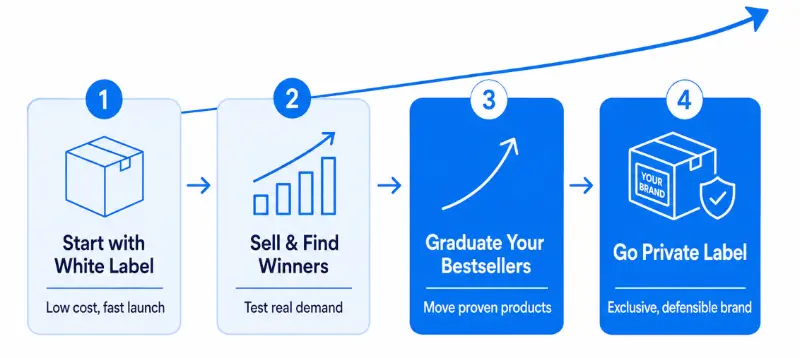
The smartest play for most growing brands is a sequence, not a side:
Start white label to validate demand cheaply, then graduate your proven winners to private label once you know what sells and exactly what your customer wants. The white-label phase tests the market; the private-label phase captures it.
FAQs
Is private label the same as white label?
No. Both put your brand on a third-party product, but white-label goods are generic and sold to many sellers, while private-label products are built to your spec and sold only by you.
Which is better, white label or private label?
Neither is universally better. White label wins on speed and low cost; private label wins on exclusivity, margin, and brand defensibility. The right one matches your stage, budget, and channel.
Is white labeling legal?
Yes. White and private labeling are standard, legal business models. Just make sure trademark use, quality liability, and certifications are clear in your supplier agreement.
Do I need private label for Amazon Brand Registry?
Effectively, yes. Brand Registry requires a registered trademark on your own brand, which private label supports and a generic white-label product generally does not.
Do I need my own factory for private label?
No. Almost all private-label brands outsource to third-party factories. You own the spec and (ideally) the mold — the factory owns the machines.
What’s the difference between white label, private label, and OEM?
White label / ODM = you rebrand the factory’s existing product. Private label / OEM = the factory builds to your specification. It’s a spectrum of how much you control.
Which is cheaper, and what are the real MOQs?
White label is cheaper upfront with lower MOQs (often a few hundred units). Private label costs more (samples, tooling) and usually starts higher (often 500–3,000+ units), but can deliver better margins.
Can I start with white label and switch to private label later?
Yes — and many brands do exactly that. Validate demand with white label, then move your bestsellers to private label for differentiation and protection.
Final Thoughts
That’s the real split between private label vs white label: white label is the fast, low-risk way in; private label is the slower, sturdier way to own a brand. The right choice isn’t the “better” model. It’s the one that fits your budget, timeline, and where you want to be a year from now. For a lot of sellers, the answer is both, in sequence.
If you’d like a second pair of eyes before you commit, that’s what we do every week. At HiSourcing, you work directly with a senior sourcing specialist in China. We help you vet suppliers, run quality control, and arrange shipping for white-label or private-label orders alike. Planning your next order from China? Book a free consultation, and we’ll walk through the options with you.
Recommended Posts:


