
The right China wholesale website depends on two things: how much this order is worth, and whether you have anyone in China who can act for you. It does not depend on which platform is biggest.
This guide from HiSourcing sorts 15 Chinese wholesale websites into three tiers, profiles the 8 that work as real wholesale channels, maps categories to the right entry point, and walks the arithmetic of what an order actually costs once it clears customs.
Key Takeaways
- Three tiers, not one ranking. Export B2B platforms sell to you directly, low-MOQ marketplaces are for testing, and domestic platforms need someone in China.
- The $800 duty-free threshold is gone. US Customs and Border Protection indefinitely suspended the de minimis exemption on 24 June 2026, so a $200 sample now needs a customs entry and pays duty.
- The EU’s €150 exemption ended on 1 July 2026, replaced by a flat €3 per item on parcels sold to EU consumers, with full abolition due 1 January 2028.
- Trade Assurance refunds are capped at each supplier’s individual limit, and post-delivery quality claims require inspection within 15 days of customs clearance.
- A Verified Supplier badge audits the company, not your product. Inspectors check legal registration, facilities and capacity, not whether your order will pass.
Which China Wholesale Website Is Right for You? Start With 5 Questions
Start with these 5 questions before you choose the wholesale platform and make the order. Each one pushes you toward a tier rather than a brand.
- What is this order worth? Under roughly $500 you are testing. Over $5,000 you are buying, and the sourcing effort starts paying for itself.
- Do you have anyone in China? An agent, a forwarder, a partner, a relative. Without one, Tier 3 is closed to you.
- Do you need the product changed? Your logo, your packaging, your spec. Custom work or private label belongs on Tier 1, not on a retail marketplace.
- Can you pay in RMB? Alipay or a Chinese bank card is required to access domestic platforms. A Visa card does not.
- Is your product regulated? Electronics, children’s items, food-contact, and cosmetics need a supplier who has previously produced for your market.
Two “no” answers on questions 2 and 4 mean you are choosing between Tier 1 and Tier 2, whatever the price difference looks like. If you have not sourced from China at all before, start with the step-by-step process for sourcing products from China.
China Wholesale Website List: 15 Sites at a Glance
Eight of these are genuine wholesale channels. The other seven are retail or research tools.
| Site | Founded | Type | Minimum order | Agent needed? | What it is for |
|---|---|---|---|---|---|
| Alibaba.com | 1999 | Tier 1 export B2B | Set per listing | No | Widest supplier base; custom and private label |
| Made-in-China.com | 1998 | Tier 1 export B2B | Set per listing | No | Industrial, technical and machinery goods |
| Global Sources | 1971 | Tier 1 export B2B | Export-scale | No | Vetted exporters; electronics heritage |
| HKTDC Sourcing | 1966 | Tier 1 export B2B | Set per listing | No | Brand, gift and packaging sourcing tied to trade shows |
| AliExpress | 2010 | Tier 2 low-MOQ | 1 unit | No | Buying samples and testing demand |
| DHgate | 2004 | Tier 2 low-MOQ | Small, tiered by quantity | No | Small restocks between sample and full production |
| 1688.com | 1999 | Tier 3 domestic | Often one carton | Yes | Domestic factory pricing once you have help in China |
| Yiwugo | 2006 | Tier 3 domestic | Usually by carton | Yes | Yiwu market stalls online; small commodities in mixed lots |
| Taobao / Tmall | 2003 | Retail, not wholesale | 1 unit | Yes | Checking what a product sells for domestically before you negotiate |
| JD.com | 1998 | Retail, not wholesale | 1 unit | Yes | Benchmarking branded electronics prices inside China |
| Pinduoduo | 2015 | Retail, not wholesale | 1 unit | Yes | Reading the floor price of a commodity item |
| Temu | 2022 | Retail, not wholesale | 1 unit | No | Spotting which products are moving in your market right now |
| Shein | 2008 | Retail, not wholesale | 1 unit | No | Tracking fashion trends and reading finished-garment specs |
| Banggood | 2006 | Retail, not wholesale | 1 unit | No | Buying a rival product to take apart |
| LightInTheBox | 2007 | Retail, not wholesale | 1 unit | No | Seeing how apparel and home goods are packaged for Western buyers |
MOQs are set by the seller on almost every one of these platforms rather than by the platform itself, which is why that column describes the convention instead of a number.
Tier 1: Export B2B Platforms
These four China wholesale websites accept overseas buyers, work in English, take international payment, and handle export paperwork as a matter of course.
Alibaba: The Widest Supplier Base, and the Most Noise
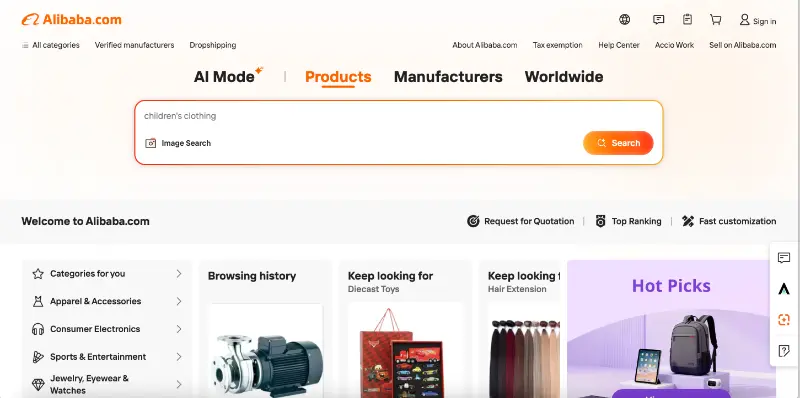
Alibaba is where you go when you do not yet know who makes your product. Nearly every category is represented, the quote-request tool puts competing offers in front of you within days, and Trade Assurance gives you a payment mechanism with actual terms behind it.
The cost of that breadth is that supplier quality varies enormously behind storefronts that look identical. Trading companies present as factories, certificates get recycled between listings, and a sample can outperform the production run it was meant to represent.
The platform is a way to build a shortlist, not a source of truth.
| Alibaba.com | Detail |
|---|---|
| Platform type | Export B2B marketplace |
| Minimum order | Set by each supplier per listing; frequently negotiable, and lower for stock items than for custom production |
| What drives the price | Export service cost, platform fees, and the sales representative’s own margin |
| Access and payment | English; open signup; no company registration required; card, T/T and Pay Later |
| Buyer protection | Trade Assurance covers on-time shipment and product quality as written into the order contract; refunds capped at each supplier’s limit; claims within 30 days of delivery |
| Strengths | Largest supplier base; competing quotes; workable dispute process |
| Risk level | Medium. High variance in supplier identity, offset by a real payment mechanism |
Further Reading:
- Is Alibaba Safe to Buy from?
- How to Purchase from Alibaba.com?
- 6 Types of Alibaba Scams You Must Avoid
- I Got Scammed on Alibaba, What to Do?
- 20 Alibaba Alternatives for Product Sourcing
Made-in-China: Industrial Goods, With Escrow That Can Release on Delivery
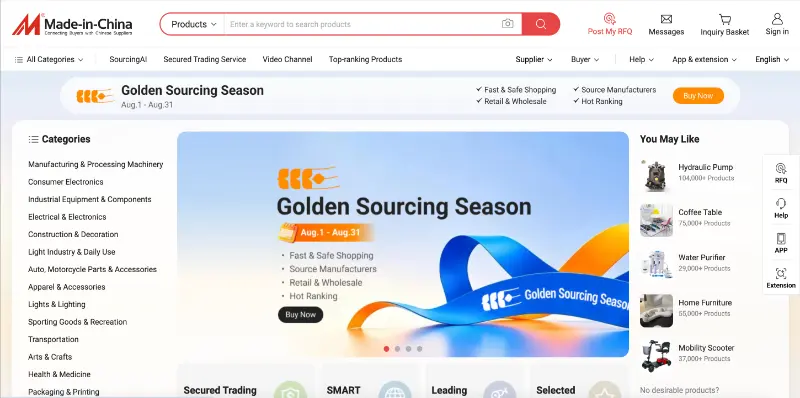
Made-in-China.com is the better first stop when your product is machinery, components, hardware or anything with a specification sheet. Its supplier base is smaller than Alibaba’s in consumer categories and stronger in industrial ones, and the filters reward a buyer who already knows the technical vocabulary of the niche.
Its Secured Trading Service holds payment in escrow and releases it once you confirm receipt, with one detail worth reading twice: the platform can also release funds when logistics data shows successful delivery. Delivery and acceptance are not the same event, so an order left unattended can pay out before anyone opens a carton.
| Made-in-China.com | Detail |
|---|---|
| Platform type | Export B2B marketplace |
| Minimum order | Set per listing; industrial goods typically carry higher minimums than consumer items |
| What drives the price | Tooling and setup for technical parts; unit cost falls steeply with volume |
| Access and payment | English; open signup; card payments capped at $5,000 per transaction |
| Buyer protection | Secured Trading Service escrow; refund requests within 30 days of receipt; funds may release on confirmed delivery as well as on buyer confirmation |
| Strengths | Depth in industrial categories; cleaner technical filtering |
| Risk level | Medium. Escrow is solid, but the release trigger favours the seller |
Global Sources: Vetted Exporters and Larger Minimums
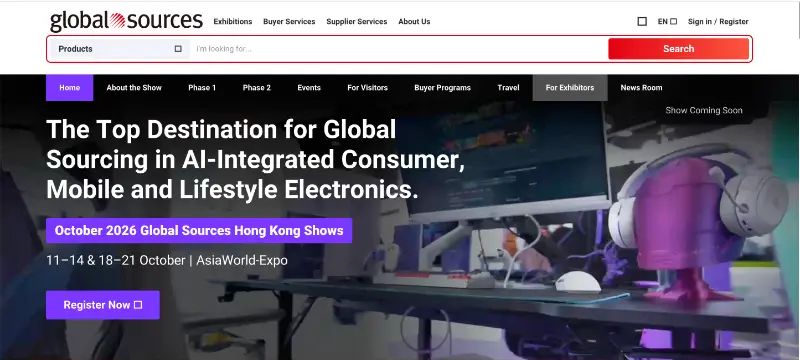
Global Sources has been matching Western buyers with Asian exporters since 1971, and its supplier list reflects that filter. Companies on it are export businesses first, which means fewer domestic-only manufacturers, better English, and a lower chance of meeting a trading company that has never shipped abroad.
The trade-off is scale. Minimums skew toward genuine export quantities, so a buyer looking for 50 pieces will find it frustrating. Its electronics depth, built on decades of Hong Kong trade shows, still runs deeper than the rest of the catalogue.
| Global Sources | Detail |
|---|---|
| Platform type | Export B2B marketplace plus trade shows |
| Minimum order | Export-scale; built around container and pallet quantities rather than trial orders |
| What drives the price | Order volume and specification; suppliers quote against a brief rather than list a price |
| Access and payment | English; open signup; transactions largely arranged off-platform between buyer and supplier |
| Buyer protection | Limited platform-level cover; payment terms are negotiated directly, so protection depends on your contract |
| Strengths | Export-ready supplier base; strong electronics depth; trade-show access |
| Risk level | Medium. Better supplier filter, weaker transactional safety net |
HKTDC Sourcing: Brand, Gift and Packaging Work Backed by Trade Fairs
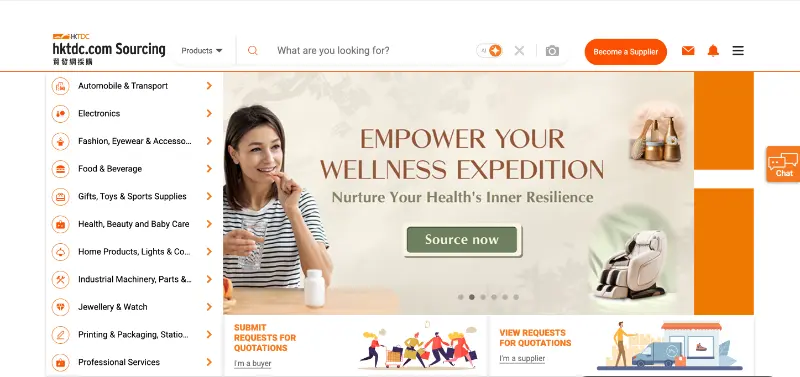
HKTDC Sourcing is run by the Hong Kong Trade Development Council, a statutory body established in 1966, and it behaves less like a marketplace than like a permanent trade fair. That suits one job in particular: finding suppliers for branded merchandise, gifts, premiums and packaging, where you are buying a capability rather than an item off a shelf.
It is the thinnest of the four for commodity goods, and it is the wrong place to chase a low price on a generic product. Used for what it does well, it puts you in front of suppliers accustomed to Western brand requirements who expect to be judged on samples.
| HKTDC Sourcing | Detail |
|---|---|
| Platform type | Trade-council sourcing platform linked to physical fairs |
| Minimum order | Set per supplier; branded and custom work sets the floor, not the platform |
| What drives the price | Design, tooling, branding and packaging work rather than the base item |
| Access and payment | English; open registration; enquiries route to suppliers, payment arranged directly |
| Buyer protection | None at platform level; you are contracting with the supplier |
| Strengths | Suppliers used to brand specs; trade-fair calendar; Hong Kong governance |
| Risk level | Medium. Reputable pool, but no transactional cover at all |
Tier 2: Low-MOQ Sites for Testing
These two China wholesale websites exist to answer one question cheaply: does anyone want this product? Use them to buy one to fifty units, photograph them, list them, and see what happens. Do not use them to stock a business, because the unit price that makes a sample affordable makes a hundredth order uncompetitive.
AliExpress: One Unit, No Negotiation, Highest Unit Price
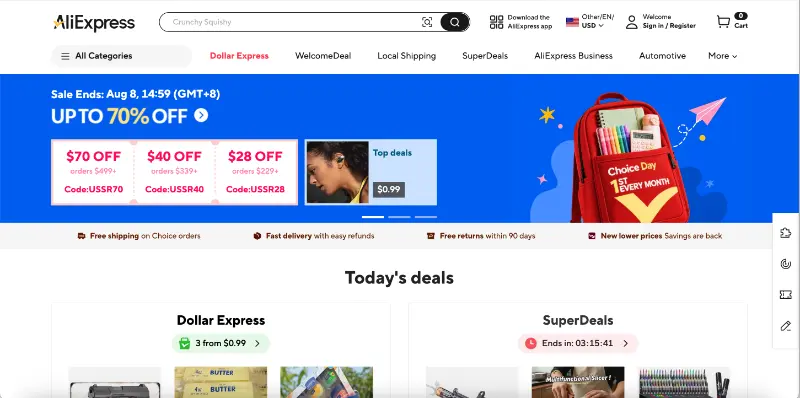
AliExpress works like an ordinary online shop, and that is exactly its value. You find the item, pay by card, and it ships to your address, with buyer protection on most transactions and nothing to negotiate.
What you are buying is speed of validation, not margin. Most sellers are resellers rather than manufacturers, branding is off the table, and the per-unit price already contains every intermediary between the factory and your door. Treat an AliExpress purchase as market research that happens to arrive in a box.
| AliExpress | Detail |
|---|---|
| Platform type | Retail marketplace operated by Alibaba Group for international buyers |
| Minimum order | 1 unit |
| What drives the price | Every layer between factory and buyer is already priced in; volume discounts are minimal |
| Access and payment | English; card payment; no company needed |
| Buyer protection | Platform buyer protection on most orders, with a defined dispute window per order |
| Strengths | Fastest route from idea to a physical sample in hand |
| Risk level | Low financially. The money at stake is small by definition |
DHgate: Tiered Pricing in the Gap Between Retail and Production
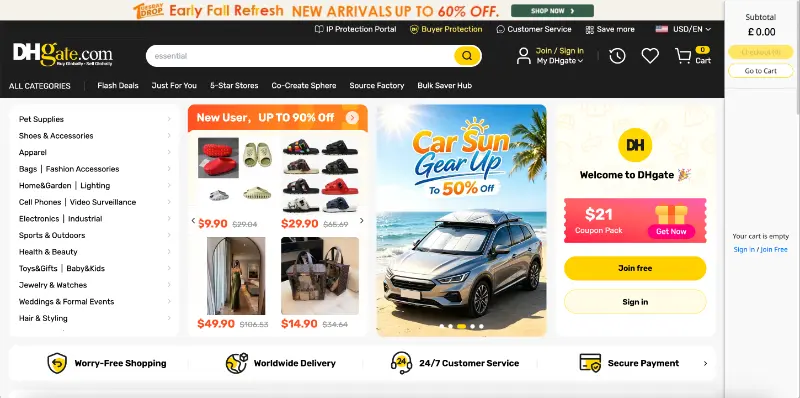
DHgate sits between AliExpress and a real factory order, with quantity tiers that drop the unit price as you move from ten pieces to a few hundred. For a small retailer building early inventory without committing to a production run, that gap is genuinely useful.
The seller mix is the catch. Factories and traders sit side by side with no reliable way to tell them apart from the listing alone, and quality can differ between two orders of the same item. Order twice before you build a product line on it.
| DHgate | Detail |
|---|---|
| Platform type | Hybrid B2B and B2C marketplace |
| Minimum order | Low; set per listing, commonly a handful of units with tiered pricing above that |
| What drives the price | Quantity tiers published on the listing; the steps are visible before you order |
| Access and payment | English; card payment; no company needed |
| Buyer protection | Platform escrow and dispute process; funds release to the seller after you confirm or the window lapses |
| Strengths | Transparent quantity pricing; genuine middle ground for restocks |
| Risk level | Medium. Consistency between repeat orders is the weak point |
Tier 3: China Domestic Platforms
These two China wholesale websites carry the lowest prices in this guide and the highest barrier to reaching them. Both are built for buyers inside China: Simplified Chinese interfaces, Chinese payment rails, delivery to a mainland address. Without someone on that end, the price advantage is theoretical.
1688: Factory Pricing You Cannot Reach Without Help
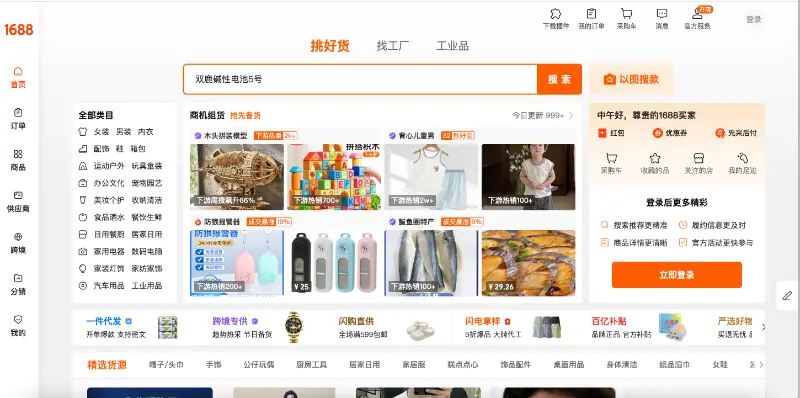
1688 is Alibaba’s domestic wholesale platform, and a meaningful share of what sells on export platforms is bought here first. Prices are lower because listings target Chinese wholesalers who negotiate in RMB, take delivery locally, and expect no export service at all.
Getting in is the whole problem. The interface is Simplified Chinese, payment runs through Alipay or Chinese bank cards, and sellers ship to domestic addresses. A cross-border channel and a 1688 Global app exist, but the interface remains Chinese and both target established resellers rather than first-time buyers.
Most overseas buyers reach 1688 through a 1688 sourcing agent or forwarder who buys, consolidates and re-ships. How the price gap actually nets out is a longer argument, worked through in 1688 vs Alibaba.
| 1688.com | Detail |
|---|---|
| Platform type | Domestic Chinese B2B wholesale platform |
| Minimum order | Often a single carton; set by the seller using domestic wholesale conventions |
| What drives the price | No export service layer, no English-language sales cost, and heavy domestic competition |
| Access and payment | Simplified Chinese only; Alipay or Chinese bank card; mainland delivery addresses |
| Buyer protection | None that extends to an overseas buyer without a China-side entity |
| Strengths | Lowest published prices; reaches factories that never sell abroad |
| Risk level | High without help, manageable with it |
Yiwugo: The Yiwu Market Online, Stall by Stall
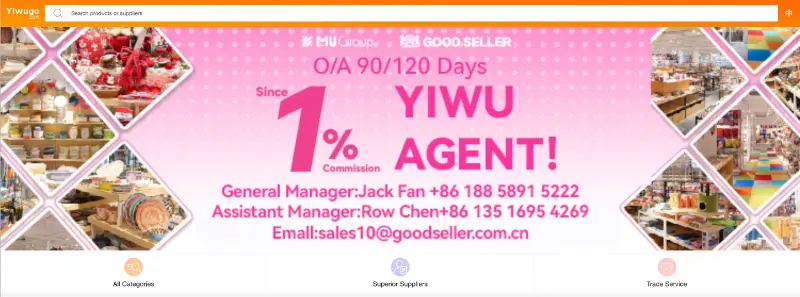
Yiwugo is the official online portal of the Yiwu wholesale market, which means the sellers behind the listings are largely the same traders who occupy the physical booths.
For small commodities bought in mixed lots, such as accessories, stationery, party goods, kitchen items and seasonal products, it is the deepest assortment in this guide.
Chinagoods, the newer platform run by the market operator, covers much the same ground and works as a second door into the same ecosystem. Both carry the Tier 3 constraints, and both reward a buyer who already understands how the market prices and packs. If you are considering going in person, see how to buy from Yiwu Market.
| Yiwugo (and Chinagoods) | Detail |
|---|---|
| Platform type | Official online portal of the Yiwu small-commodities market |
| Minimum order | Usually by the carton, following the market’s own selling conventions |
| What drives the price | Market-stall pricing on high-turnover generic goods; mixed lots are normal |
| Access and payment | Chinese interface and domestic payment; sellers expect a China-based counterpart |
| Buyer protection | Minimal for overseas buyers; the market’s own norms govern disputes |
| Strengths | Unmatched breadth in small commodities; traceable to a physical booth |
| Risk level | High without help. Most listings assume a Chinese buyer |
China Wholesale Website for Clothes, Electronics, Toys, and Other Categories
No category genuinely needs its own dedicated China wholesale website. What changes by category is which of the big platforms you should open first, and which door inside it you should use.
| Category | Start here | Why this one |
|---|---|---|
| Clothing and apparel | Alibaba, then 1688 with help | Fabric, cut and finishing need sampling rounds; domestic pricing matters most once the spec is fixed |
| Consumer electronics | Global Sources, then Made-in-China | Both hold export-ready suppliers used to certification requirements; electronics is Global Sources’ oldest strength |
| Toys | Alibaba, then Yiwugo | Safety compliance rules out untested suppliers; Yiwugo covers generic and seasonal lines |
| Shoes | Alibaba, then 1688 with help | Sizing and last shape need physical samples before any bulk commitment |
| Jewellery and accessories | Yiwugo, then Alibaba | Yiwu is the volume centre for costume jewellery and accessories in mixed lots |
| Machinery and components | Made-in-China | Deepest industrial listings and the filtering to match a technical spec |
| Gifts, premiums and packaging | HKTDC Sourcing | Suppliers already work to Western brand and packaging briefs |
Which China Wholesale Website Is Cheapest?
The site with the lowest unit price is usually not the lowest total cost for the order in front of you. Two changes in 2026 widened that gap considerably.
US Customs and Border Protection indefinitely suspended the $800 de minimis exemption on 24 June 2026, so every shipment into the United States now requires a customs entry and pays duty regardless of value.
The European Commission removed its €150 customs duty exemption on 1 July 2026, replacing it with a flat €3 per item on parcels sold to EU consumers until the exemption is abolished outright on 1 January 2028.
Both changes fall hardest on exactly the orders Tier 2 was built for. Here is the same $600 test order, before and after.
| $600 test order, air freight, into the US | Before 2026 | Now |
|---|---|---|
| Goods value | $600 | $600 |
| Customs entry | Not required under de minimis | Required |
| Duty | $0 | Charged at your HS code rate |
| Broker or entry handling | $0 | Charged per entry, whatever the shipment is worth |
| Effect on unit economics | Sample cost ≈ goods + freight | Fixed entry costs spread across a small quantity |
The practical consequence is a shift in where the lowest total cost sits. Under de minimis, splitting an order into several small parcels was often cheaper, because a $600 shipment carried no duty and no entry.
Now the fixed cost of an entry lands on every parcel, so consolidating small shipments into one is worth more than shaving 10% off the unit price.
A €120 parcel into the EU that previously cleared free now carries the €3 flat charge plus VAT, which is small in absolute terms and no longer zero.
That is what makes a unit-price comparison misleading. A domestic platform quoting 30% below an export platform still has to absorb three costs the headline number leaves out:
- the agent or forwarder who makes the purchase possible at all
- the domestic leg from the seller to that agent’s warehouse
- the customs entry, which now applies either way
On a first order of a few hundred units, the delivered difference is frequently a fraction of the headline gap.
Getting a like-for-like comparison is the hard part, and it is where most first orders go wrong. If you want the landed arithmetic run on a specific product before you commit, send us the details and we will price it out.
Who Adds a Margin to the Quote You Get?
The person answering your messages on a China wholesale website is frequently a salaried sales representative whose income depends on the margin added to the factory price.
One Chinese seller on Reddit put that buffer at 20% to 30% on a typical order, rising sharply on small ones, and noted that an American buyer signals a high-margin order before the first quote is written (practitioner account, not survey data).
This is also why one supplier can quote differently on two platforms. An export listing carries costs a domestic listing does not, a different representative may handle each channel, and each has its own read on what that buyer will pay. One buyer documented a gazebo quoted at roughly $15,000 on an export platform against about $3,300 domestically, though a gap that size is an outlier.
Comparing the same item across platforms is worth doing, but the number it produces is a negotiating input, not a price you can claim. Ask what each figure includes before assuming the gap is pure markup.
What Every Platform Leaves to You
Whichever tier you land in, three jobs stay yours. No China wholesale website inspects your goods before they ship. None consolidates orders from several suppliers into one shipment. And none sends anyone to the factory floor when the production run does not match the sample you approved.
Those three gaps are why sourcing agents exist, and also why the argument about whether to use one is so muddled.
Buying Direct vs Using a Sourcing Agent: When Each One Costs Less
The case for an agent is narrower than it is usually sold, and it is strongest on consolidation rather than on price. In our experience the buyers who save most are the ones running several suppliers at once: combining shipments, sharing an inspection visit, and clearing one entry instead of four produces savings that survive arithmetic. That effect got larger when the de minimis suspension made every separate entry cost money.
The case against is real and worth stating plainly. Buyers report reaching the factory themselves and beating the agent’s price, because a factory that knows an agent is shopping on someone else’s behalf may quote defensively. Below roughly $10,000 a year of purchasing, neither the factory nor an agent has much reason to prioritise you, and a commission is hard to earn back on a single SKU you already source reliably. If you have one product, one supplier and a working relationship, adding a layer will probably cost you money.
| Where the money moves | Buying direct | Working through an agent |
|---|---|---|
| Unit price | Whatever you negotiate | May be better or worse; not automatic |
| Service fee | None | Commission or flat fee |
| Pre-shipment inspection | You arrange and pay separately | Confirm whether it is included; often it is not |
| Consolidating several suppliers | Multiple shipments, multiple entries | One shipment, one entry |
| Access to Tier 3 platforms | Closed without a China-side entity | Open |
| Problem on the factory floor | Handled by email across time zones | Someone can attend |
One assumption is worth killing before it costs you a container: inspection is not automatically included in a sourcing fee. Buyers have written off entire shipments believing that it was. Whoever you work with, confirm in writing who inspects, against what standard, and at whose expense. If you would rather keep that function independent, arrange pre-shipment inspection separately and treat it as a line item.
We are HiSourcing, and this is the part of the job we do: finding and vetting suppliers, inspecting before shipment, and consolidating orders into one shipment. Send us the product link, your target price and your monthly quantity, and you will get back a feasibility read and a landed-cost estimate with our commission shown as its own line. Get a landed-cost estimate.
When a Wholesale Website Is Not the Right Channel
Three situations call for something other than a China wholesale website.
- You need to compare dozens of variants quickly. A physical market does in an afternoon what a week of messaging cannot, because you can handle the goods and negotiate in the same conversation. That is what China’s wholesale markets are for.
- You are buying a capability rather than an item. Trade fairs concentrate suppliers who came to win development work, and a fair’s phase calendar tells you which categories are present when.
- You already know whose product you want to match. US import records are public, and services built on customs bills of lading let you look up which factory ships to an existing brand. That route skips the platforms entirely and answers a question they cannot.
Frequently Asked Questions
Do China wholesale suppliers offer free shipping?
Rarely, and not in the way the phrase suggests. On retail-style platforms, “free shipping” means freight is already inside the listed price, which works only for light, small items. On genuine wholesale orders freight is quoted separately, because it depends on weight, volume, destination and the Incoterm you agree. A supplier offering free international shipping on a bulk order has either priced it into the unit cost or is quoting a service they cannot deliver. Ask for the price on FOB terms and quote the freight yourself.
Can you still order from China to the USA?
Yes. Nothing about importing from China became illegal in 2026, but it did become more paperwork. US Customs and Border Protection suspended the $800 de minimis exemption on 24 June 2026, so every shipment now needs a customs entry and pays duty at the rate for its HS code, regardless of value. In practice this hits small parcels hardest, since the fixed cost of an entry no longer disappears below a threshold. Larger consolidated shipments absorb it far better.
Do I need a business license to wholesale from China?
Not to buy. Alibaba, Made-in-China, DHgate and AliExpress all accept individual buyers without company registration. The requirement comes from your own country’s import rules rather than from the platform: many countries want an importer number, a tax registration or an EORI-style identifier before customs will release a commercial shipment. Check what your customs authority requires for commercial imports before placing a first order, because that is where the paperwork actually bites.
Can a regular person buy wholesale?
Yes, and more easily than most people expect. No China wholesale website checks whether you are a business before letting you order, and minimum quantities are set by individual sellers rather than by any rule about who you are. The real limits are practical: somewhere to store the goods, a payment method the seller accepts, and the ability to complete a customs entry in your own name. Individuals clear all three regularly on small orders.
Is 1688 a legit website?
Yes. 1688.com is operated by Alibaba Group and is one of the largest wholesale platforms inside China, used daily by Chinese businesses. Legitimate is not the same as suitable, though. It is built for domestic buyers, so the interface is Simplified Chinese, payment runs through Chinese methods, and sellers ship to mainland addresses. The platform is real; the question is whether you have the China-side support to use it.
What is the minimum order on Alibaba?
There is no platform-wide minimum. Each supplier sets a MOQ per listing, which is why the same product can show 10 pieces on one storefront and 1,000 on another. Stock items usually carry lower minimums than custom production, because custom orders have to cover setup and tooling. Stated minimums are also frequently negotiable, particularly if you accept standard packaging or an existing colourway instead of asking for changes.
Which app can I use to order goods from China?
Alibaba, AliExpress, DHgate and Made-in-China all have English mobile apps that handle the full order flow, so a Tier 1 or Tier 2 purchase can be run from a phone. Domestic platforms are harder: 1688 has a Global app, but the interface remains largely Chinese and it assumes a Chinese payment method. For Tier 3 buying, most overseas buyers work through an agent rather than an app.
Final Thoughts
Hope this comparison helps you narrow down which China wholesale website fits the order you are actually placing. If you have questions about a specific platform or product, feel free to reach out.
We are HiSourcing, a Yiwu-based sourcing company founded in 2017, serving 1,200+ clients from 50+ countries. If you would rather skip the platform comparison and have someone quote, sample, and inspect the product for you, contact us for a free consultation.
Further Reading:


